Last week, I was shocked to learn that Shirley Waisman and I won a Golden Duck Notable award from Core for HOW TO WELCOME AN ALIEN! It’s for excellence in sci-fi kidlit. Before I learned I’d won it, I had no idea this award even existed, but it gives me particular pleasure because while the book got some attention as a Jewish book, I think of it as a sci-fi book, as well.
Apparently, Core is the national association that advances the profession of librarians and information providers in central roles of leadership and management, collections and technical services, and technology. It’s part of ALA, the American Library Association. It’s nice they recognized HOW TO WELCOME AN ALIEN, and I hope to go from strength to strength.
HOW TO WELCOME AN ALIEN also appeared on a great list of books about Jewish Joy for Multicultural Book Day last week. The list was compiled by Charlotte Offsay. You can read her list and enter a giveaway for her book CHALLAH DAY! here.
I’ve got a lot of submissions out right now and am hoping (praying!) for some acceptance letters.
It’s now a month and a half since the release of HOW TO WELCOME AN ALIEN, and it’s a new year, too! I thought I should post a few more of the reviews the book has gotten, even if I don’t have *that* much to say for myself otherwise (still writing, still querying, still trying to sell books, still washing lots of dishes and dealing with loads of laundry).
Liza Weimer published a review in The Wisconsin Jewish Chronicle a couple weeks back. No online access yet, but someone shared the print clipping with me. https://www.instagram.com/p/CxJttirPqaj/
I feel like I have to pre-empt the following with a “Ptui, ptui, ptui—bli ayin hara!” qualifier.
Prepping for the release of HOW TO WELCOME AN ALIEN, my latest book, was a lot of work. The publisher and I brainstormed who to send ARCs to, we secured a bunch of reviews and interviews, and I posted almost daily to try to drum up sales.
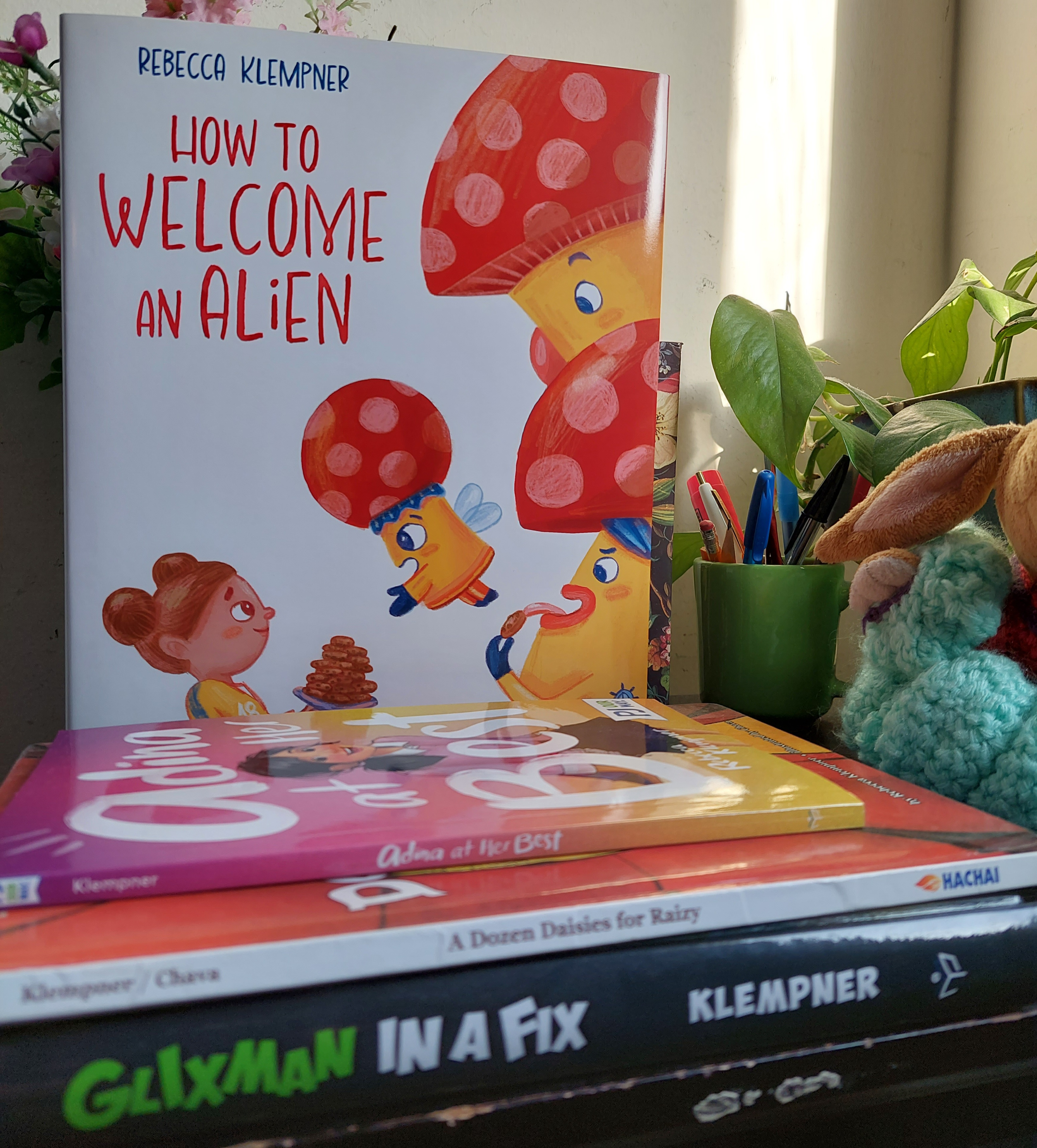
My newest book, HOW TO WELCOME AN ALIEN, joins the other books I’ve published on my banged up shelf.
For the first couple week, sales were pretty good. Not fantastic, but okay. Trying to sell books past the week of release is…challenging.
I’m pleased with how my book turned out, but there are so many other beautiful books out there, and I’m afraid that my book will be lost in the crowd. Sure aliens are great, and the lesson (about the mitzvahs of hachnassat orchim and taking care of strangers) is really important. But there are a lot of authors with new books out trying to get in front of readers.
Also, I have that “Book just came out, and I need to worry about the next book,” feeling. There’s an idea floating around the writing world that a successful author has a new book coming out every couple years, at minimum. I’m writing and submitting but keep getting one rejection after another. I just keep writing and submitting, but I’d really like to have another book under contract by now.
It’s much nicer to have books published than to have no books published. But it’s also not an easy business and staying power is…hard to find.
Anyway, to focus on the positive:
Reviews have been good.
I feel proud of the way the book turned out (shout out again to Shirley Waisman for her illustrations and to Lili Rosenstreich for shepherding this project for Kalaniot).
I really appreciate my writing group members, friends, and all the people who reviewed my book or posted about it on social media. It’s really great to have such a supportive book community.
Lots of exciting stuff happening around the release of my next book, HOW TO WELCOME AN ALIEN!
I was interviewed—twice! The first interview was by the always-lovely Barbara Bietz for Jewish Books for Kinds…and more!. You can find that interview here. And the one with Kylie Ora Lobell appeared in the Jewish Journal last week. You can read that one here.
Additionally, I got lots of help from my writing group friends (plus my pal Merri Ukraincik, who has a fantastic newsletter for Jewish creatives) to polish up a personal essay called “My UFOs.” It details my attraction to aliens, UFOs, and all things sci-fi. Even though I wrote it a while back, it also addresses many of my complaints from my last blog post. It went up on the Paper Brigade Daily blog by JBC yesterday. Go ahead and check it out if you haven’t yet.
And, finally, there’s another review out, this one from the Sydney Taylor Schmooze. Read that here.
Don’t forget to place my book on pre-order if you haven’t yet! It’s available on Bookshop, Amazon, and Barnes & Noble. If you want to help me out, you can also ask your local library or bookstore to order it. And if you’ve already ordered the book, you should be getting your copy next week. When you do, I’d love it if you snapped a picture with your book and tagged me on your social media pages!
Dara Horn appeared this week on one of my favorite podcasts, 18Forty. If you haven’t heard of her till now, Horn is an extraordinary Jewish author, journalist, and thought leader. She’s written several (often award-winning) novels and a non-fiction book (also award-winning), and I’m a huge fan. Since 18Forty’s theme this month is BOOKS! BOOKS! BOOKS!, Horn is the perfect guest for Rabbi Bashevkin to invite onto the podcast.
Her conversation with Rabbi Bashevkin is fantastic. (You can listen here.) She’s funny, erudite, creative, and I thoroughly enjoyed the entire episode. Only, there’s one thing she said that is so laughably, demonstratively wrong, I had to vent about it on Twitter after listening to episode to the end.
And now I’m going to expand upon the Twitter thread here.
What is this thing that Dara Horn said which literally cracked me up because her own work proves her wrong? She said that “Books don’t teach morals.” (If that’s not a direct quote, it’s close.) Afterwards, she said that fiction writers don’t write with the intent to teach a moral (a blanket statement). And that books aren’t good at teaching morals.
Horn accurately starts off saying that every work of literature emerges from a set of beliefs. Those beliefs are largely sociocultural, but may be unique to the book itself. It is necessary to understand them even if you don’t share them in order to process the book. But then she says that blanket statement I mentioned above.
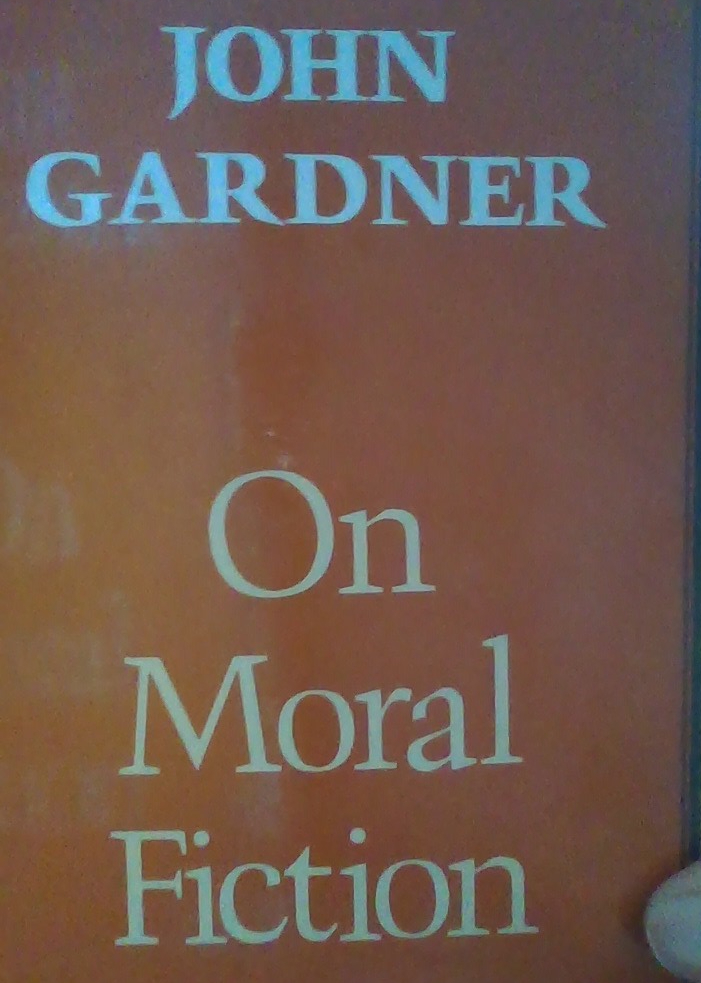
The cover to John Gardner’s ON MORAL FICTION, a classic on literature, writing, and art criticism.
As John Gardner points out, “Art is as original & important as it is because it does not start out with clear knowledge of what it means to say.” So, sure, many writers do not start off a project with a particular moral lesson in mind. But that doesn’t mean that the finished project is not imbued with values. In fact, according to Gardner, it’s through revision, retouching, re-envisioning as we edit our own work that we figure out what we really think about its themes. The final messaging might be very different than the original take we had at the inception of the project.
Nor does no intent by Horn to write a book with a moral message mean that no author starts off with the intent to convey one. Personally, some of my work starts off with a moral angle, some of it doesn’t. But it always ends with one. I’m pretty sure that Frank Herbert intended to teach his views about the nature of power and the way human cultures interact with the environment when he wrote DUNE. Ray Bradbury had Things to say about literacy and book banning when he wrote FAHRENHEIT 451. Octavia Butler’s THE PARABLE OF THE SOWER had things to say about power and race and religion. I’m pretty sure that Lisa See intended to teach a particular view about the nature of love when she penned PEONY IN LOVE (she’s still alive, so we could at least in theory ask her). I might not be performing at their level, but I’m in good company on this one thing.
In short, Horn’s blanket statement–like most blanket statements–has so many exceptions, it becomes meaningless.
But there’s more to kvetch about (because, yes, this is me kvetching).
Horn seems to think that a moral to a story means a clunky message provided by an author who wants to tell you what to think. However, you don’t have to tell people what to think to promote a moral vision. Merely by inviting the reader/viewer/listener to explore a particular perspective on a theme, you have led them to alter their interior moral landscape. This is the best artistic expression, according to Gardner.
…And I would argue that Horn’s own work demonstrates several very clear moral views, whether she intends it as such in a conscious way or not. For example:
By weaving (in most of her fiction) Jewish past & Jewish present, she assures us that religion & even religiosity is not a thing relegated to the past.
By showing characters who are both religious & non-religious, and by showing them making flawed choices, she demonstrates that she doesn’t think that religiosity makes you good, at least not religiosity alone.
If I delved into each of her books, I could find other moral positions unique to her books. If I recall correctly, for example, in IN THE IMAGE, Horn expresses a moral view that people chose the religious life often for psychological reasons, not theological ones. But I think I’ve made my point.
Even the desire to say, “Books don’t have to mean things,” or “Books don’t have to suggest a moral perspective,” is paradoxical. Saying, “I don’t want to teach my readers a lesson,” is a moral stance itself, because it’s the position, “I don’t think that we should be telling people what to think,” or “I think that we shouldn’t look to morals to make life choices and certainly not artistic ones,” or other similar value judgments.
And then I come to the oddest claim of all, that writing isn’t good at teaching morals. Aristotle said, “Every art and every inquiry, and similarly every action and choice, is thought to aim at some good; and for this reason the good has rightly been declared to be that at which all things aim.” (Nicomachean Ethics, Book One, Part 1)
Before Aristotle, Jewish literature already included the mashal. A mashal is an allegory, a short fiction intended to teach a lesson. They pepper Tanach. One whole book (Shir haShirim/Song of Songs) is composed of a single mashal. Another book (Mishlei/Proverbs) is called by the word mashal (“mishlei” being one what to pluralize the word) and includes many of them.
Other ancient societies used epic poems and narrative songs to teach people, young and old. Eventually, these were written as books. While some were based on myths, historical events, or the like, others were purely imaginary. And they all conveyed value systems, intentional or not.
Today, we live in a contentious society. There are those who ban books or want to do so…and they don’t do it because storytelling is meaningless. They do it because storytelling can affect changes in people’s personal values.
I primarily (although not exclusively) write for children. In moments of choice, adults have told me there are times where they think of a beloved story from childhood, and the message therein helps them make the choice. We feel jealous of someone else, and then we remember reading a Mimmy and Simmy story (by Yaffa Ganz) about how each felt her friend had the better life, and then after a prolonged stay with her friend, she realized her life was just right for her. And then we choose to accept that our own circumstances aren’t really so bad. There are times when we might be embarrassed by our unusual name, or other qualities we have which are uncommon, and then we remember Chrysanthemum (from the eponymus book by Kevin Henkes) and are reminded that our differences make us special.
IN SUM: If Dara Horn says, “I don’t intend to write moral lessons,” I believe her (although I think she does it unintentionally…see above). But to make a blanket statement about all fiction writers seems to ignore a huge body of evidence that fiction writers often have morality as part of their writing agenda. And that thing she overlooks (the moral weight of fiction) is the very thing that makes fiction so powerful.
Reviews in Kirkus can greatly influence people’s interest in a new title, particularly the interest of bookstore managers and librarians. Therefore, I was greatly relieved to see a postive review for HOW TO WELCOME AN ALIEN up on their site. If you want to read the review in full, you can find it here.
The Kirkus Review is up for my upcoming book!
There was another supposed alien sighting in Vegas a couple weeks back, so maybe that will increase sales, too. (My best friend called it an extraordinary marketing effort.) Remember: Preorders are available on Amazon, Barnes & Noble, and Bookshop.



 Rebecca Klempner