How to write funny: what you can learn from Isaac Asimov

Asimov on Humor

A must-read for anyone who wants to write humor

When I first married my husband, I was delighted to discover among his possessions a copy of Isaac Asimov’s Treasury of Humor. I had read the book in high school and enjoyed reading it again, this time discussing it extensively with my husband.

Not only does this book contain jokes–great, classic ones–but Asimov explains why they’re funny, how to tell them, the origin of them, and if there are different versions. He explains the differences between shaggy dog stories, puns, black/gallows humor, and so on, and what makes each type tick. Asimov does this all in a chatty way that reminds you of your great-uncle shmoozing with you–it’s just so much fun.

Flash forward a few years. Continue reading

Library Love – Bibliophiles and the places they frequent

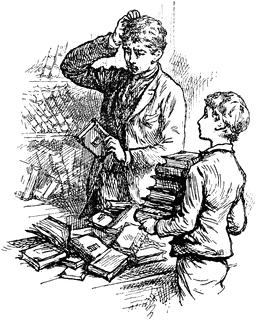
father and son in the library

Hey, kiddo! Do you really need this one, to? Good thing I don’t have to pay for all of these.

When I was a teenager, I lived across the street from the library. I did homework there, typed most of my college applications on their noisy electric typewriter (10 cents for each 15 minutes, I think), and perused the shelves for hours on end. I’d already developed a taste for books by that age, but there’s no doubt in my mind that my family’s proximity to the library solidified my attachment to books, reading, and libraries, in general.

Now that I’m older, I live in a family fully of bibliophiles. We read to learn Torah. We read for entertainment; we read to learn how to do new things; we read for school assignments. We read because otherwise we’d go into withdrawal and start twitching in a dark room. Continue reading

How to find a kosher book: Nifty bit in this week’s HaModia

There’s an article this week about Rabbi Alexander Seinfeld in HaModia, and it mentions almost as an aside that he and his 12 year old daughter have started a website with books for Jewish kids.
I visited the site, and the coolest thing is that it is SEARCHABLE! You can look up selections by subject and by age of reader, as well as title and author. However, it does not contain all the books out there. I’m assuming it is a work in progress and I’m very impressed with what they’ve done so far. It would be a great resource, for example, for those looking to buy a gift for a particular child or looking to stock up for a school or classroom library.
The link is in the list to the right of this blog, as well, and will remain there indefinitely.
In other “HaModia” news…my all-time favorite serial (aside from the one co-written by yours truly…) wrapped up in that magazine last week. Hopefully, This is America! will soon appear in novel format in Jewish bookstores. I really hope so, as it will deservingly find more readers this way.

How to Provide Books to the Needy

About thirty years ago, a linguistic anthropologist researched children’s literary experiences at home in three communities. In her famous article, “What No Bedtime Story Means,” Dr. S.B. Heath wrote about her findings. She reported that children who have books in their home and use them regularly have better literacy in school. Even if a child had books in the house, they had to be used…it was insufficient to have a beautiful book if it was treasured so much to the extent that it was left on the shelf as a display piece.

When I taught in So. L.A. nearly a decade ago, my students (mostly working class and Latino) often had no books of their own. Many didn’t visit the library unless on a school visit, although there was one in the neighborhood. Many parents, cash-strapped and not functionally literate themselves, chose to spend what little money they had on DVDs and video games. Others had a few books. These had often been received as gifts, and remained on the shelf so as not to be ruined (just as in Dr. Heath’s study). Alternatively, my students had books, but these were often t.v. tie-ins of questionable literary merit. And some of my students had parents who wanted to read, but were each working two jobs to make ends meet. These folks were simply too busy and too exhausted to read a bedtime story. Thus, my students often had very few literary experiences before they reached school.

Contrast this with the average Ashkenazy Jew in America: books cover the walls (content and language varies by religiosity); many books are so well used they have actually been “loved to death” and are in tatters; libraries are regularly visited; newborns are given copies of Baby Faces, Brown Bear, Brown Bear, and Blue Hat, Green Hat as gifts long before they can actually hold the books in their own tiny hands.

And people wonder why we are the people of the book?

In steps the wonderful organization, First Book. First Book has partnered with General Mills to distribute free books in Cheerios boxes at selected times of year. Plain Cheerios is a WIC friendly food, so putting them in that particular brand helps them reach their target audience, kids whose families may not be able to afford books, and who may not access public libraries. While these books are printed cheaply, they are high-quality literature. The authors have either won First Book’s annual writing competition for new writers or are established writers themselves…and the illustrations are fabulous.

Here’s a link to this wonderful organization. http://www.firstbook.org/