Good news and a helping Hand

Great news! My short story, “What Do You Really Want?” appears in this week’s Binah BeTween, the tween supplement of Binah Magazine! It’s available at Jewish bookstores and newstands nationwide. This is my first appearance in that magazine, making it especially exciting for me.

It’s also the story I’ve written on the shortest deadline (other than an academic paper). It proved quite harrowing, because the six days I was given included both Shabbat and the time difference between L.A. and Israel. However, baruch HaShem (thanks to the Source, G-d), the delay ended up working in my favor. Because I started work before the editor got back to me about what genre she preferred (it was Shabbat in Israel, but not here)…the resulting fantasy story was not what she planned, and at first I panicked. Thank G-d, the editor ended up thinking my unexpected approach worked out beautifully and accepted it after all. I hope all of you like it, too.

This leads me to contemplate how much I owe to Heavenly Assistance. When I was offered that piece on a short deadline, I had no idea where I wanted the story to go until an idea “just popped” into my head. Likewise, I was offered another job more recently. The deadline was much farther off, but I still needed to get an idea and get cracking. G-d aligned all sorts of experiences and conversations on the very theme that the editor had selected. Other times, I’ve awakened at 5 o’clock in the morning with the perfect solution to my stalled Work In Progress.

A rabbi once explained to me that the reason people like Dovid HaMelech (King David) were able to accomplish so much was because they knew their own limits and that their ultimate success depended entirely on G-d. They trusted in His assistance and the endowments He gave them (acknowledging the Source of those endowments) to accomplish things most people would give up on. I’m not on that level, but there are times when I look back and go, “How did I do that!” and know I didn’t do it on my own.

Does anyone else out there feel like G-d gives them the final push to get them to their goals?

Moving day!

I just moved to this new WordPress URL after several years at Blogger. Instead of packing a suitcase, I imported my posts from my old Blogger site. Why the move? I felt I needed a fresher look and some features that Blogger just doesn’t have. Most importantly, I now can post PDFs of pieces I’ve published in the past in order for you folks to see a little of what I do. Just take a peek at “Want to read a story?” in the menu above.

Bitter with a touch of sweet

It’s the Three Weeks. For those in the know, this period (from the 17 of Tammuz through the 9th of Av) are historically the three saddest, most unlucky, dreadful weeks for the Jewish people. Both Temples destroyed. Declaration of the First Crusade. The Jews expelled from England. The beginning of the Spanish Inquisition. The deportation of the Jews of the Warsaw Ghetto to Treblinka. Bad, bad stuff.

My bad stuff does not compete. But of course, this had to be the week when I received a rejection letter from the first publisher I sent my novel to. In the end, it might not be bad news (maybe it’s sub-par, maybe the next publisher I send it to would be a better match…), but it feels like it right now. I’m not really down in the dumps–probably because of the 5 month delay–but it’s still a disappointment.

On the other hand, it’s tempered by some great news. I IY”H expect to have a short story in Binah BeTween this week, with a few other pieces placed for publication soon. As soon as they reach newstands, I’ll let everyone know.

Three books, three lessons

I haven’t been posting to this blog very much recently because I’ve been very, very busy. Among other things, I’ve been writing (I’ll post about that IY”H soon) and reading–reading to my kids, parallel to my kids, and on my own. Notably, I’ve recently read several books that are “message books”–books with a sincere moral message that the author wants readers to absorb. While many such books come across as heavy-handed, these do not. I’m highlighting these books because they definitely represent one of the directions I want to go with my writing–using speculative fiction to explore subjects that might not appeal to children or teens if approached more directly.
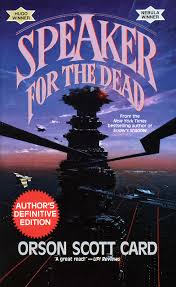
HIGH SCHOOL AND ABOVE Orson Scott Card (as a practicing Mormon, he often introduces ethical dilemmas and messages into his books) is most famous for his first novel, Ender’s Game. I recently read the first sequel Speaker for the Dead, and was sucked in right away by the introduction by the author. (In it, Card says that one of his motivations for writing the book was because he wanted to show a central character who is NOT an adolescent, or a drifter, or any other aloof, single man on the fringe of society who usually stars in sci-fi novels. Rather, he portrays a man ready to create a family, who really wants to build bridges between the members of communities.)

Speaker for the Dead follows the hero of Ender’s Game to the age of 35–although 3000 years have passed, he hasn’t aged because he has spent so much time travelling at nearly light speed, teaching people insights into the behavior of the dead, allowing people to walk in the shoes of people before judging them (as it says in Pirkei Avot/The Ethics of the Fathers). This is his personal tikkun (rectification of error) following his (SPOILER ALERT) near-destruction of the species of Buggers at the climax of the last novel. Now, Ender’s sister and travel companion, Valentine, is expecting her first child. Her travels are over, and he realizes he wants his to end, too. But he has one last mission–to find out why members of another alien race have started killing the scientists (actually xenologists–like anthropologists, but studying aliens instead of humans) who have befriended them and studied them.

This novel provides a nuanced discussion about a new kind moral relativism–not that right and wrong are relative, but that our ability to judge them is. The story is a little focused on one side of the argument, and I was able to guess the mysterious cause of the aliens’ behavior right off–but that might be because I 1) am a writer myself and 2) hold a master’s degree in anthropology. However, I really enjoyed the book and it would be an excellent stepping off point for discussion in a classroom, book club, or around the dinner table.

MIDDLE GRADE Vivian Vande Velde’s middle-grade novel, Three Good Deeds, tells the story of Howard, a rowdy boy who spends several months as a goose. Howard’s transformation is at the hands of the local witch, who feels he is a selfish child more interested in his own entertainment than the needs or wants of others. The only way out of the curse is for Howard to complete three genuinely good deeds.
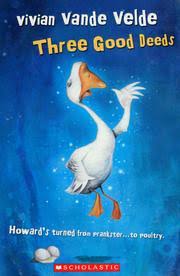
Three Good Deeds uses fantasy, a charming although obnoxious anti-hero, and plenty of droll humor to draw the audience (ages 8 and up) into the story. Despite the light treatment, the message–that a person should be a giver and not a taker–is beautifully interwoven into the text. Warning: the end is a bit of a tear-jerker for softies (it mentions chessed shel emes).

PICTURE BOOK Paul Budnitz’s The Hole in the Middle takes a fantastic approach, as well, to teach its lesson. Morgan quite literally has a hole in his middle. He tries to fill it up with superficial and self-centered pursuits. However, it only shrinks when he does chessed (kindness) for his friend Yumi.

The fanciful, metaphorical style of this book ALMOST overpowers the moral. My 3-year-old and not-quite-5-year-old children laughed at the story outright–it’s just so outlandish. But when I asked the older of the two about the message, she had indeed absorbed it!

I’m wondering if the wackiness of the set-up might make the book so memorable that even if a younger child doesn’t quite understand the message at the time she reads it, she’ll draw on its memory to guide her after she reaches a stage where it’s no longer over her head.

The Hole in the Middle

What will your children be reading this summer?

I just read an interesting opinion piece in the New York Times by Claire Needell Hollander, a middle school teacher. Her article explains that while young, inexperienced readers should go ahead and read whatever they want during the summer, so long as they read, maturing readers of 10 years old and up will benefit more from selective reading. Ms. Hollander’s preferred books build “verbal knowledge (an increase in word recognition) and world knowledge (an increase in understanding about the world around them).”

Ms. Hollander believes that middle- and high-schoolers should not self-select their summer reading. She believes that some students do well with the traditional recommended reading list (heavy on literary novels recognized as “classics”), but she prefers to narrow the students’ selection by genre to ensure they are getting the literary diet that will enhance their academic health. Her top picks? High-quality but developmentally appropriate non-fiction. Most revolve on serious moral issues–child soldiers, the bombing of Hiroshima, and the like.

I believe Ms. Hollander when she says that studies have shown that students who read “high quality” material over the summer do better than those who completely self-select. My problem is that this is too short-sighted a goal. We don’t just want successful students who pass tests, we want to make life-long learners who will turn to books for information as well as pleasure through adulthood. 

So, yeah, a kid who (her comparison) reads The Hunger Games might in the short term learn less words and information that the kid who reads The Red Badge of Courage. But if the kid who reads The Hunger Games enjoys it and develops a real pleasure in reading, they might read more as a 30 or 40 year old than the kid who read The Red Badge of Courage and gritted his teeth through the whole thing (not because it’s a bad book, but because it was not to his taste). There was a wonderful post on the Nerdy Book Club recently by Sasha Reinhardt about how her low-brow love of The Babysitters’ Club series helped develop her lifelong devotion to books.  

And while studies have supported (as mentioned in previous blog posts) that non-fiction appeals to many children who normally don’t identify themselves as book-lovers, the serious tone of the books Ms Hollander lists will turn-off many children. The graphic novels Kampung Boy and American-Born Chinese may not appeal to her, but they certainly introduce serious subjects, geographic detail, and lots of new vocabulary in a format that might appeal to reluctant readers more than Francesco D’Adamo and Ann Leonori’s Iqbal  or John Hersey’s Hiroshima.


Need help with research, but can’t reach primary resources?

My husband showed me a marvelous website today, both for teachers and for writers–the updated Library of Congress website. The benefits of this site are the following:

1) Large amounts of the LOC’s collections are now digitized. That means, without actually visiting its site in DC, you can view rare materials like maps created by George Washington, newpapers from the time of the Civil War, and political cartoons from the Great Depression.
2) The award-winning interactive site offers the opportunity to virtually “visit” the current exhibitions at the LOC, play “Knowledge Quest,” and make your own personal collection of favorite items.

As writers, we can benefit enormously from this resource. Setting a story in the past? We can find letters, diaries and journals of historical figures and be able to quote them in our work. Wondering what should be in the bedroom or office of your main character? You can see the books they read, find out from their diaries what their favorite foods were, places they visited, who they knew, see photos (from 1860s on) of how people dressed in those days, or paintings or woodcuts of where they lived. Need the characters to sound real? You can find out how people felt about historical events while they were still happening through personal correspondence, letters to the editor of newspapers, and political cartoons.