Be childlike, not childish–What we can learn about writing from kids

We now—joyfully—have 2 1/2 literate kids in our household. (The 1/2 is only 5. Cut her some slack.) One of the interesting things in my life lately has been watching them become writers, as well. I think we adults can learn a thing or two from their learning curve.

1) Kids enjoy writing about what they like. However, one of the things that makes them better writers is writing about things outside their comfort zone.  It’s a lot easier to get my 10 year old to write about cars or maps, but his writing skills have been built up greatly by writing all those friendly letters, book reports, essays, and so on that get assigned as homework or classwork. When was the last time you wrote something outside YOUR comfort zone? I know professional writers who only write personal essays, or those who have always exclusively written for kids. Try a little of everything. Mix it up. It’ll surprise you.

Watch out! Your bookworm might just become a writer!

2) Kids try to copy what they like to read. They’ll borrow liberally from Captain Underpants, Tintin, and the like. They recognize excellence and strive to emulate it. Of course, we want writers to develop their own voice (and never, ever plagiarize), but there’s nothing wrong from learning from the greats. So do a little pastiche–you’ll get a childlike pleasure from it, and brush up your skills, too.

3) There might be obstacles in the way. The right tools can help. One of my kids has a graphomotor problem. Upon advice, we bought him pencils with fatter leads. What a difference. And now he usually types writing assignments. So much easier for him. Another of my kids is so young, she hasn’t learned to spell yet. Relying on invented spelling allows her to communicate on paper, and she’s so pleased with the result she does a little dance (really, she does). If your inner kid has problems with writing, break it down and see if there’s a solution. Don’t just give up. Continue reading
Wavering

NaNoWriMo is National Novel Writing Month, running for the month of November each year. By November 30th, participants hope to finish writing a 50,000-word (approximately 175-page) novel. Some people try to fly solo, but most participants sign up on the official website. The website offers guidance about pacing, tracks your progress, and provides support. NaNoWriMo has resulted in some book sales for participants, but many others say it taught them discipline, skills and persistence that helped them with future projects.

If your book idea is Jewish and for kids, there’s also (mentioned in a previous blog) the “Write Your Own Megillah” event.

Truthfully, I have a few novel ideas out there, and it would be good to have an outside source telling me to crank out a draft in one month. But I’m still working on my last novel, still hoping to sell it, and still have deadlines for my magazine work to meet. Plus, I probably need to add another part-time job to my plate for financial reasons.

So I keep wavering. Should I or shouldn’t I? Should I or shouldn’t I? It’s like balancing two different categories of responsibility.

What’s harder than writing 1000 words a day?

Well, the kids are all in school, so I no longer have any excuses. I’ve been sitting at my desk daily and attempting to crank out a thousand words. This seems to be a pretty common goal for writers, and I seem to make it most days. Okay, some days. The days I’m not editing the stuff I wrote previously.

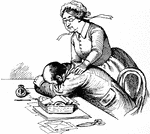
I guess he didn’t make it to 1000 words today.

On Friday, I set myself a different goal. I had written a piece a while back that the members of my writing group liked. However, when trying to market the piece, the best match for the story was a magazine that has strict word counts for each of its departments. I could only submit to one department at a time, and the piece would only be accepted if it met the qualifications listed. At 1500-ish words, my story didn’t fit in either department that matched the subject matter.

I had a choice with this piece. I could either beef it up to 2000 words, or cut it to 800 words.

So, Friday morning, I sat down to cut 700+ words from my article.

The piece had been well-edited before, and there were few passive constructions or the like to tighten up. At various points, I despaired that I would ever succeed. However, the process was extremely educational, and I’ll share a few of its lessons with you.

1) Think about showing vs. telling. I was able to cut several places where I found I was both showing and telling. The showing was enough. Let the readers make a couple inferences. It’s good for them.

2) Consider, “What it the main purpose of the story?” In a novel, there are often subplots or backstory that add to the narrative. Even a short story will often contain these elements. But in the short, short story (yes, it’s an actual genre), and even more in flash fiction, you have room to keep only the story elements that push the main narrative along. Yes, my little subplot was funny. Yes, I’d grown attached to it. But did it support the main idea? Not so much. Thus, it landed on the chopping block. Off went a couple hundred words.

3) Occasionally, adding a line will help you cut a dozen–or even more.I added a new ending (partly suggested to me by my friend Devorah Talia) and was able to eliminate a huge final scene that took up another two hundred words, or so.

Snip, snip!

4) How many adjectives and adverbs do you really need? After reading an article a year or so ago, I’d eliminated many adverbs from my writing vocabulary, switching to stronger, more precise verb usage. I had hardly any adverbs modifying verbs in the article. However, I seem to cling to the use of adverbs that modify adjectives. In this piece, the biggest offenders were the words “really,” “very,” “so” and the like. Also, the improved choice of nouns and verbs removed the necessity of using many adjectives.

5) Read aloud several times. I had read this piece to myself dozens of times already. Reading out loud was a very different experience. I was able to discern unnecessary material more readily, and often could think of natural substitutions for certain wordy idioms I’d used. Breaks in between allowed me to see the words with new eyes each time.

I submitted the piece this morning after cutting one more word. Let’s hope the exercise helps me sell the piece! Even if it doesn’t sell, the editing practice will have served me well.

Denial is more than a river in Egypt

Sorry for the corny post title. I’m starting to evaluate why my novel manuscript was rejected in preparation for revising it. The truth is, parts of it are original and thought-provoking, but parts are outright terrible.

1) I need to spend more time developing my setting and characters. My beta readers told me my characters were appealing, but are they believable? I’m not so sure. And the setting could be more convincing. I’m going to do some mapping out of additional material to flesh things out, plus do a few strategic cuts (or changes) to make each more consistent with their inner logic.

2) It’s too short. Yes, I am a champion of short novels, but this novel is TOO short. I need at least another 12,000 words so the speed isn’t so breakneck. In retrospect, there are plenty of scenes alluded to in conversation or flashback that could be fleshed out so there is more showing and less tell.

3) Parts are too pedantic. I’ve been reading some books which take a similar approach to serious topics (see previous post here), and have recognized that I could write my little sci-fi fable with a little lighter hand.

4) The book doesn’t always convey the exact message I intended. I think I changed my outlook a few times in the process of writing, and it shows. I have to have more focus and consistency.

I’m not really ashamed that my book is less than perfect, but BOY I’m glad I didn’t follow the advice of people who told me to self-publish. At least there are fewer than 10 people who have read the whole thing thus far.

EWN3DPDHS62A

What I was supposed to be doing this summer

I really intended to write my next novel this summer. Really. I have it all outlined. I even tweaked the outlined last week and diagrammed characters, settings, and the like. I did.

But life happens. I have all my kids and the stupendous Mr. Klempner all home this summer, and we’ve been busy tidepool-hopping and museum-visiting and swing-pushing and the like. Also, I had a few deadlines to meet on short pieces, so I haven’t been lazy.

Really.

It might be more realistic to keep outlining and diagramming until the kids all head back to school. At that point, I should have more time to sit at the computer and crank out 1,000 words a day. Plus, I want to set aside an hour a day to revise the recently-rejected previously-completed novel. Then I can justify agent hunting.

I’m trying to be patient with all the interruptions and distractions. Just one more month to go, and I should have plenty time to write.

At least, that’s the theory.

The Romance of Writing a Novel

I subscribe to the daily emails from Garrison Keillor’s Writer’s Almanac (which I highly recommend) and today’s email included a lovely quote from the award-winning author, Khaled Hosseini (here I have to admit that I couldn’t finish The Kite Runner–there’s this violent street-fight scene I just couldn’t deal with–but I love this quote just the same).

Apparently, he once said, “There is a romantic notion to writing a novel, especially when you are starting it. You are embarking on this incredibly exciting journey, and you’re going to write your first novel, you’re going to write a book. Until you’re about 50 pages into it, and that romance wears off, and then you’re left with a very stark reality of having to write the rest of this thing. […] A lot of 50-page unfinished novels are sitting in a lot of drawers across this country. Well, what it takes at that point is discipline … You have to be more stubborn than the manuscript, and you have to punch in and punch out every day, regardless of whether it’s going well, regardless of whether it’s going badly. […] It’s largely an act of perseverance […] The story really wants to defeat you, and you just have to be more mulish than the story.”

Having just submitted my own first novel (please keep praying a publisher buys it!), and having discussed writing novels with a lot of people, I have to agree with the first half of Dr. Hosseini’s statement here. A lot of people dream of writing a novel. Many people actually start writing novels, but most of those peter out right around the point Dr. Hosseini describes.

But here’s where Dr. Hosseini and I are going to disagree: while I think that discipline and perseverance are the keys to finishing a novel, I think that many people who begin to write books just don’t know how to! While there are people who like to “write by the seat of their pants” or “wing it,” completing a novel in a timely fashion without outlining or diagramming or writing notes or some sort of prewriting exercise, and without studying how to write a novel in advance (even just reading a single how-to book from the library can help) is a much more daunting exercise than doing it without putting in those steps up front. Many of these abandoned books could be finished if their authors took these steps. For more on this subject, check out this recent post by Susanne Larkin here.