Shimon, the son of Rabban Gamliel, said:
“I was brought up all my life among the Sages,
and I have found nothing as good for the body as silence…”
(Pirkei Avot/The Sayings of our Fathers)
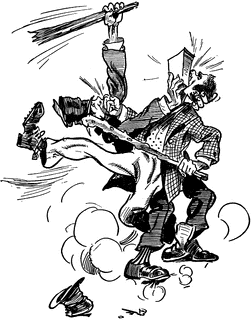
Sometimes a punch is less painful than a verbal blow.
Usually, when we hear about the value of silence, we think about what literally comes out of our mouths. According to Jewish law, before speaking, we’re supposed to chose our words carefully, and use them to teach, to learn, to express love and gratitude, to connect with people and with G-d.
However, as we become more conscious of our speech, we discover how often we use our words to accomplish the opposite. How many people have we offended because we mouthed off with the first thing that came to our heads? How often many times have we said something hasty and then wished we could take it back? Are there people who don’t trust us because we let slip their secrets?
If we’re lucky, we learn–like Rabbi Shimon, above–to value the word that is withheld as much or more than the one that is expressed.
Recently, I’ve noticed that sometimes silence can be golden when it comes to writing, too. It’s striking that many writers out there will justify misusing words for “art” or for profit. In the news lately, we’ve seen writers paid to produce reviews of books and others who write college and graduate school essays for a fee. Both are misleading their intended audiences.
I once read a novel that portrayed a beloved historical figure as a murderer. I guess the author thought it was was okay because it was just “fiction,” but the personage has living relatives. If she were living, she could sue, but because she’s dead, there’s nothing to protect her reputation.
And think about all the memoirists who paint vengeful, unflattering one-sided pictures of their nearest and dearest “because it’s the truth.” It might feel great to tell everyone you were mistreated by your drunken father, but how does your sister feel? And what if dad decides to become sober and you patch things up…how will you be able to retract the words you published for all the world to see?
It’s interesting, but in Jewish law, you can say something that could be harmful to a person’s reputation if it is for a constructive purpose–but ONLY if it is for a constructive purpose. If you have even the slightest thought of vengeance when you write a review, or you take the smallest grain of pleasure in describing your neighbor’s foibles, you are not allowed to share them. Imagine if everyone held themselves to that standard.
With the new year approaching (at Rosh HaShanah), I’ve been considering how much a writer has to say…and what shouldn’t be written. Even the non-professional writer has moments wishing they could push “unsend” after sending an email or drop a fishing line into the mailbox in order to retract the angry letter they’d just posted. Let’s hope we all channel beauty and purity into the world through our pens and our keyboards in the coming year.


 Rebecca Klempner