Seeing the world through a writer’s eyes

I’ve been thinking a little bit more about my theme of a couple posts ago, “how to be funny.”
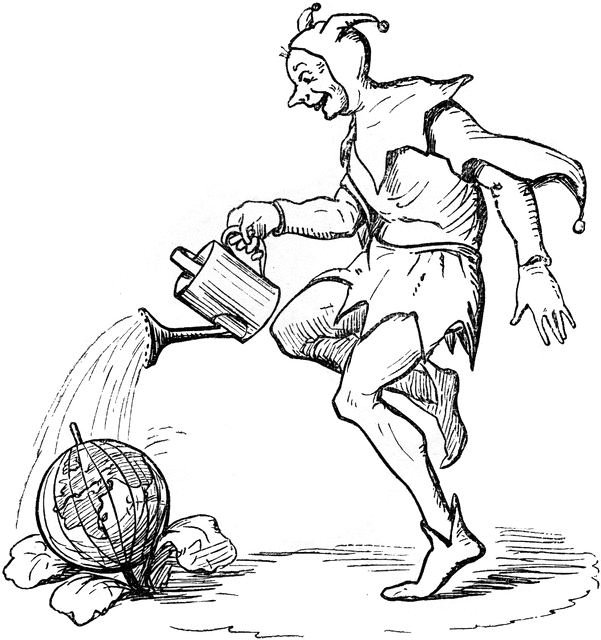
jester

A good jester will find humor in any situation, not just those that are obviously funny.

One of the steps to writing funny is seeing funny all around you. You can look at almost any situation and find something funny in it if you relax and try to experience it through calm, judgment-free observation.

A few months ago, someone (it might have been Erika Dreifus) pointed out this opinion piece by Silas House in the N.Y. Times:

We are a people who are forever moving, who do not have enough hours in the day, but while we are trying our best to be parents and partners, employees and caregivers, we must also remain writers.

There is no way to learn how to do this except by simply doing it. We must use every moment we can to think about the piece of writing at hand, to see the world through the point of view of our characters, to learn everything we can that serves the writing. We must notice details around us, while also blocking diversions and keeping our thought processes focused on our current poem, essay or book.

This way of being must be something that we have to turn off instead of actively turn on. It must be the way we live our lives.

Some people take this kind of remote observation a bit far. Silas House argues that the majority of a writer’s mind should be working on literary pursuits at any given time. I’d disagree. I try to turn this part of my brain off on Shabbat, during conversations with loved ones, and on date night, too. The key is not to remove yourself entirely from life around you, but to be able to see it calmly with a portion of your mind at will.

But that doesn’t mean that when on a stroll with my kids and I’m admiring your garden that I’m not noting which flowers are in bloom at this season so I can work them into the setting of my work in progress.

There’s a story Continue reading
Thank the folks who’ve rejected you–a radical suggestion for writers this Thanksgiving

Thanksgiving is upon us here in the U.S., and this is a wonderful opportunity to reflect upon gratitude, whether you celebrate the holiday or not. I’m a big fan of Rabbi Zelig Pliskin and also of Rabbi Shalom Arush, and I’m going to combine their approaches for this writing exercise appropriate to the Thanksgiving season and year-round. This exercise is useful whether you’re Jewish or not–please don’t get turned off to it just because it was inspired by a couple of rabbis.

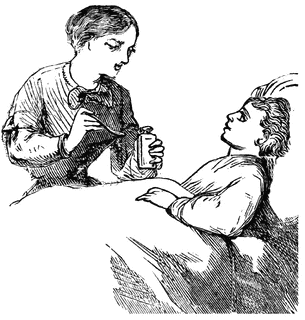
mother offering child medicine

Be grateful for the medicine–it’s good for you.

Rejection is just about the hardest thing to cope with when you decide you’re going to become a writer, but it’s something that you need to learn to accept graciously. When that rejection letter first comes, you are often overwhelmed by feelings of resentment, anger, and frustration. You might lash out, calling the editors idiots or saying that the publisher doesn’t know what good writing is. You might despair, consider yourself a failure, or even give up writing.

But here’s the truth–you were meant to be rejected, at least in this specific instance. Continue reading

Flashes and foraging: where story ideas come from

I was reading this interesting little article a while back about the flashes of inspiration that triggered 10 authors to pen their most classic works. The article really focuses on novels that arose out of a spontaneous image or idea that popped into the author’s head. Perhaps the most dramatic was Gabriel Garcia Marquez’s inspiration for 100 Years of Solitude. His sudden insight prompted him to turn his car around and drive his family home to work on his new book instead of continuing towards the beach vacation they’d been headed for.

Now, I recognize that many stories are born that way–bolts of lighting unexpectedly sent from Above, and so on–and it has certainly happened to me before. An editor will select a topic for me to write on (1200-1400 words by next Thursday on this theme, please!) and I’ll sit stumped about how to approach it in some way that isn’t stale and predictable. Hours (or days) later, I’ll try to get back to sleep after someone’s car alarm has gone off and–zing!–HaShem will pop an idea into my brain. (Insert here a sound effect to emphasize the moment.) Sometimes, a detail of a conversation or picture in a book will provoke an entire story to arise almost fully formed from my imagination, with little effort on my part. Yes, this does happen.

Most of the time, however, I forage for ideas. I’ll flip through science news for a new discovery or technology that sounds too impossible to be true. I’ll read three novels all of the same genre or subject, and then compare them. I’ll snip articles out of my HaModia or Mishpacha or Ami. I’ll browse the pages of my journal for wacky things my kids do or things kids fight about, or scribble clusters of words that a topic evokes from my mind.

Once I collect these ideas, they require careful combination. At times the way to do this comes through hard work, strategically arranging plot elements based on the needs of the assignment. Other times, I sit and contemplate them and then let the ideas sorta drift together until something sounds right. I’ll meld a new technology with a situation my children recently dealt with. I’ll transport the subplot from a novel I liked into a fantastic setting, then give it a different ending. Sometimes, after sampling the rough draft, I’ll recognize there’s a missing ingredient and have to hunt around for something that adds just the right flavor. It’s not like there’s no Heavenly assistance involved…it’s just a lot more dramatic, with more input on my part.

In the HaModia Sukkos 5773 story supplement (out today!), you’ll find a piece by yours truly that was generated in just such a way. Discovering that earthbound scientists will likely be exploring new planets via remote-controlled robots, I filed it away for future contemplation. (This isn’t the original article, but it was about the same subject.) After a lot of publicity last winter and spring about how the internet and smart technologies affect human relationships, I revisited the initial idea and found a way to blend the two concepts into an entertaining (I hope!) sci-fi story. I’m hoping the readers enjoy it. It will be my first piece for adults in a magazine with an international circulation!