Fans, friends, and trolls–publishing my first piece on Tablet

So, Tablet published a piece of mine this week. It’s been a crazy experience.

In the first place, writing the piece was a bit out of my comfort zone. While I usually write fiction, this is a personal essay. In brief, the story is about confronting my inner teenager as I’m approaching 40 and relates an episode where I thought a younger man was checking me out in a cafe.
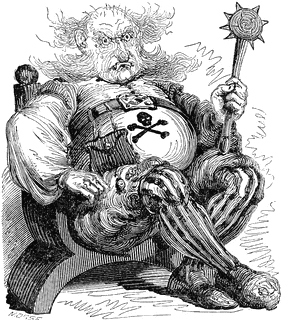
Troll

Trolls don’t only live under bridges.

The subject matter was outside the editorial policies of the chareidi magazines that comprise my usual stomping grounds, so I had to find an alternative publisher. Afraid I might embarrass my husband, I almost decided not to publish it at all, but he assured me that he didn’t mind. And when I shared an early draft with writing friends, the strongly positive reaction encouraged me further.

Tablet accepted my query, then the completed essay. They had it up in a matter of days. Whoa. It didn’t leave me much time to prepare myself. And, boy, did I have to prepare myself.

You see, there’s a lot of differences between a Jewish, but broad-spectrum, online magazine like Tablet and print magazines in the chareidi world. The biggest difference is the comments section.

In a print magazine, there is no comments section. Continue reading

The Writing for Pay-Writing for Blog Balance

Lately, I’ve been neglecting my blog. I’m not being delinquent; I’m just being practical. Thank G-d, I’ve been doing a lot of writing in the last couple weeks, writing that is both fun and paying (my favorite combination). G-d willing, I’ll be publishing a short 5-part serial in Binyan in the next few weeks, as well as a few other exciting projects that have been time-consuming.

It’s true that blogging is not independent of my work–I maintain my site largely to create an audience for my writing, promote it when published, and help others overcome some of the professional hurdles I’ve come across (sometimes stumbling along the way). However, writing a decent post that I don’t mind having my name attached to takes time. Lately, for good reasons, I’ve felt my time has to be spent elsewhere. But posting regularly is key to maintaining a good blog.

How do the readers out there strike the right balance between blogging and other professional activities?

Grandma: A stellar source for writer’s research & just on the other end of the phone line

grandma and little girl

This grandmother may be cute, but she’s not as awesome as mine! (On the other hand, the little girl is much cuter than I ever was.)

I happen to be blessed with an amazing grandmother. At 92 (she should live to 120!) she’s slowed down a bit, and I wish I could spend more time with her. I used to phone just once a week, but I’m trying to call her more often, as it’s now hard for her to get out and about the way she used to. I fill her in on what’s going on around here, and she tells me what she’s been up to.

Frequently, what my grandma is up to is sorting through old letters, photos, magazines, and other memorabilia. Continue reading

Which part is historical and which part is fiction? My Semi-official 39 Clues Rant

Book 10: Into The Gauntlet

It’s by the fantastic writer Margaret Peterson Haddix. What’s there not to like?

This post might get me in trouble with my kids, but so be it.

In case you don’t know The 39 Clues is a book series for middle grade readers (roughly kids 8-12). I think the initial target audience was older, but that’s who’s reading this series in my neck of the woods.

Kids love these books. They are exciting and are so engaging as to be addictive. Tweens clamor for more titles, which are delivered to bookstores at an astonishing rate. They are written by some top names in kids’ lit, like Rick Riordan, Margaret Peterson Haddix, and (one of my faves) Linda Sue Park. What’s there to dislike?

Here’s my beef.

The 39 Clues series freely borrows from historical fact, then elaborates on this to create a thrilling adventure for kids. Continue reading

How to write funny: what you can learn from Isaac Asimov

Asimov on Humor

A must-read for anyone who wants to write humor

When I first married my husband, I was delighted to discover among his possessions a copy of Isaac Asimov’s Treasury of Humor. I had read the book in high school and enjoyed reading it again, this time discussing it extensively with my husband.

Not only does this book contain jokes–great, classic ones–but Asimov explains why they’re funny, how to tell them, the origin of them, and if there are different versions. He explains the differences between shaggy dog stories, puns, black/gallows humor, and so on, and what makes each type tick. Asimov does this all in a chatty way that reminds you of your great-uncle shmoozing with you–it’s just so much fun.

Flash forward a few years. Continue reading