Grandma: A stellar source for writer’s research & just on the other end of the phone line

grandma and little girl

This grandmother may be cute, but she’s not as awesome as mine! (On the other hand, the little girl is much cuter than I ever was.)

I happen to be blessed with an amazing grandmother. At 92 (she should live to 120!) she’s slowed down a bit, and I wish I could spend more time with her. I used to phone just once a week, but I’m trying to call her more often, as it’s now hard for her to get out and about the way she used to. I fill her in on what’s going on around here, and she tells me what she’s been up to.

Frequently, what my grandma is up to is sorting through old letters, photos, magazines, and other memorabilia. Continue reading

How to write funny: what you can learn from Isaac Asimov

Asimov on Humor

A must-read for anyone who wants to write humor

When I first married my husband, I was delighted to discover among his possessions a copy of Isaac Asimov’s Treasury of Humor. I had read the book in high school and enjoyed reading it again, this time discussing it extensively with my husband.

Not only does this book contain jokes–great, classic ones–but Asimov explains why they’re funny, how to tell them, the origin of them, and if there are different versions. He explains the differences between shaggy dog stories, puns, black/gallows humor, and so on, and what makes each type tick. Asimov does this all in a chatty way that reminds you of your great-uncle shmoozing with you–it’s just so much fun.

Flash forward a few years. Continue reading

On Writing About Writing: a guest post by Miriam Hendeles, author of Mazel Tov, It’s a Bubby!

Mazel Tov! It's a Bubby!

Miriam’s Book!

Today’s guest post is from my partner in crime writing, Miriam Hendeles.

What do writers write about? We write about our lives and our families. Some of us write about our struggles and triumphs. Others write about philosophies and opinions; hope and dreams.

We tell stories, and conduct interviews; we compose lists and craft essays.

We even write about “Writing.” Now what is there to tell, conduct, compose and craft about Writing?

So much. We can write about the writing process, solutions to writer’s block, publishing opportunities, strategies for success, online writing techniques, SEO, PLR and myriad other acronyms. Bloggers and gurus craft advice to the masses on how to become the most polished, pithy, and popular Writer. You see, many writers choose to write about Writing, because if we write about Writing, we know we are guaranteed an audience, comprised of the following loyal and faithful readers:

Writers. Wannabe writers. Bloggers. Publishers. Agents. Editors.

But when we do not write about Writing? Then who is our audience?

Random Interested Persons of Non-Writing topic.

For example, Continue reading

3 Tricks for magazine writers: How to write on a theme and still make your deadline

keyboard

Before you start to type, you might want to try one of these 3 things.

One of my writing jobs is penning teen and tween stories for Jewish magazines. Before getting this gig, I had to learn an important lesson: most kids’ magazines select one theme per issue, and they are only open to stories on those themes. That means you have to write what they want, when they want it–but you’ve got to still tap into your creativity to make your story fresh, fun, and readable.

NOTE: Writing contests (although many are scams, there are plenty of legit ones) and classroom assignments frequently require that submissions/assignments include a specific topic or theme and have a deadline, as well. You don’t have to write for magazines to benefit from these 3 tips.

Sometimes, I get the heads-up on what story the editor wants on what theme a month in advance. But sometimes it’s a lot less. How do I come up with a story on short notice?  Continue reading

The 2 Best Ways to Improve Your Writing Skills (with a little backup from Anne Lamott)

I’m going to offer some advice today that seems simplistic, so basic as to be ridiculous. Yet recently, I’ve experienced people who have neglected these 2 important strategies that are pretty much guaranteed to improve their writing abilities. So here I am repeating them.

Almost every book about writing offers the following advice. (The wording might vary according to the delicacy of the audience, but the meaning is the same.)

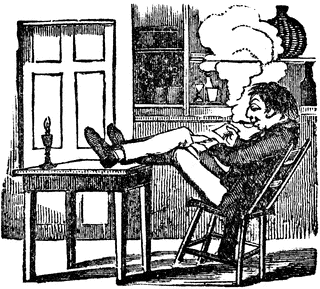
relaxing in a chair

Okay, so you might need more than a chair. This guy isn’t going to get much writing done if he doesn’t pick up a pen!

1) PUT YOUR TUSH IN THE CHAIR.

By this, of course, we learn that if you tell us you want to write, well that’s a nice sentiment. But we know that you mean it if you sit at a desk, pick up a pen (or keyboard) and actually practice writing. Certainly weekly, and preferably daily, you need to write. A human being is only a writer if s/he is a person who writes.  Continue reading