Silence is golden: how to be a writer without harming others

Shimon, the son of Rabban Gamliel, said:

“I was brought up all my life among the Sages,

and I have found nothing as good for the body as silence…”

                                                                                                   (Pirkei Avot/The Sayings of our Fathers)

Sometimes a punch is less painful than a verbal blow.
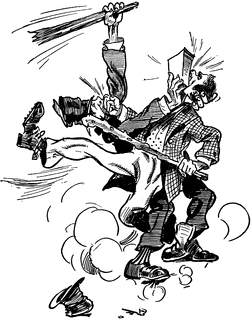
Usually, when we hear about the value of silence, we think about what literally comes out of our mouths. According to Jewish law, before speaking, we’re supposed to chose our words carefully, and use them to teach, to learn, to express love and gratitude, to connect with people and with G-d.

However, as we become more conscious of our speech, we discover how often we use our words to accomplish the opposite. How many people have we offended because we mouthed off with the first thing that came to our heads? How often many times have we said something hasty and then wished we could take it back? Are there people who don’t trust us because we let slip their secrets?

If we’re lucky, we learn–like Rabbi Shimon, above–to value the word that is withheld as much or more than the one that is expressed.

Recently, I’ve noticed that sometimes silence can be golden when it comes to writing, too. It’s striking that many writers out there will justify misusing words for “art” or for profit. In the news lately, we’ve seen writers paid to produce reviews of books and others who write college and graduate school essays for a fee. Both are misleading their intended audiences.

I once read a novel that portrayed a beloved historical figure as a murderer. I guess the author thought it was was okay because it was just “fiction,” but the personage has living relatives. If she were living, she could sue, but because she’s dead, there’s nothing to protect her reputation.

And think about all the memoirists who paint vengeful, unflattering one-sided pictures of their nearest and dearest “because it’s the truth.” It might feel great to tell everyone you were mistreated by your drunken father, but how does your sister feel? And what if dad decides to become sober and you patch things up…how will you be able to retract the words you published for all the world to see?

It’s interesting, but in Jewish law, you can say something that could be harmful to a person’s reputation if it is for a constructive purpose–but ONLY if it is for a constructive purpose. If you have even the slightest thought of vengeance when you write a review, or you take the smallest grain of pleasure in describing your neighbor’s foibles, you are not allowed to share them. Imagine if everyone held themselves to that standard.

With the new year approaching (at Rosh HaShanah), I’ve been considering how much a writer has to say…and what shouldn’t be written. Even the non-professional writer has moments wishing they could push “unsend” after sending an email or drop a fishing line into the mailbox in order to retract the angry letter they’d just posted. Let’s hope we all channel beauty and purity into the world through our pens and our keyboards in the coming year.
Denial is more than a river in Egypt

Sorry for the corny post title. I’m starting to evaluate why my novel manuscript was rejected in preparation for revising it. The truth is, parts of it are original and thought-provoking, but parts are outright terrible.

1) I need to spend more time developing my setting and characters. My beta readers told me my characters were appealing, but are they believable? I’m not so sure. And the setting could be more convincing. I’m going to do some mapping out of additional material to flesh things out, plus do a few strategic cuts (or changes) to make each more consistent with their inner logic.

2) It’s too short. Yes, I am a champion of short novels, but this novel is TOO short. I need at least another 12,000 words so the speed isn’t so breakneck. In retrospect, there are plenty of scenes alluded to in conversation or flashback that could be fleshed out so there is more showing and less tell.

3) Parts are too pedantic. I’ve been reading some books which take a similar approach to serious topics (see previous post here), and have recognized that I could write my little sci-fi fable with a little lighter hand.

4) The book doesn’t always convey the exact message I intended. I think I changed my outlook a few times in the process of writing, and it shows. I have to have more focus and consistency.

I’m not really ashamed that my book is less than perfect, but BOY I’m glad I didn’t follow the advice of people who told me to self-publish. At least there are fewer than 10 people who have read the whole thing thus far.

EWN3DPDHS62A

Expanding my home business

This summer has been very enjoyable, but hasn’t left me with much opportunity to work. In just a week and a half, I hope to have a little more time on my hands. For the first time in ten years, I will have no children at home with me for half of the day. At least in theory, I will be using this time to write more, edit more, proofread more, and coach more writers.

One of the areas I want to expand into the most is writing coaching, especially for graduate students. In the past, I’ve helped doctoral candidates complete their dissertations and Master’s students complete the requirements of their degrees. Some graduate students need help structuring their work so that their arguments are comprehensible. Without assistance, their writing tends to ramble and wander…it contains lots of ideas, but who can follow them if they are all jumbled together?

Do you dump all your research together in no particular order?

Others need help pacing themselves so they can meet deadlines. Some students don’t even know where to start–I help them organize their research and prewrite so that they have a strong scaffold on which to build their writing. I’ve also seen that non-native speakers of English struggle with the editing and proofreading of their own work. They might have mastered the concepts and skills required by their graduate program, but find it difficult to express themselves in a final product that competes with those of native speakers.

There are some people who outright (ghost)write academic papers for graduate (even undergraduate!) students. Such writers make money that way, but who really benefits? Those who I help acquire real writing skills which they will employ in the years to come. They also gain greater mastery of the concepts they are expressing in their dissertation or thesis, because they have to explain them to their audience (including a layman–that would be me). Students who are properly coached can feel pleasure in their accomplishment, because it is real, as opposed to someone whose degree is based on a deception about who actually completed the graduation requirements.

While I love working with graduate students–especially because I learn so much from them about a wide range of topics–I also love coaching people through their first picture book submissions and the like.

Now that I will truly be working part-time every weekday, I will be advertising more widely for clients. If you or anyone you know hopes to graduate with a PhD or Master’s Degree in the spring, now is the time to get a handle on your graduation requirements. Writing coaching might just be the boost you need to help you finish with less mess and less stress. Coaching can be done in person for those in L.A., or over Skype for those elsewhere.  For more information, follow this link: proofreading, editing, and writing coach services.

Need help with research, but can’t reach primary resources?

My husband showed me a marvelous website today, both for teachers and for writers–the updated Library of Congress website. The benefits of this site are the following:

1) Large amounts of the LOC’s collections are now digitized. That means, without actually visiting its site in DC, you can view rare materials like maps created by George Washington, newpapers from the time of the Civil War, and political cartoons from the Great Depression.
2) The award-winning interactive site offers the opportunity to virtually “visit” the current exhibitions at the LOC, play “Knowledge Quest,” and make your own personal collection of favorite items.

As writers, we can benefit enormously from this resource. Setting a story in the past? We can find letters, diaries and journals of historical figures and be able to quote them in our work. Wondering what should be in the bedroom or office of your main character? You can see the books they read, find out from their diaries what their favorite foods were, places they visited, who they knew, see photos (from 1860s on) of how people dressed in those days, or paintings or woodcuts of where they lived. Need the characters to sound real? You can find out how people felt about historical events while they were still happening through personal correspondence, letters to the editor of newspapers, and political cartoons.

When you write about a place without really capturing its essence

There’s an interesting article by Janet Fitch in today’s L.A. Times discussing the way local (L.A.) writers fail to portray Los Angeles in an authentic way. “L.A. writers still must navigate the entrenched notion that we’re all out here lying by the pool with a margarita in one hand and a phone in the other,” she writes. Failure accurately describe our city in print, Fitch argues, will not only misrepresent the city in the eyes of readers, but in those of its citizens. “To write about this city is in some essential way to create it…An image that is, in its way, as important as the concrete place where people live and sleep and look for places to park” she explains. 

People remember the movie “L.A. Story”–which really is an ingenious satire of life here in the Southland–but seem to have forgotten that satire is about inflation and exaggeration. They remember the bored weatherman prerecording his reports of “sunny, sunny, sunny” three-day forecasts and believe that’s the reality. The reality is more complex–rainy winters, June gloom, droughts. Viewers remember “L.A. Story”‘s superficial actress wannabes and vicious agents, when many Angelenos have no more experience in Hollywood than someone from Wichita. They recall the characters who would rather drive than walk even one block, without realizing that our city maintains a fantastic public transit system which is widely used and growing more popular all the time. Maybe people assume that the average resident of Southern California goes to the beach daily, surfs, and maintains a perfect tan year-round, but they don’t get that the water in Santa Monica is freezing cold even in August, and that many of kids in the inner city never get to dip their toes in because their parents are too busy working two jobs a piece just to pay rent.


I think there are some authors who capture L.A. well. Ayelet Waldman’s Nanny Track mysteries depict many familiar landmarks more or less accurately (although I’ve caught a few geographic inaccuracies). Rochelle Krich manages to depict many L.A. neighborhoods in ways that accurately reflect my personal L.A. experiences. However, I think that by and large, I have to concur with Ms. Fitch’s comments.

How to Cope with Rejection When Your Colleagues are Coping with Success

“Expect rejection.”

     That’s what I was told as I entered the field of the professional writer. Sure enough, the vast majority of us do experience it—and in varied and often humiliating forms–and I was not exempt. I no longer sulk for days if I receive a rejection later (although it might cast a fog of discontent over an hour or two). The more mature of us move beyond tolerating rejection and even learn to appreciate it, and maybe someday I’ll reach that stage. Recently, however, I discovered a facet of the rejection experience that has been less commonly addressed, but needs some attention.
    In the space of a few days, two of my colleagues received contracts for their first books. These are two hard-working artists with talent and skill, who worked very hard to reach this point. I’d shared all the ups-and-downs of these particular manuscripts, so each phoned with their good news soon after they received it.
Meanwhile, I’d been tapping away endlessly on my first novel. I had come to a point where I feared it was unpublishable. What made it worse was that I’d been so preoccupied with writing that novel, I’d sent out far fewer pieces of writing than usual. Not one submission had resulted in a sale. I’d been feeling stuck and frustrated that week when my friends phoned with their exciting book deal news.
     In this situation, I had to make a decision.
     I could have hung up the phone and sneered, “But his book isn’t any better than mine!” or “Why is it always someone else?” I could have given the cold shoulder to my recently-successful friends. But the pleasure would be tiny, and it would be brief. Worse, it could cause the loss of a collaborator, colleague, or friend.
     But there was another choice. It’s best described by one (Yiddish) word: farginen.
     To fargin is the opposite of schadenfreude. Whereas the sufferer of schadenfreude delights in the misfortune of others, the person who fargins another delights in their good fortune.
     There is a tendency in artists of all kinds—writers are not exempt—to experience envy, envy in a deeply unattractive shade of green. Somehow, someone else’s success feels like it has prevented your own. Or maybe you believe your work is more deserving than your friend’s.
     You hear about “fair weather friends,” but some people are “foul weather friends.” There are individuals who like having other people around only when they can feel equal or even superior to them. They feel life is a competition, and they always want to be the one on top.  Taking pleasure in someone else’s successes and good fortune, regardless of your own state of being, is just as much of an expression of unconditional love as is sticking it out with a friend in need.
     To be fargin isn’t always a spontaneous emotion. In most people, it requires practice. You remind yourself that your friend’s success doesn’t prevent your own. You cheer for your friend. You spread the word about their new project. You buy the book as a gift for other friends. You let their success remind you that yours is possible at a future date. After all, G-d can hand out as many book deals (or sales or whatever) as there are people, all at the right time. 
     The more you practice this spiritual muscle, the stronger it will become.


(Update: I wrote the original draft of this piece a couple months ago. Don’t worry–I got some writing/coaching gigs after the dry spell.)