Thank the folks who’ve rejected you–a radical suggestion for writers this Thanksgiving

Thanksgiving is upon us here in the U.S., and this is a wonderful opportunity to reflect upon gratitude, whether you celebrate the holiday or not. I’m a big fan of Rabbi Zelig Pliskin and also of Rabbi Shalom Arush, and I’m going to combine their approaches for this writing exercise appropriate to the Thanksgiving season and year-round. This exercise is useful whether you’re Jewish or not–please don’t get turned off to it just because it was inspired by a couple of rabbis.

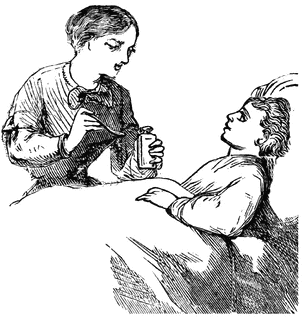
mother offering child medicine

Be grateful for the medicine–it’s good for you.

Rejection is just about the hardest thing to cope with when you decide you’re going to become a writer, but it’s something that you need to learn to accept graciously. When that rejection letter first comes, you are often overwhelmed by feelings of resentment, anger, and frustration. You might lash out, calling the editors idiots or saying that the publisher doesn’t know what good writing is. You might despair, consider yourself a failure, or even give up writing.

But here’s the truth–you were meant to be rejected, at least in this specific instance. Continue reading

Denial is more than a river in Egypt

Sorry for the corny post title. I’m starting to evaluate why my novel manuscript was rejected in preparation for revising it. The truth is, parts of it are original and thought-provoking, but parts are outright terrible.

1) I need to spend more time developing my setting and characters. My beta readers told me my characters were appealing, but are they believable? I’m not so sure. And the setting could be more convincing. I’m going to do some mapping out of additional material to flesh things out, plus do a few strategic cuts (or changes) to make each more consistent with their inner logic.

2) It’s too short. Yes, I am a champion of short novels, but this novel is TOO short. I need at least another 12,000 words so the speed isn’t so breakneck. In retrospect, there are plenty of scenes alluded to in conversation or flashback that could be fleshed out so there is more showing and less tell.

3) Parts are too pedantic. I’ve been reading some books which take a similar approach to serious topics (see previous post here), and have recognized that I could write my little sci-fi fable with a little lighter hand.

4) The book doesn’t always convey the exact message I intended. I think I changed my outlook a few times in the process of writing, and it shows. I have to have more focus and consistency.

I’m not really ashamed that my book is less than perfect, but BOY I’m glad I didn’t follow the advice of people who told me to self-publish. At least there are fewer than 10 people who have read the whole thing thus far.

EWN3DPDHS62A

Bitter with a touch of sweet

It’s the Three Weeks. For those in the know, this period (from the 17 of Tammuz through the 9th of Av) are historically the three saddest, most unlucky, dreadful weeks for the Jewish people. Both Temples destroyed. Declaration of the First Crusade. The Jews expelled from England. The beginning of the Spanish Inquisition. The deportation of the Jews of the Warsaw Ghetto to Treblinka. Bad, bad stuff.

My bad stuff does not compete. But of course, this had to be the week when I received a rejection letter from the first publisher I sent my novel to. In the end, it might not be bad news (maybe it’s sub-par, maybe the next publisher I send it to would be a better match…), but it feels like it right now. I’m not really down in the dumps–probably because of the 5 month delay–but it’s still a disappointment.

On the other hand, it’s tempered by some great news. I IY”H expect to have a short story in Binah BeTween this week, with a few other pieces placed for publication soon. As soon as they reach newstands, I’ll let everyone know.

How to Cope with Rejection When Your Colleagues are Coping with Success

“Expect rejection.”

     That’s what I was told as I entered the field of the professional writer. Sure enough, the vast majority of us do experience it—and in varied and often humiliating forms–and I was not exempt. I no longer sulk for days if I receive a rejection later (although it might cast a fog of discontent over an hour or two). The more mature of us move beyond tolerating rejection and even learn to appreciate it, and maybe someday I’ll reach that stage. Recently, however, I discovered a facet of the rejection experience that has been less commonly addressed, but needs some attention.
    In the space of a few days, two of my colleagues received contracts for their first books. These are two hard-working artists with talent and skill, who worked very hard to reach this point. I’d shared all the ups-and-downs of these particular manuscripts, so each phoned with their good news soon after they received it.
Meanwhile, I’d been tapping away endlessly on my first novel. I had come to a point where I feared it was unpublishable. What made it worse was that I’d been so preoccupied with writing that novel, I’d sent out far fewer pieces of writing than usual. Not one submission had resulted in a sale. I’d been feeling stuck and frustrated that week when my friends phoned with their exciting book deal news.
     In this situation, I had to make a decision.
     I could have hung up the phone and sneered, “But his book isn’t any better than mine!” or “Why is it always someone else?” I could have given the cold shoulder to my recently-successful friends. But the pleasure would be tiny, and it would be brief. Worse, it could cause the loss of a collaborator, colleague, or friend.
     But there was another choice. It’s best described by one (Yiddish) word: farginen.
     To fargin is the opposite of schadenfreude. Whereas the sufferer of schadenfreude delights in the misfortune of others, the person who fargins another delights in their good fortune.
     There is a tendency in artists of all kinds—writers are not exempt—to experience envy, envy in a deeply unattractive shade of green. Somehow, someone else’s success feels like it has prevented your own. Or maybe you believe your work is more deserving than your friend’s.
     You hear about “fair weather friends,” but some people are “foul weather friends.” There are individuals who like having other people around only when they can feel equal or even superior to them. They feel life is a competition, and they always want to be the one on top.  Taking pleasure in someone else’s successes and good fortune, regardless of your own state of being, is just as much of an expression of unconditional love as is sticking it out with a friend in need.
     To be fargin isn’t always a spontaneous emotion. In most people, it requires practice. You remind yourself that your friend’s success doesn’t prevent your own. You cheer for your friend. You spread the word about their new project. You buy the book as a gift for other friends. You let their success remind you that yours is possible at a future date. After all, G-d can hand out as many book deals (or sales or whatever) as there are people, all at the right time. 
     The more you practice this spiritual muscle, the stronger it will become.


(Update: I wrote the original draft of this piece a couple months ago. Don’t worry–I got some writing/coaching gigs after the dry spell.)
How to get back into the swing of things after taking a vacation from writing

Checklist on clipboard
I took some time off from posting to concentrate on Passover preparations…and then another couple weeks off recovering. My brain was so focused on errands and checklists, and my body was so exhausted from scrubbing, that I pretty much couldn’t write at the end of the day, not anything coherent anyway. I had several manuscripts under review by editors, so I thought it would be best just to step back a bit from cranking out stories and submitting them.

It was strangely relaxing to stop writing. While I love to write, things were getting jumbled in my head, ideas tangled up, and I was losing focus. I’ve always been a person whose problem is too many ideas, not too few. But it was getting to the point that sitting down to write was like opening up the doors to one of those closets where people just keep shoving things in wherever they fit, and you’re left fumbling for your navy pumps in a mess of fluffy pink sweaters, old luggage, and forgotten handbags that really ought to be sent to Goodwill. Where to start?

Plus, my writing was feeling less joyful. When writing becomes your job, and you expect yourself to produce something (hopefully brilliant) every day, it can become a chore instead of a pleasure. When most of your writing is done at the end of a long day of homemaking, it just turns into one more thing to check off your to-do list. A succession of rejection letters hadn’t helped the situation.

During Passover, I found extra time to lavish on my husband and children, without worrying that I was being a slacker or would miss a deadline (even a self-imposed one). Since most of the publishers I deal with are Jewish ones, I figured they’d all be out of the office, too.

However, my vacation had to come to an end some time. I belong to a critique group, and with a meeting coming up, I had to get back to writing. I forced myself to sit at the computer. My first couple attempts didn’t go anywhere, and I felt a bit demoralized. Thankfully, some wonderful helpers were sent to me from Shamayim (Heaven). Totally unsolicited, two friends told me that they like my writing. One particularly focused on my quirky way of looking at things in a way that’s humorous but true. This made me reconsider what I had been attempting to write.

I think that one of the problems with my recent attempts of writing was that I was trying to write what other people have successfully sold, as opposed to staying true to my own voice. Half-submerged anxiety about pieces that hadn’t sold because they didn’t “fit in” with publisher’s expectations must have led me down the wrong path, and a little reflection set me straight. I ditched the stuff that wasn’t really “me,” and returned to my uniquely wacky and off-beat voice. The ideas are beginning to flow and I’m feeling more optimistic.

The Providential arrival of a complimentary email from an editor contributed to the general upswing, too. If this particular editor loved my piece, I must be good!

A Writer’s Blues

Currently, my least favorite words to hear (of a professional nature) are, “Do you have a second book out yet?” My honest answer (despite many close calls and lots of magazine work) is still, “No.”
I just turned in two more pieces to a magazine editor today, and received timely payment for another piece just before Shabbos. Magazine work is good for me. To keep things in perspective: I’ve published more in the last year than in my entire previous writing life put together, and I’m getting paid for my work. I’m learning new stuff by writing new stuff with new people, and audiences are reading it!

However, when I tell people, “Sorry, no second book yet. But I’ve been writing for magazines,” most people glaze over. If it ain’t a book, it doesn’t count
Lately, I’ve written several pieces which were really good but when friends and colleagues have read them, they’ve said, “It’s awesome, but no one will ever publish it.” I don’t want to write what everyone else is writing, but book publishers (especially in the current market) are afraid to take risks.
I’ve saved up a lot of rejected book manuscripts. I rewrote a few for the magazine format, which is a little more forgiving and a lot easier to break in to, and a couple of them sold. Another, I’m holding on to, because I think it’s only right for a picture book, and I think it might sell after book #2 proves my work can sell well, if that ever happens.
I know it’s great publishing in magazines, and I hate being nudged by people about when my next book will be coming out. Part of the problem is this: I still want to sell another book. Books endure. They get read over and over. They generally do not end up in recycling bins.
I’m giving up on picture books for now. I have a LONG short story (more a novella) that I’m considering rewriting as a short novel for Jewish teenage girls.
Genre: sci-fi/fantasy. Probably will get rejected anyway. -sigh-