Seeing the world through a writer’s eyes

I’ve been thinking a little bit more about my theme of a couple posts ago, “how to be funny.”
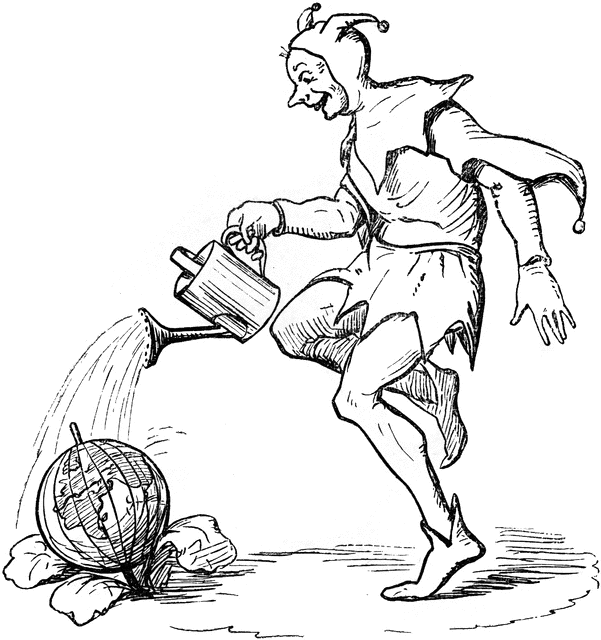
jester

A good jester will find humor in any situation, not just those that are obviously funny.

One of the steps to writing funny is seeing funny all around you. You can look at almost any situation and find something funny in it if you relax and try to experience it through calm, judgment-free observation.

A few months ago, someone (it might have been Erika Dreifus) pointed out this opinion piece by Silas House in the N.Y. Times:

We are a people who are forever moving, who do not have enough hours in the day, but while we are trying our best to be parents and partners, employees and caregivers, we must also remain writers.

There is no way to learn how to do this except by simply doing it. We must use every moment we can to think about the piece of writing at hand, to see the world through the point of view of our characters, to learn everything we can that serves the writing. We must notice details around us, while also blocking diversions and keeping our thought processes focused on our current poem, essay or book.

This way of being must be something that we have to turn off instead of actively turn on. It must be the way we live our lives.

Some people take this kind of remote observation a bit far. Silas House argues that the majority of a writer’s mind should be working on literary pursuits at any given time. I’d disagree. I try to turn this part of my brain off on Shabbat, during conversations with loved ones, and on date night, too. The key is not to remove yourself entirely from life around you, but to be able to see it calmly with a portion of your mind at will.

But that doesn’t mean that when on a stroll with my kids and I’m admiring your garden that I’m not noting which flowers are in bloom at this season so I can work them into the setting of my work in progress.

There’s a story Continue reading

For writers: 5 ways to be funny

Stripped Hyena

If you play your cards right, you’ll have them laughing like hyenas!

It’s been a week and a half since Purim, so I’ve gotten lots of feedback about this year’s Klempner family Purim Spiel. My husband and sister (fellow contributors) agreed with me that this year’s was less funny than last year’s, but we seem to be in a minority. As I mentioned last year, since I began writing professionally, my little hobby now feels like work, and I avoided cranking out a complete rough draft until the week before Purim.

And then, I deleted several stories at almost the last minute. They just weren’t funny enough. So, I prayed–yes, that’s what this professional writer with a Master’s Degree and a generally pragmatic outlook on life did–I prayed for new ideas. And G-d sent some!

Besides relying on Heavenly Intervention, there are other ways to be funny. Without further ado:

5 Ways To Be Funny Continue reading

My 5 Favorite Things Currently on the Web

I spend most of my time on the internet doing work, but every once in a while, I stumble upon something I love and have to keep coming back for more. Here are links to my current favs so you can check them out and get obsessed, too.

1) Space Rabbi – I love the brothers Taub and have enjoyed their various projects on Chabad.org for years. Episode 1 gets off to a slow start, but it’s all wackiness from then on, from the retro “futuristic” design elements, to the HAL references, to the bizarre characterizations of all the electronic gadgets that come to life and interact with Rabbi Blastoffski.

Yes, the main character is actually called Rabbi Blastoffski. How cool is that?

2) Pop Chassid – Currently, my favorite Jewish blog on the internet. Elad Nehorai reflects on Judaism, Chassidus, the arts, and modern life. Not only are his posts insightful, but he has some wonderful followers who post great comments.

3) Hanan Harchol – I first got wind of this guy through a bit he had up on Aish.com.  Most of the videos are animated dialogues between Hanan and (his impersonation of) his father and contain reflections about Jewish philosophy. Utterly charming and thought-provoking.

4) Verplanck – I’m not sure how long these guys are going to be around, because they need to raise funds for their project, but part 6 of their Orthodox online comedy is simply hilarious. (Although you probably need to be religious to get the jokes.) It’s awesome if you’re home sick and are too old for Agent Emes. You will laugh yourself healthy.

5) Shtar – Because they rock. Literally. (Okay, sometimes it’s more like hip-hop. Or maybe techno. Or maybe just cool.) “Wonderland” should be used in commercials by the Ministry of Tourism to encourage travel to Israel.

(My first runner-up is G-dcast, video interpretations of Jewish texts that aren’t always Orthodox, but always creative. Check out Avoiding the Mud for a Chassidishe meise, or The Rise of Yavneh for the story of Kamsa and Bar Kamsa and destruction of the Temple.)

How to write funny: what you can learn from Isaac Asimov

Asimov on Humor

A must-read for anyone who wants to write humor

When I first married my husband, I was delighted to discover among his possessions a copy of Isaac Asimov’s Treasury of Humor. I had read the book in high school and enjoyed reading it again, this time discussing it extensively with my husband.

Not only does this book contain jokes–great, classic ones–but Asimov explains why they’re funny, how to tell them, the origin of them, and if there are different versions. He explains the differences between shaggy dog stories, puns, black/gallows humor, and so on, and what makes each type tick. Asimov does this all in a chatty way that reminds you of your great-uncle shmoozing with you–it’s just so much fun.

Flash forward a few years. Continue reading

On Writing About Writing: a guest post by Miriam Hendeles, author of Mazel Tov, It’s a Bubby!

Mazel Tov! It's a Bubby!

Miriam’s Book!

Today’s guest post is from my partner in crime writing, Miriam Hendeles.

What do writers write about? We write about our lives and our families. Some of us write about our struggles and triumphs. Others write about philosophies and opinions; hope and dreams.

We tell stories, and conduct interviews; we compose lists and craft essays.

We even write about “Writing.” Now what is there to tell, conduct, compose and craft about Writing?

So much. We can write about the writing process, solutions to writer’s block, publishing opportunities, strategies for success, online writing techniques, SEO, PLR and myriad other acronyms. Bloggers and gurus craft advice to the masses on how to become the most polished, pithy, and popular Writer. You see, many writers choose to write about Writing, because if we write about Writing, we know we are guaranteed an audience, comprised of the following loyal and faithful readers:

Writers. Wannabe writers. Bloggers. Publishers. Agents. Editors.

But when we do not write about Writing? Then who is our audience?

Random Interested Persons of Non-Writing topic.

For example, Continue reading