Do writers hibernate? How long winter nights might affect your work habits

In the last couple weeks, my productivity level has dropped dramatically. At first, I couldn’t tell what was going on with me. Was it because I was fighting a cold? The outcome of my flu shot? Too many days with a kid home sick or Thanksgiving vacation?

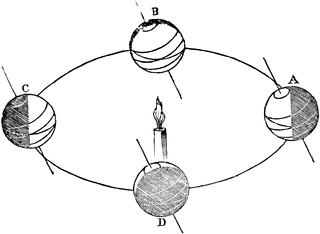
the four seasons experiment

an experiment to demonstrate the change of seasons

Then I realized that this happens to me every December–the winter doldrums. Like many others, the lack of daylight in the winter months drops my energy level drastically. I feel like a bear who wants to return to my cave to hibernate.

It’s harder to focus. I’m working more slowly, and I’m a mite less sharp. For someone who likes to accomplish a lot each day, it’s hard not to be disappointed with myself. It’s hard not to feel like a dummy when your mind goes all fuzzy by mid afternoon, and a mild case of the blues makes it hard to be my normal optimistic self. Continue reading

Early birds and the people who hate them–the writing habits of a morning person

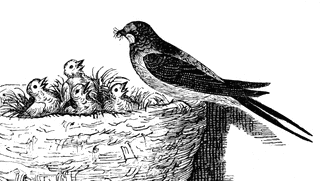
Swallow feeding worms to her chicks

I may be an early bird, but I promise I don’t feed worms to my kids for breakfast.

I’m almost ashamed to admit it, but I am a morning person. Why the shame? Because I have discovered that there is nothing that night owls hate as much as the behavior of us early birds. And it seems that there are a lot of night owls around, judging but the fuzzy eyeballs cast in my direction at 7 am, when I smile and bounce and chirp, “Good morning!” at them.

When I lived in that sleep-deprived state induced by having an infant at home, my natural biorhythms were completely disrupted. Continue reading

Flashes and foraging: where story ideas come from

I was reading this interesting little article a while back about the flashes of inspiration that triggered 10 authors to pen their most classic works. The article really focuses on novels that arose out of a spontaneous image or idea that popped into the author’s head. Perhaps the most dramatic was Gabriel Garcia Marquez’s inspiration for 100 Years of Solitude. His sudden insight prompted him to turn his car around and drive his family home to work on his new book instead of continuing towards the beach vacation they’d been headed for.

Now, I recognize that many stories are born that way–bolts of lighting unexpectedly sent from Above, and so on–and it has certainly happened to me before. An editor will select a topic for me to write on (1200-1400 words by next Thursday on this theme, please!) and I’ll sit stumped about how to approach it in some way that isn’t stale and predictable. Hours (or days) later, I’ll try to get back to sleep after someone’s car alarm has gone off and–zing!–HaShem will pop an idea into my brain. (Insert here a sound effect to emphasize the moment.) Sometimes, a detail of a conversation or picture in a book will provoke an entire story to arise almost fully formed from my imagination, with little effort on my part. Yes, this does happen.

Most of the time, however, I forage for ideas. I’ll flip through science news for a new discovery or technology that sounds too impossible to be true. I’ll read three novels all of the same genre or subject, and then compare them. I’ll snip articles out of my HaModia or Mishpacha or Ami. I’ll browse the pages of my journal for wacky things my kids do or things kids fight about, or scribble clusters of words that a topic evokes from my mind.

Once I collect these ideas, they require careful combination. At times the way to do this comes through hard work, strategically arranging plot elements based on the needs of the assignment. Other times, I sit and contemplate them and then let the ideas sorta drift together until something sounds right. I’ll meld a new technology with a situation my children recently dealt with. I’ll transport the subplot from a novel I liked into a fantastic setting, then give it a different ending. Sometimes, after sampling the rough draft, I’ll recognize there’s a missing ingredient and have to hunt around for something that adds just the right flavor. It’s not like there’s no Heavenly assistance involved…it’s just a lot more dramatic, with more input on my part.

In the HaModia Sukkos 5773 story supplement (out today!), you’ll find a piece by yours truly that was generated in just such a way. Discovering that earthbound scientists will likely be exploring new planets via remote-controlled robots, I filed it away for future contemplation. (This isn’t the original article, but it was about the same subject.) After a lot of publicity last winter and spring about how the internet and smart technologies affect human relationships, I revisited the initial idea and found a way to blend the two concepts into an entertaining (I hope!) sci-fi story. I’m hoping the readers enjoy it. It will be my first piece for adults in a magazine with an international circulation!
“How do you do it?” How to write while you’re a stay at home mother

People often ask me this question: How do you find time to write? Other moms work outside the home, sometimes full-time, yet my extremely-part-time and mostly at home writing puzzles them. Life as a FT mom is so wild and wacky, my head buzzes with ideas that could make great kids’ books. Doesn’t yours? This is how to get the ideas out and coherently on paper:

First of all, I have a giant notebook. Inside, I write lots of lists. Some titles you’ll find in my notebook: funny things kids do; annoying things kids do; what kids fight about; excuses they give; sweet things kids do. Don’t just email your girlfriend or tell Mom or Hubby about the craziness you endured during the day–write it down, even just in shorthand.
Also, after a workshop by Sarah Shapiro, I’ve learned to listen and practice writing dialogue. She says to do it daily, but I’m not that good about it. Just copy down a short conversation every week or so, and you’ll get practice.
Read LOTS…then respond in a book club, blog, or by writing a review online. If the book gave you an idea, extend it as far as you can.
No T.V. means more time and more productive time is available in this house.
After you write, revise. Test out on friends by sending your story to them or by joining a writing group. Then revise more according to what they suggest, then re-read to them. Is it improved?
Figure out who publishes similar pieces to yours, get the submission guidelines, then send the manuscript in! You’ll never know if you might have succeeded if you never try.
And remember, rejection letters are good for your middos.