Looking for a gift? 5 New books to consider this Chanukah season, including Red is My Rimon, Chanukah Guess Who?, The Torah Book of Opposites, The Wooden Sword, and The Tempest in the Tea Room

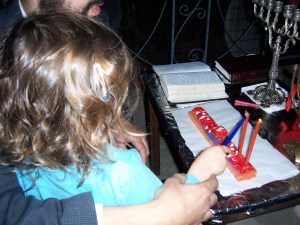
lighting chanukiah with abba

Chanukah is coming! Did you remember to get this cutie a gift?

In the upcoming Chanukah edition of CitySpirit Magazine (available here in L.A. within the next week or so), you’ll find reviews of four books either authored or illustrated by local L.A. talent. Any of them would make perfect gifts for Chanukah for kids. The books I reviewed for CitySpirit (with links to their pages on Amazon) are:

Red is My Rimon

Chanukah Guess Who?

The Torah Book of Opposites

The Wooden Sword

If you’re looking for a Chanukah gift for a teen or an adult reader, why don’t you check out Libi Astaire’s newest The Tempest in the Tea Room.  Continue reading

Finding Inspirational Words from Sarah Shapiro–Defining Jewish Writing, Part 2

A couple of weeks ago, some of the comments on a post I wrote about defining Jewish writing revolved around the introduction to Sarah Shapiro’s All of Our Lives. I took a workshop with Sarah–who writes, edits, and teaches amazing writing workshops that have inspired many fledgling Jewish writers–and have a lot of respect for her opinions, so I borrowed the book from a friend (thanks Miriam!) in order to more accurately represent Sarah’s opinions here.

Sarah’s essay “The Writer’s I” reflects several of the issues I discussed in my original post. Jewish Writing can be defined by the author’s identity, by its subject matter, or can be considered a completely arbitrary label. She personally feels that “all three are right,” but admits the difficulty in establishing a single definition.

Sarah goes on to say that attempts to identify or define specifically Orthodox Jewish writing are even more complicated. Continue reading

Jewish magazines still jockeying for market share

Hamodia front page.jpgYated Neeman
In the last few years, English-language Orthodox (charedi) periodicals have proliferated. (A little disclosure is appropriate here–I’ve written for both Aim! and Mishpacha Junior, am a long-time subscriber to HaModia.) Interestingly, as new publications show up, the older ones change formats (sometimes repeatedly) in order to improve their market share.
For example: HaModia came out with an online edition and now so has the Yated (honestly, I don’t know which happened first, but I heard about HaModia’s first). HaModia came out with a unique format for the kids’ mag that competes more with Weekly Reader than with any other charedi publication and sets it apart. Supplements targeted towards kosher “foodies” are in vogue almost across the board. Most recently, I noticed that Binah Bunch is now divided in two–one half “Clubhouse” (which seems designed to compete with Mishpacha Junior) and one half a tween magazine (more similar to Aim!).
Watching these “renovations” is sometimes entertaining (trying to guess the reasons behind different editorial decisions, for example), but it’s also a little depressing because these magazines HAVE to compete in order to make money. I enjoy all of them, but I can’t afford to purchase all of them on a regular basis. Neither can the average Jewish consumer, so these magazines and newspapers have to compete for our subscriptions.
It also has implications for us writers. If there’s more variety out there, there are more niches writers can develop for their writing…which is fabulous. But if everyone just tries to do the same thing, just better, (how many food magazines do we really need?) writers get locked in. I’ve seen a little of both in these format changes.
On a happier note, I think the competition has forced all the magazines to strive for a level of excellence that I don’t think has been reached before. Not only are there more magazines, but they are better than ever, I think.

What is the responsibility of the Orthodox Jewish writer?

Published under pseudonym by a secular company, a frum woman recently authored a book about molestation in a Chassidic home. Judging by reviews, the author wrote a realistic description of the community she portrays outside the abuse issue. Many reviewers even found her portrayal of Jewish customs compelling and beautiful. However, the main thrust of the novel is that this insular community covers up child abuse, thus aiding and abetting the abuser. Another troubling aspect of the book is that it is marketed towards teens.

Clearly, the author wants to publicize what is a grave issue for any community. However, no frum publisher would touch such a book. The anonymous author decided to submit to a secular publisher. And there the trouble starts. Now, most of the readers of this book are not even Jewish. A minute problem in terms of numbers (not severity) turns into a horrifying generalization about the Chassidic community in the eyes of many readers. She has essentially thrown her own community under the bus in the hope someone will read the book and report abuse. Yet the very community whose eyes the author wants to open doesn’t generally even read books published by secular publishing houses!
The author makes it look like the entire Orthodox community pretends molestation doesn’t exist and would avoid reporting it at all costs. Perhaps that was the case in the past, but you can’t make such a statement today. There are some people who turn a blind eye on abuse in the Orthodox world, just as there are such people in the world at large. However, there are currently Orthodox organizations equipped to deal with child abuse, and many (if not most) Orthodox people would report the crime and support the victim.

Even if the small slice of the Orthodox community portrayed in the book continues to do cover it up, secular readers don’t understand enough to differentiate between Modern Orthodox, Litvishe, Chassidishe, Eidot HaMizrach, etc. They don’t know the difference between Lubavitch, Ger, Belz, and Satmar. Many will assume all religious Jews are aiding and abetting child molesters.
This debacle provokes the broader question: what is the responsibility of the Orthodox writer to her community when she represents it to the world at-large? Clearly, a PR campaign between the covers of a book is inappropriate. Over-idealizing the religious Jewish community is preferable to demonizing it, but it’s still disingenous. It also compromises the complexity of characters in a novel. I think there’s a balance that is difficult to achieve, and I’m always impressed when it is done skillfully. An example of this is the mystery Now You See Me by Rochelle Krich; another is the novel Seven Blessings by Ruchama King Feuerman.
It would be interesting if the anonymous author’s cover ever is “blown”. Will she tell us then how she feels when she sees that her book caused one woman to write the following:

“The author note following this story was even more disturbing, as an Ultra Orthodox she was raised in society such as this. She explains how components of this story were actually experiences that she had experienced in her own life. I try to believe that I maintain a fairly open mind to all ways of life, but I can not say that I felt anything positive about this lifestyle.”
Another writes:

“Imagine growing up in a world where most of your life is planned out for you and where women are little more than things to marry off and produce children. Imagine not having a voice and imagine that no one would believe a word you said, simply because you were a woman?”
Is this (extremely simplistic and inaccuarate) impression what the author intended to leave her readers with?

[Added at a later date: The book’s author has since revealed her identity. Her name was not entirely a surprise, because the writing skill evident in the book and alleged background limited the field greatly. The author won a major book prize and continues to advocate on the topic of abuse. While there has been increased attention since the publication of the book to crimes against children, unfortunately this may have less to do with the book in question, but rather to the death of Leiby Kletzky and several molestation incidents in the news, both in the Jewish community and not.


Upon further reflection, I still agree with my initial statement that the book should not have been published in a non-Jewish setting. However, I think that Jewish publication houses need to step up to the plate and produce books on controversial or distasteful topics. There are Jewish answers on how to react to these situations–answers for Jewish audiences–and they need to be shared within the community. The author of this book desperately wanted people to hear her message so they would act on this tragic shortcoming, but a Jewish publisher wouldn’t handle her book. While several articles in publications like Mishpacha and HaModia (couched in very subtle wording so as to be sensitive but clear) had appeared about molestation long before this book came out, books on this topic and other similarly “immodest” ones have been considered a big no-no, along with many other sensitive topics. Another recent book–on teaching the birds and bees to the Jewish child–was refused by a number of Orthodox presses, so the author self-published. G-d forbid a Jewish parent adopt an inappropriate approach to the “Conversation” simply because they don’t have access to the right book and turned to a secular one.]

fantasy, sci-fi and the Jewish reader

Thanks to my brother-in-law Joshua, I just heard about a wonderful new graphic novel called Hereville. The subject: an 11 y o Orthodox girl fights trolls. With a little research, I discovered that this is currently the #1 Jewish book for kids being sold on Amazon. This doesn’t surprise me in this least. There is a dearth of fantasy and sci-fi books for Jewish kids out there, but there is certainly demand.

Look at the popularity of Harry Potter novels, Percy Jackson adventures, The Dragonriders of Pern, the Circle of Magic series (by Tamora Pierce), The Blue Sword and other books by Robin McKinley, and all those early Heinleins (in his pre-Stranger in a Strange Land days when he still wrote “appropriate” material). Frankly, kids crave these types of books. Why? 1) Kids and teens want to be experience more than their everyday lives. This is escapism from the discomforts of childhood–bullying, homework, parental rule, etc. 2) Kids and teens are still learning to be comfortable with themselves. They have yet to learn many of their personal strengths and often feel inadequate. Many of them hope their hidden talents will “magically” come out and prove them to be special (maybe they’ll even save the world!), a common theme in many of these books.

Jewish kids are no different in these psychological needs. Some frum parents let their kids read secular sci-fi books, but there are a lot of problems with unrestricted access to them. Many fantasy books incorporate pantheism, animism, and avodah zara. Some (His Dark Materials series by Phillip Pullman, for example) are outright anti-religion. Others describe magic as an appealing alternative religion (many Tamora Pierce books).

Sci-fi books also frequently espouse atheism or portray Science as religion. Moreover, many frum people are uncomfortable with idea of life on other planets, though it is not clear that this opinion has a sound basis in our tradition. Another big barrier in portraying the future is that Moshiach must come, and most rabbeim hold He’ll arrive by the year 6000 on our calendar. Finally, the rigors of space travel introduce unwieldy elements into narratives about Jewish characters: halachic times, Shabbos, kashrus, etc. all must be dealt with.

I think we’re slowing coming to grips with these issues. I’ve seen some fantasy and sci-fi in the fiction department on Chabad.org. A few years ago, there was a fun adult novel of speculative fiction by David Shapiro called The Promise of G-d, and an anthology called Wandering Stars which is Jewish, though certainly not Orthodox. On the juvenile literature front, time travel has become an acceptable subgenre somehow–there’s The Devil’s Apprentice and Trekking Through Time. In 2009, a blogger described the 2009 Jewish Children’s Book Writers and Illustrators Conference at the 92nd Street Y. There, participants were told that among the “in demand” topics was time travel, and that one lecture was about writing Jewish books for the “Twilight Generation”.

There was a piece in HaModia for You set in space last year, and currently the Aim tween supplement to Ami Magazine has a serial with a sci-fi mystery called “To the Edge of the Galaxy.” (disclaimer: I co-author it with Beth Firestone). Ami specifically wanted a sci-fi spin on the serial.

And now there’s Hereville. The reviews I’ve seen are great, and the readers aren’t just religious or even just Jews. Maybe the time for authentically Jewish sci-fi and fantasy books has come. It would be my fantasy come true!


great news!

I haven’t been active on my page for a while, but I wanted to share good news with anyone who drops by.

I’ve been publishing articles on the website www.metroimma.com about parenting small children and connection between real-life and classic children’s books.
The new Jewish magazine, Ami, is now available by subscription at http://www.amimagazine.org/ and on the newsstands in NYC and Chicago…hopefully, it’ll be available in all major Jewish markets soon. I’m co-authoring one of the weekly serials contained in the Aim tween supplement (my co-author is Beth Firestone, known for her novel Candles in my Window). It’s entitled “To the Edge of the Galaxy”. The story follows the adventures of an Orthodox family chosen to colonize a distant planet. I’m hoping all you readers up there will pick up a copy of Ami and try it out!

Additionally, Mishpacha Junior magazine published a story of mine a couple of months ago and expects to publish another soon. I’m really enjoying writing for periodicals and will continue to list my ongoing projects.