Kveller writers talk G-d with their kids

The Jewish parenting website Kveller is running a series right now on parenting. They’ve got 5 perspectives so far, and I have to admit I have mixed feelings.

They seem to have picked some extreme situations–a mom who clearly has OCD, a kid who has chosen Communism over Judaism–but also some pretty normal ones, like the soon-to-be dad finally realizes the fate of his unborn child is out of his hands and chats with G-d about protecting him and (this had me laughing both out of amusement and empathy) the mother whose kids imitate G-d saying, “No!” to each and every request she makes at a trying stage of life.

What surprised me most is that so far most of the parents seem to not have thought about what they would say about G-d before talking about Him with the kids. Some of the stories are frankly depressing, like watching the blind leading the blind. Not surprisingly, their fumbling responses get some pretty sad results.

But I just love that a non-Orthodox (at least, not only Orthodox) Jewish website is hitting this issue, which largely goes undiscussed in polite American circles. And we’re getting a real glimpse into American Jewish households to see what’s going on in there.

It’s pretty harrowing.

Sure G-d says, “No,” an awful lot. But what about all the times it turned out good for you?

What about saying, “Thanks, G-d!” every time you experiences a moment of joy? “Thanks for the parking space!” and “Thanks for there being exactly enough cupcakes for us all!” make an impression on kids as much as all those heaven-sent No’s.

What about discussing with your co-parent about how you’ll represent G-d to your kids ahead of the “Big Talk?” Because it’s as much of a Talk as the more famous one, and requires at least as much forethought.

Something that surprised me also was that no one really mentioned sharing books about G-d with their kids. A lot of the what I’ve communicated with my own kids about G-d has come from books and magazines, like  Where are You Hashem?, The Invisible Book, and Hashem is Truly Everywhere.

Do any readers out there have literature they like to share with their kids to enhance their “G-d Talk?”

Soul-bearing writing–writing personal essays that are a little too personal for comfort

Tablet published a new piece of mine today, about the untidy family life of a person who is an Orthodox Jew with relatives who are devout Christians. The comments are busy, and no trolls have appeared so far (meaning that anyone who disagrees with me does so with politeness and reflection).

I’ve published the piece because the problem I described in the article is a surprisingly common one  (among the “baalei teshuvos” who come to religiosity as adults) that most people ignore.

It’s sorta mortifying. This is a problem that is very private for me, and–like many who share it–it is a source of pain that I usually sweep under the rug. I’ve had to explain the absence of half of my family to many people over the years, and it’s never comfortable. Now the entire world can read about it (and share! and comment!).

In general, I don’t write about my family unless it is 100% positive. I felt that this needed to be an exception, in order to support people who share this type of situation. I intentionally omitted the name of my father’s family, and I tried to protect their identities. I wanted not to expose them, but the problem. Nonetheless, one of the commenters pointed out that I was still airing my family’s laundry in public.

I’d love it if readers weighed in here (in a comment below) or in the comments section on Tablet.

<a href=”http://www.makealivingwriting.com/?p=2538″><img src=”http://www.makealivingwriting.com/wp-content/uploads/2013/04/MALW_linkparty1.jpg”/></a&gt;

Play-by-play: The Weird Things that Happen When You Write Under Time Pressure

clock

Tick-tock…Quick, that deadline’s approaching!

Foolish me.

So, as I mentioned last week, I committed to produce a story just three days after Passover was over. I did prewrite before the holiday, and even had started a first draft in longhand (I often do). It was this surprisingly dark piece, written in second-person. A concerned family member was talking to “you,” and “you” (it becomes clear) are suffering from a clinical depression.

When I picked these materials back up after Passover had wrapped up,  the first thing I thought was: ugh.

  1. The tone was too dark, especially for this particular venue (Ironically, the theme I was given was “Put some spring in your step!” Right.).
  2. The second-person thing effectively pulled you in–making the dark subject matter even more depressing.

I felt like hyperventilating. Was I back to square one? With only three days to go?

AHHH!

Continue reading

Seeing the world through a writer’s eyes

I’ve been thinking a little bit more about my theme of a couple posts ago, “how to be funny.”

jester

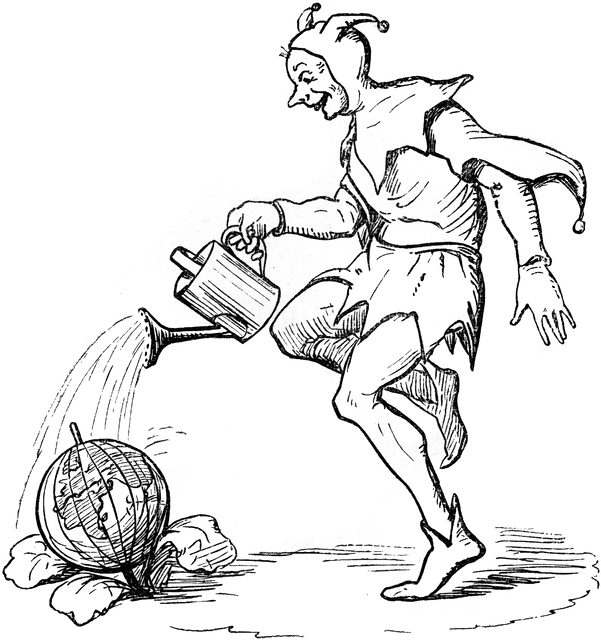
A good jester will find humor in any situation, not just those that are obviously funny.

One of the steps to writing funny is seeing funny all around you. You can look at almost any situation and find something funny in it if you relax and try to experience it through calm, judgment-free observation.

A few months ago, someone (it might have been Erika Dreifus) pointed out this opinion piece by Silas House in the N.Y. Times:

We are a people who are forever moving, who do not have enough hours in the day, but while we are trying our best to be parents and partners, employees and caregivers, we must also remain writers.

There is no way to learn how to do this except by simply doing it. We must use every moment we can to think about the piece of writing at hand, to see the world through the point of view of our characters, to learn everything we can that serves the writing. We must notice details around us, while also blocking diversions and keeping our thought processes focused on our current poem, essay or book.

This way of being must be something that we have to turn off instead of actively turn on. It must be the way we live our lives.

Some people take this kind of remote observation a bit far. Silas House argues that the majority of a writer’s mind should be working on literary pursuits at any given time. I’d disagree. I try to turn this part of my brain off on Shabbat, during conversations with loved ones, and on date night, too. The key is not to remove yourself entirely from life around you, but to be able to see it calmly with a portion of your mind at will.

But that doesn’t mean that when on a stroll with my kids and I’m admiring your garden that I’m not noting which flowers are in bloom at this season so I can work them into the setting of my work in progress.

There’s a story Continue reading

For writers: 5 ways to be funny

Stripped Hyena

If you play your cards right, you’ll have them laughing like hyenas!

It’s been a week and a half since Purim, so I’ve gotten lots of feedback about this year’s Klempner family Purim Spiel. My husband and sister (fellow contributors) agreed with me that this year’s was less funny than last year’s, but we seem to be in a minority. As I mentioned last year, since I began writing professionally, my little hobby now feels like work, and I avoided cranking out a complete rough draft until the week before Purim.

And then, I deleted several stories at almost the last minute. They just weren’t funny enough. So, I prayed–yes, that’s what this professional writer with a Master’s Degree and a generally pragmatic outlook on life did–I prayed for new ideas. And G-d sent some!

Besides relying on Heavenly Intervention, there are other ways to be funny. Without further ado:

5 Ways To Be Funny Continue reading

Throwing down the gauntlet: I challenge you to write something different!

knight in armor

Be careful! If this guy throws down the gauntlet, it’ll probably hurt.

So yesterday I read this post by the Rubber Ducky Copywriter. In it, she posts about her first rejection letter after going out on a limb and submitting a short story. Despite her success as a copywriter, fiction is a new endeavor for her, and rejection hurt.

First of all, I’d like to cheer her on. Despite the rejection letter (and my readers will know I’m no stranger to them), the Rubber Ducky Copywriter did something a lot of us writers don’t do: try something new.

A lot of us avoid writing new things, especially after we find success (especially financial) in a particular niche. I know that it took me a long time to start writing for adults after I’d succeeded with kids’ lit. Other changes were also scary, because they carry risk. What if you invest time and emotions and no one ever publishes it?

But the pay-off can be big.

For years, I focused on my fiction. When I ventured on occasion to write a personal essay, it would inevitably face a quick rejection. Out of frustration, I gave up writing personal essays for a long time.

But, when I came back to it, I did better. My years of practicing fiction helped me hone my storytelling abilities. The first personal essay I’ve had published shows this and found a much wider audience than my fiction thus far has.

So here’s my creative writing challenge:
Continue reading