Different strokes for different folks: How one book can inspire so many others

A while back, someone my husband respects very much encouraged him to read this book:

Stop Surviving Start Living Shafier

Rabbi Shafier’s book, based largely on Mesillas Yesharim

The first time I read Rabbi Shafier’s book, Stop Surviving, Start Living, I just didn’t get it. Not the content of the book — the content was clear as day, written lucidly by Rabbi Shafier, with nice anecdotes and everything. What I didn’t get was that it was based on a book my husband had already read. This one: Mesillas Yesharim, known in English as The Path of the Just, one of the most foundational texts in the Mussar world.

Mesillas Yesharim by the RAMCHAL

The original. So inspirational…and a bit scary for the uninitiated.

Why, I asked my husband, write a book based on another one, a book that you actually want people to read (because you’re such a fan yourself)? Continue reading

Even turtles have to poke their heads out sometimes

What makes Jewish literature Jewish?

In theory, I’m on vacation, make that staycation, with my kids and not posting. However, in the last week, two authors I respect both posted on a topic I’ve contemplated before: what is Jewish literature? Their ideas were both useful and inspirational. It’s worth reading the posts. You can read Libi Astaire’s post here and Erika Dreifus’s here.

On a related note, after a short hiatus, Tablet has started posting fiction again. I’m wondering if the complaints about whether their previous stories were examples of Jewish literature had an effect — both the recent pieces have been translations of Israeli authors.

Do your feelings about an author affect your feelings about his or her work?

Today’s post from Erika Dreifus deserves a look-see. She comments on a recent NY Times essay by Margot Rabb entitled “Fallen Idols,” then adds her own reflections, touching on various writers with Anti-Zionist or antisemitic beliefs, such as T.S. Eliot and Alice Walker (the latter of whom has recently made headlines). I invite you to read both pieces (the links are embedded above).

An interesting aspect of the writer-reader relationship that Rabb touches on is that readers get to step inside the brains of authors. For this reason, there are some Chareidim who only allow their children to read books written by people who are either Orthodox Jews themselves, or are otherwise respected and considered to have good character. While I don’t have this “policy” myself, I do understand that it’s reflecting a genuine concern. Authors don’t have to have a conscious agenda to slip all sorts of allusions to their beliefs in their work. For example, English authors are particularly well known for their antisemitism, which pops up in all sorts of weird places (Georgette Heyer’s The Great Sophy, several works by Dickens, and so on). The science-fiction/fantasy author Phillip Pullman is a proud atheist, and his work reflects this viewpoint.

Then again, if an author uses their money to donate to causes we don’t agree with, a political cause that does not have anything to do with their writing, is that a reason shun their work? Or, to take it a step further, protest their work?

One of the commentators on Erika Dreifus’s blog mentions Orson Scott Card. There are people who want to picket the movie adaptation of his book, Ender’s Game, because they disagree with his political and religious beliefs. (I happen to not agree with the commentator’s assessment of Card, but he’s a good example.) Ender’s Game does not mention the particular beliefs that the protesters find repulsive in Card’s public statements.

Personally, I can see forgoing a trip to the theater, or skipping a book, if you disagree with an author or artist. But a public protest seems excessive to me unless the novel/play/whatever is actively preaching the message you disagree with in that particular piece of work.

How likely are you to read a book by someone whose character is deeply flawed or who espouses beliefs you find repugnant?


Books–still better than TV?

Liel Liebovitz, on Tablet Magazine this week, argues that TV is for Dummies.

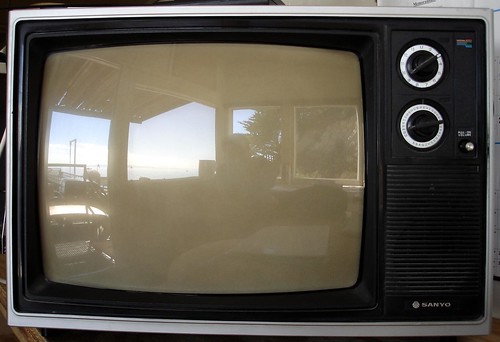
old TV

Photo of Sanyo TV courtesy of Kevin Simpson via Flickr

Like most titles, this one exaggerates Mr. Liebovitz statement: that even if TV has achieved more creative sophistication than ever before, it still fails to reach the majesty of the written word (or something to that effect). In his mind, books are still king. He bases his argument, as I understand it, on the inability of a visual art form to capture the interior life of characters, using a passage written by Henry James as evidence. In the first hour online, Mr. Liebovitz has received 19 comments on his article.

Well, I haven’t had a TV set in my home since 2000, so I can’t really attest to the increase quality of television programming in the last few years. Continue reading