Okay, so I’ve written about rejection a lot of times. Like, a whole lotta times. But since the story I revised and returned to my wonderful editor is still deemed insufficiently engaging by her, I’m coping with rejection again. (Honestly, she gave me the option of cutting half its length, but I have officially washed my hands of the whole situation.) If I have to cope with it, I might as well post about it. Continue reading
write
Rehab for my Lame-O story
Last week, I resubmitted the Lame-O story that stressed me out a couple weeks ago. I found an ending that was logical, got some advice from my husband and my writing buddies about how to make the main character more sympathetic, and cut a lot of material that just seemed to distract from the main focus of the story.
I’m hoping the editor will now find it publishable, because I am simply sick of the story. Continue reading
This story does not stop here!
For the last week, I’ve been struggling with a major rewrite of a short story. Basically, the character was not so likeable, her journey was boring, and the ending was very, very lame.
The problems with my Lame-O story:
This was already the third or fourth draft of the story. I’d originally written it for a particular venue, who rejected it. Later, it was accepted for a different one, conditional on me completing a satisfactory rewrite.
The main structural changes the editors asked for were the removal of one subplot (and the scenes both where it was introduced and where it was resolved) and a new ending.
I cut out the subplot. No problem. I wasn’t entirely attached to it.
But still not done!
Now my story had a new problem Continue reading
Regional dialect in the U.S. – Pardon me for my nerdiness
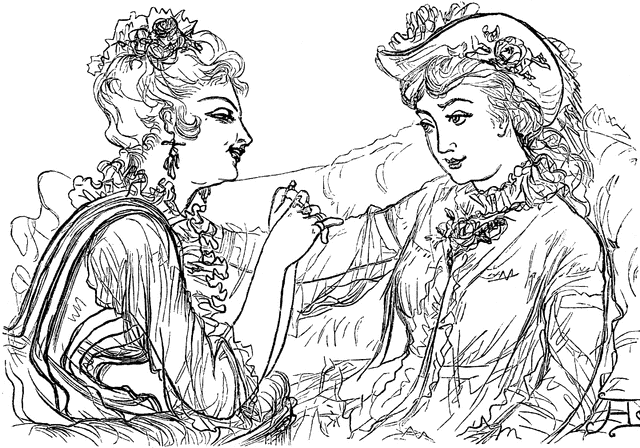
“I’m sorry I laughed at you for calling the ginger ale, ‘Coke.'” “That’s alright, Mabel. I’ll forgive you if you pardon me for laughing when you called the spigot a ‘spicket.'”
Like most people who read and write SF and fantasy, I have a tendency towards nerdiness. I watched Star Trek loyally (until I ditched my TV at age 24). I read graphic novels. I watched foreign films as a teen and young adult and snubbed “Forrest Gump” and “Titanic.” And my idea of a fun day out could easily involve a museum, planetarium, or library.
Yes, I sat at the table with the nerds, geeks, and dweebs in high school. At least the social consequences of nerdiness drop drastically at some point during college.
One of the things I studied in college and graduate school happens to be sociolinguistics, and the topic still fills me with geeky glee, so when Discover Magazine directed readers to Joshua Katz’s work at NC State University, I had to give it a look-see. Continue reading
Helpful tools to plot your story

“Excuse me, sir. Do you happen to remember that story where that guy dies and one of his sons thinks the other did the crime, but it turns out to be the mother instead?”
I was reading a post by Noelle Sterne on Writer’s Digest today where she describes “How to Prevent Predictable Plots.” She cites Georges Polti, who listed 36 classic plots which are constantly used and reused in literature and drama. (Sterne suggests that it’s inevitable you’ll use one of these basic plots, but that you can set yourself apart and introduce unpredictability through the details.)
Intrigued, I went to a description of these “dramatic situations.” Continue reading
I stepped up to the challenge…but did I succeed?
Well.
A couple months ago, I challenged writers to try something new: a new genre, new POV, new publication, anything that would help us to stretch our wings.
Since I threw down the gauntlet, I had to participate in this challenge, right? So I thought about a couple possible places to sub a feature, a genre I hadn’t published in at least two years. Then I brainstormed a few feature ideas, and I sent our queries based on them.
Guess what.
I got nada.
I know that my ultimate success isn’t in my hands, so I feel like I did my share and can take no responsibility for the rest. And I plan to try for features and other new things, too. In fact, I heard about a poetry contest that sounds so interesting, I’m thinking of attempting serious poetry for the first time in many years.
So, is this a success–because I did try something new–or is this a failure–because I didn’t get responses to my queries?
What do you think? (Please post comments below.)

Never made it off the launch pad.
 Rebecca Klempner