How to write funny: what you can learn from Isaac Asimov

Asimov on Humor

A must-read for anyone who wants to write humor

When I first married my husband, I was delighted to discover among his possessions a copy of Isaac Asimov’s Treasury of Humor. I had read the book in high school and enjoyed reading it again, this time discussing it extensively with my husband.

Not only does this book contain jokes–great, classic ones–but Asimov explains why they’re funny, how to tell them, the origin of them, and if there are different versions. He explains the differences between shaggy dog stories, puns, black/gallows humor, and so on, and what makes each type tick. Asimov does this all in a chatty way that reminds you of your great-uncle shmoozing with you–it’s just so much fun.

Flash forward a few years. Continue reading

3 Tricks for magazine writers: How to write on a theme and still make your deadline

keyboard

Before you start to type, you might want to try one of these 3 things.

One of my writing jobs is penning teen and tween stories for Jewish magazines. Before getting this gig, I had to learn an important lesson: most kids’ magazines select one theme per issue, and they are only open to stories on those themes. That means you have to write what they want, when they want it–but you’ve got to still tap into your creativity to make your story fresh, fun, and readable.

NOTE: Writing contests (although many are scams, there are plenty of legit ones) and classroom assignments frequently require that submissions/assignments include a specific topic or theme and have a deadline, as well. You don’t have to write for magazines to benefit from these 3 tips.

Sometimes, I get the heads-up on what story the editor wants on what theme a month in advance. But sometimes it’s a lot less. How do I come up with a story on short notice?  Continue reading

The 2 Best Ways to Improve Your Writing Skills (with a little backup from Anne Lamott)

I’m going to offer some advice today that seems simplistic, so basic as to be ridiculous. Yet recently, I’ve experienced people who have neglected these 2 important strategies that are pretty much guaranteed to improve their writing abilities. So here I am repeating them.

Almost every book about writing offers the following advice. (The wording might vary according to the delicacy of the audience, but the meaning is the same.)

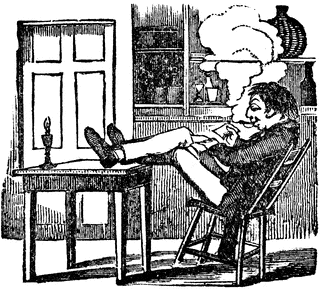
relaxing in a chair

Okay, so you might need more than a chair. This guy isn’t going to get much writing done if he doesn’t pick up a pen!

1) PUT YOUR TUSH IN THE CHAIR.

By this, of course, we learn that if you tell us you want to write, well that’s a nice sentiment. But we know that you mean it if you sit at a desk, pick up a pen (or keyboard) and actually practice writing. Certainly weekly, and preferably daily, you need to write. A human being is only a writer if s/he is a person who writes.  Continue reading

Try this wacky avatar hack!

As part of a course I’m taking through Carol Tice’s amazing website Make a Living Writing, I received the following homework assignment: put an avatar up on Gravatar to pop up whenever I comment on blogs, etc. Now, I could use a photo, but that would just be no fun, so I decided to create my own Gravatar.

avatar

Me, in black and white and nothing on my head to cover my hair. For shame!

I started off by googling “free avatar tools” and discovered a lot of nifty links to different programs to help you make your avatar. The best site I found was Digibody. The results of a picture created with their Avatar-Maker tools look much nicer and more professional than those created with other programs, I found.

However, that left me with a small problem. Or rather three:

  1. The pic was black and white. I thought color might be more eye-catching and engaging.
  2. I don’t leave my house without a hat or headscarf on my head. There was no way to put a hat or headscarf on the picture using Digibody’s tools.
  3. I don’t leave my bed without my glasses. (2 a.m. trips to the bathroom don’t count.) No one would recognize me without some glasses on my face.

Here’s what I did:

becca avatar with color

Thanks to Microsoft Paint, I added my headscarf, glasses, and a touch of color.

  1. I saved the image to as a jpeg onto my computer.
  2. Then I pulled it up in Microsoft Paint (how I wish I had Adobe InDesign or something fancier, but alas, no) and started sprucing up my avatar.

This is my DIY avatar. It’s recognizably me.

What do you think of the end product? I’d love some reviews in the comments.

Coming clean: sometimes you’re supposed to do housework instead of writing

G-d wanted me to do the dishes this morning.

I finished a large-ish writing project yesterday, then pulled open another document to begin the next assignment. I got the first paragraph written, and then every ounce of creativity in my brain dried up. Okay, I had a couple ideas, but they weren’t RIPE. More like literary fetal tissue than the next baby ready to be birthed.

Those who know me or who regularly read my blog know that I rarely get writer’s block. I usually have more ideas in my mind than really is good for me. Sometimes I can’t sleep at night, because my mind is so busy that the ideas are dripping out my ears.

kitchen photo

See this immaculate kitchen? Clearly not mine.

I spent the rest of yesterday taking care of my kids, feeding them and hubby (not to mention myself), and finishing Bird by Bird. (More on that later this week.) Then I had a Tiferes meeting, but before I left, I checked my email. A girlfriend would be dropping by Tuesday morning.

Oh, no.

You see, my back had been out, and then there had been Shabbos, and then I was writing on a “finish ASAP–please!” type deadline. Result–my house was a wreck. Continue reading

Who’s talking? POV, Voice, and Narrator as explained in Anne Lamott’s Bird by Bird

book cover

Bird by Bird by Anne Lamott

There are few books that come up with my writer friends more often than Anne Lamott’s Bird by Bird. In the same way that I feel like I’m not quite smart enough because I’ve never taken Calculus, I’ve felt like a slacker because I never got around to reading it.

And I should have felt guilty–because it’s great.

Okay, so it has a lot of rather vulgar language, but Lamott’s writing is so funny, and yet so useful, that I’m pretty much in love with the book.

One of the interesting bits of advice that Lamott gives writers is a gem she attributes to the author Ethan Canin. The most important way to improve your writing, he says, is to employ a likeable narrator.

Here’s the thing that struck me about this advice: for many, many years, I always wrote in third person. Continue reading