Review of My Very Own Mitzvah Hands–new from Bracha Goetz & just in time for Chanukah!

My Very Own Mitzvah Hands cover

The Latest from Bracha Goetz!

My friends know that I love to support writers and illustrators local to me in L.A., but this time I’m turning to a writer from my hometown (hint, I’m forever an Orioles fan).

Bracha Goetz is a well-known Jewish writer and the creator of the popular “What Do You See” series of boardbooks from Judaica Press. She’s now teamed up with them for a new series, of which the first book just came out.

My Very Own Mitzvah Hands follows two young children as they employ their hands in a variety of activities. This book is similar to the secular Hands Are Not for Hitting, but differs in two significant ways: 1) the emphasis is exclusively on the positive, 2) the actions are directly connected to using our hands to connect to the Almighty through His mitzvos.

Bracha Goetz’s text rhymes nicely, and uses simple, clear language which is appropriate to the youngest readers. Attractively and colorfully illustrated by Malka Wolf, children will find the pictures engaging, and they’ll particularly appreciate the final spread, which recaps all the actions discussed earlier in the book.

I very much liked the underlying message to children–just because your hands are little, doesn’t mean they can’t bring good into our world. This message is empowering, but it isn’t overpowering in its presentation.  My Very Own Mitzvah Hands lends itself also very well to two common parenting experiences:

1) If your child is using their hands for trouble (like creating murals on your wall with permanent marker or smacking the baby), you can use the rhymes in this book to redirect them or to remind them of better things to do with their hands.

2) Sometimes, children complain about being bored. Using this book as a springboard, parents can invite their children to brainstorm things they can do with their hands to alleviate that boredom.

Whether you’re still doing your Chanukah shopping or looking for books at other times of the year, I’d recommend this book. My Very Own Mitzvah Hands refers to several of elements of Jewish practice only engaged in on a daily basis by traditional and religious families, so I would describe the target audience as children 1-5 years from those backgrounds.

Be childlike, not childish–What we can learn about writing from kids

We now—joyfully—have 2 1/2 literate kids in our household. (The 1/2 is only 5. Cut her some slack.) One of the interesting things in my life lately has been watching them become writers, as well. I think we adults can learn a thing or two from their learning curve.

1) Kids enjoy writing about what they like. However, one of the things that makes them better writers is writing about things outside their comfort zone.  It’s a lot easier to get my 10 year old to write about cars or maps, but his writing skills have been built up greatly by writing all those friendly letters, book reports, essays, and so on that get assigned as homework or classwork. When was the last time you wrote something outside YOUR comfort zone? I know professional writers who only write personal essays, or those who have always exclusively written for kids. Try a little of everything. Mix it up. It’ll surprise you.

Watch out! Your bookworm might just become a writer!

2) Kids try to copy what they like to read. They’ll borrow liberally from Captain Underpants, Tintin, and the like. They recognize excellence and strive to emulate it. Of course, we want writers to develop their own voice (and never, ever plagiarize), but there’s nothing wrong from learning from the greats. So do a little pastiche–you’ll get a childlike pleasure from it, and brush up your skills, too.

3) There might be obstacles in the way. The right tools can help. One of my kids has a graphomotor problem. Upon advice, we bought him pencils with fatter leads. What a difference. And now he usually types writing assignments. So much easier for him. Another of my kids is so young, she hasn’t learned to spell yet. Relying on invented spelling allows her to communicate on paper, and she’s so pleased with the result she does a little dance (really, she does). If your inner kid has problems with writing, break it down and see if there’s a solution. Don’t just give up. Continue reading

Using books to build the emotional intelligence of children: Innovative programming at Aleinu/JFS this week

Aleinu Family Services here in Los Angeles will be integrating literature into parenting classes over the next few weeks. Parents attend with children in tow. The Aleinu therapists have selected picture books that effectively communicate social and personal skills to children, then developed discussions and art activities for parent(s) to share with their child(ren) to reinforce those ideas. Many teachers do this in classrooms, and some parents do this will their own children, but this is the first time I’ve seen this in a therapeutic setting like this. Very creative! See the flyer below for details. * UPDATE: THE TIME FOR THE SECOND AND THIRD PARTS OF THE PROGRAM HAVE BEEN CHANGED TO 6-7:15 p.m.

Three books, three lessons

I haven’t been posting to this blog very much recently because I’ve been very, very busy. Among other things, I’ve been writing (I’ll post about that IY”H soon) and reading–reading to my kids, parallel to my kids, and on my own. Notably, I’ve recently read several books that are “message books”–books with a sincere moral message that the author wants readers to absorb. While many such books come across as heavy-handed, these do not. I’m highlighting these books because they definitely represent one of the directions I want to go with my writing–using speculative fiction to explore subjects that might not appeal to children or teens if approached more directly.
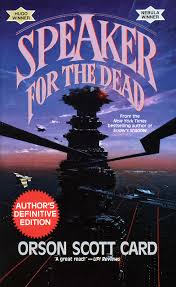
HIGH SCHOOL AND ABOVE Orson Scott Card (as a practicing Mormon, he often introduces ethical dilemmas and messages into his books) is most famous for his first novel, Ender’s Game. I recently read the first sequel Speaker for the Dead, and was sucked in right away by the introduction by the author. (In it, Card says that one of his motivations for writing the book was because he wanted to show a central character who is NOT an adolescent, or a drifter, or any other aloof, single man on the fringe of society who usually stars in sci-fi novels. Rather, he portrays a man ready to create a family, who really wants to build bridges between the members of communities.)

Speaker for the Dead follows the hero of Ender’s Game to the age of 35–although 3000 years have passed, he hasn’t aged because he has spent so much time travelling at nearly light speed, teaching people insights into the behavior of the dead, allowing people to walk in the shoes of people before judging them (as it says in Pirkei Avot/The Ethics of the Fathers). This is his personal tikkun (rectification of error) following his (SPOILER ALERT) near-destruction of the species of Buggers at the climax of the last novel. Now, Ender’s sister and travel companion, Valentine, is expecting her first child. Her travels are over, and he realizes he wants his to end, too. But he has one last mission–to find out why members of another alien race have started killing the scientists (actually xenologists–like anthropologists, but studying aliens instead of humans) who have befriended them and studied them.

This novel provides a nuanced discussion about a new kind moral relativism–not that right and wrong are relative, but that our ability to judge them is. The story is a little focused on one side of the argument, and I was able to guess the mysterious cause of the aliens’ behavior right off–but that might be because I 1) am a writer myself and 2) hold a master’s degree in anthropology. However, I really enjoyed the book and it would be an excellent stepping off point for discussion in a classroom, book club, or around the dinner table.

MIDDLE GRADE Vivian Vande Velde’s middle-grade novel, Three Good Deeds, tells the story of Howard, a rowdy boy who spends several months as a goose. Howard’s transformation is at the hands of the local witch, who feels he is a selfish child more interested in his own entertainment than the needs or wants of others. The only way out of the curse is for Howard to complete three genuinely good deeds.
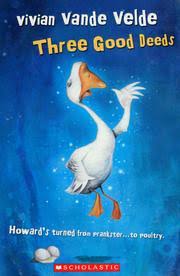
Three Good Deeds uses fantasy, a charming although obnoxious anti-hero, and plenty of droll humor to draw the audience (ages 8 and up) into the story. Despite the light treatment, the message–that a person should be a giver and not a taker–is beautifully interwoven into the text. Warning: the end is a bit of a tear-jerker for softies (it mentions chessed shel emes).

PICTURE BOOK Paul Budnitz’s The Hole in the Middle takes a fantastic approach, as well, to teach its lesson. Morgan quite literally has a hole in his middle. He tries to fill it up with superficial and self-centered pursuits. However, it only shrinks when he does chessed (kindness) for his friend Yumi.

The fanciful, metaphorical style of this book ALMOST overpowers the moral. My 3-year-old and not-quite-5-year-old children laughed at the story outright–it’s just so outlandish. But when I asked the older of the two about the message, she had indeed absorbed it!

I’m wondering if the wackiness of the set-up might make the book so memorable that even if a younger child doesn’t quite understand the message at the time she reads it, she’ll draw on its memory to guide her after she reaches a stage where it’s no longer over her head.

The Hole in the Middle

So little time, so many books to write…

I’ve been busy recently with editing projects, creating a new website (for family campers), and dealing with the general craziness in the Klempner family. That means that I haven’t been doing my own writing very much in the last month. I sat down today to revise something I worked on a couple of weeks ago in my writers’ critique group, and it felt divine. Ahhhh…

Another thing that kept me busy for the past month was an author visit. I read A Dozen Daisies for Raizy just in time for Shavuot & we did a great art project with the students (here are a couple more Raizy tie-in project suggestions…1&2). As usual, the kids wanted to know if there were any more books written about Raizy. I had to explain (again) that in fact I’ve written two sequels, one of which has never been published, the other of which was revised with a different central character and longer format, then published as a short story in Mishpacha Jr. 

I miss Raizy. But rejection letters have demoralized me. I haven’t even tried to write a sequel for quite a while. I’m planning to write another novel this summer, but I think I’ll also try my hand (again) at a follow-up to Raizy. 

I’ve already started brainstorming and scribbling away in my little notebook.