Some clear ideas from the author of Cloud Atlas, David Mitchell

Wednesday’s L.A. Times online contains an intriguing interview with David Mitchell, the author of the novel Cloud Atlas, which has recently received renewed attention due to its film adaptation. Mr. Mitchell’s comments are worth reading, as they illuminate some of the points I’ve been blogging about recently.
On the topic of inspiration (see my original post here), Mitchell says:

I think Mr. Mitchell just blew some of those clouds away. It looks like smooth sailing ahead!

When I go to a place I get a number of free gifts. I get some good lines about the environment. If I was here for long enough, and could have a little time to walk around more thoughtfully, I’ll get five decent sentences. Or halfway decent sentences, or sentences I can make worthwhile. About the place; they’re textual photographs. I’m just in the habit of taking them. Maybe because it was a long time before I had a camera.

Do you jot them down?

Yeah. It gives you something to do in restaurants and not look like a sad sack. And also makes the staff nervous that you’re a reviewer, so they’re nice. You should try it, it works! If you get these free gifts, use them in the text, use them in the prose, use them in descriptions. Put them in and they’re lovely little things to find on the forest footpath of the story, of the book. 

What’s interesting about the process that David Mitchell so clearly describes is that its both what I’ve previously called “the flash” of inspiration AND “foraging” for it. Continue reading

What’s harder than writing 1000 words a day?

Well, the kids are all in school, so I no longer have any excuses. I’ve been sitting at my desk daily and attempting to crank out a thousand words. This seems to be a pretty common goal for writers, and I seem to make it most days. Okay, some days. The days I’m not editing the stuff I wrote previously.

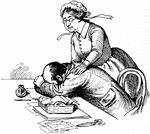
I guess he didn’t make it to 1000 words today.

On Friday, I set myself a different goal. I had written a piece a while back that the members of my writing group liked. However, when trying to market the piece, the best match for the story was a magazine that has strict word counts for each of its departments. I could only submit to one department at a time, and the piece would only be accepted if it met the qualifications listed. At 1500-ish words, my story didn’t fit in either department that matched the subject matter.

I had a choice with this piece. I could either beef it up to 2000 words, or cut it to 800 words.

So, Friday morning, I sat down to cut 700+ words from my article.

The piece had been well-edited before, and there were few passive constructions or the like to tighten up. At various points, I despaired that I would ever succeed. However, the process was extremely educational, and I’ll share a few of its lessons with you.

1) Think about showing vs. telling. I was able to cut several places where I found I was both showing and telling. The showing was enough. Let the readers make a couple inferences. It’s good for them.

2) Consider, “What it the main purpose of the story?” In a novel, there are often subplots or backstory that add to the narrative. Even a short story will often contain these elements. But in the short, short story (yes, it’s an actual genre), and even more in flash fiction, you have room to keep only the story elements that push the main narrative along. Yes, my little subplot was funny. Yes, I’d grown attached to it. But did it support the main idea? Not so much. Thus, it landed on the chopping block. Off went a couple hundred words.

3) Occasionally, adding a line will help you cut a dozen–or even more.I added a new ending (partly suggested to me by my friend Devorah Talia) and was able to eliminate a huge final scene that took up another two hundred words, or so.

Snip, snip!

4) How many adjectives and adverbs do you really need? After reading an article a year or so ago, I’d eliminated many adverbs from my writing vocabulary, switching to stronger, more precise verb usage. I had hardly any adverbs modifying verbs in the article. However, I seem to cling to the use of adverbs that modify adjectives. In this piece, the biggest offenders were the words “really,” “very,” “so” and the like. Also, the improved choice of nouns and verbs removed the necessity of using many adjectives.

5) Read aloud several times. I had read this piece to myself dozens of times already. Reading out loud was a very different experience. I was able to discern unnecessary material more readily, and often could think of natural substitutions for certain wordy idioms I’d used. Breaks in between allowed me to see the words with new eyes each time.

I submitted the piece this morning after cutting one more word. Let’s hope the exercise helps me sell the piece! Even if it doesn’t sell, the editing practice will have served me well.

More crazy ideas from yours truly

I’m sorta infamous among my friends for having lots of whacked-out, creative-but-slightly-off-kilter, usually (but not always) impractical ideas. Here’s my latest:

Rabbi Aryeh Leib Nivin–a motivational speaker/life coach/teacher/rabbi–speaks of everyone having a yeod, a unique life mission with which they are supposed to serve G-d (and people), and a tikkun, a soul correction they have to make in order to maximize their potential (by fulfilling their yeod). Also, a person has short-term lessons that must be learned as stepping stones to reach their yeod and tikkun. This self-development paradigm is very useful for those of us who want to build ourselves (especially now that we’re in Elul, the introspective month that leads up to Rosh HaShanah and Yom Kippur).

“That wacky Mrs. Klempner has some weird idea again!”

As I mentioned in a post last week, I’m going to be rewriting (yes, again!) the novel I wrote last year. One of the areas I want to focus on is character, really fleshing each one out better and more coherently. Many expert authors suggest strategies about developing character such as:

1) Learn about Myers-Briggs personality types and assign one to each of your characters.

2) Consider what each character most wants, most fears, their biggest secret, and what they have to learn.

3) Use drawing, cut-and-paste, or the like to assign an appearance for your character. Brainstorm their likes, dislikes, etc. Paste such items on your character chart.

4) Pretend to interview your character for a magazine.

All these strategies make sense, but they didn’t appeal so much to me. Then I thought, “Hey! Why don’t I apply Rav Nivin’s rules to fictional characters?” Assign a tafkid, a yeod, to each one, and a tikkun, as well?

So that’s what I think I’m going to be doing. Maybe not exclusively, but I think it will bring a Jewish approach to my mostly Jewish characters and subject matter.

Has anyone else out there tried “unorthodox” (pun definitely intended) ways of developing characters or doing other work that usually isn’t done in a “spiritual” or “religious” way?

Denial is more than a river in Egypt

Sorry for the corny post title. I’m starting to evaluate why my novel manuscript was rejected in preparation for revising it. The truth is, parts of it are original and thought-provoking, but parts are outright terrible.

1) I need to spend more time developing my setting and characters. My beta readers told me my characters were appealing, but are they believable? I’m not so sure. And the setting could be more convincing. I’m going to do some mapping out of additional material to flesh things out, plus do a few strategic cuts (or changes) to make each more consistent with their inner logic.

2) It’s too short. Yes, I am a champion of short novels, but this novel is TOO short. I need at least another 12,000 words so the speed isn’t so breakneck. In retrospect, there are plenty of scenes alluded to in conversation or flashback that could be fleshed out so there is more showing and less tell.

3) Parts are too pedantic. I’ve been reading some books which take a similar approach to serious topics (see previous post here), and have recognized that I could write my little sci-fi fable with a little lighter hand.

4) The book doesn’t always convey the exact message I intended. I think I changed my outlook a few times in the process of writing, and it shows. I have to have more focus and consistency.

I’m not really ashamed that my book is less than perfect, but BOY I’m glad I didn’t follow the advice of people who told me to self-publish. At least there are fewer than 10 people who have read the whole thing thus far.

EWN3DPDHS62A

Another existential crisis in the life of my Novel-in-Progress

So, if there was any one thing that every single person I’ve had read the Work In Progress has said, it’s this:

You call this an ending?

Otherwise known as: time to find another way to end this book.

I’ve been avoiding this issue a bit as I’ve been rewriting, because I’m still not sure what would be a better ending. However, I’m almost done resolving the other issues in the book. My new ending must be found. Preferably soon rather than later.

It’s not that I don’t know where my story’s going. Or at least the general neighborhood. It’s just the details.

I’ve been looking for some inspiration online, and have found a few great links to help me out. I’ll share them with my readers, in case any of you are in the same corner as me.

Post from The Other Side of the Story with Janice Hardy http://blog.janicehardy.com/2010/03/end.html

Post from the Creative Penn http://www.thecreativepenn.com/2010/08/09/how-to-write-the-ending/

From How to Write a Book Now http://www.how-to-write-a-book-now.com/plot-development.html

Article by Holly Lisle http://hollylisle.com/how-to-finish-a-novel/