To outline, or not to outline, that is the question.

I just viewed this interesting slideshow on Flavorwire containing outlines by famous writers. I use “outlines” in a broad sense–several were more like graphic organizers than true outlines. I had a weird reaction to the piece.

Usually, I start stories with clusters or notes, not with actual outlines, unless we’re talking something big–a serial (even a mini-serial) or a novel. Sometimes, I cross out and draw arrows to rearrange the elements so often, I end up rewriting the whole thing a few times because I no longer can read my own diagrams.

In most cases, these scribbles remain private. However, I happen to be working on a project right now where the publisher requested an outline first, but that’s never really happened before.

Several of my friends tell me they just start writing. They skip the outlines, diagrams, and charts and words just start to flow.

This slideshow bizarrely made some part of my brain do a superiority dance. “I am in good company with other prewriters,” it seems to say. “Just look at me with the likes of Henry Miller, William Faulkner, Sylvia Plath and Joseph Heller!”

This is utter nonsense. Plenty of writers do just fine without scribbling diagrams, outlines, or the like first, particularly if they are writing short form.

Are you an outliner? Why or why not?

Soul-bearing writing–writing personal essays that are a little too personal for comfort

Tablet published a new piece of mine today, about the untidy family life of a person who is an Orthodox Jew with relatives who are devout Christians. The comments are busy, and no trolls have appeared so far (meaning that anyone who disagrees with me does so with politeness and reflection).

I’ve published the piece because the problem I described in the article is a surprisingly common one  (among the “baalei teshuvos” who come to religiosity as adults) that most people ignore.

It’s sorta mortifying. This is a problem that is very private for me, and–like many who share it–it is a source of pain that I usually sweep under the rug. I’ve had to explain the absence of half of my family to many people over the years, and it’s never comfortable. Now the entire world can read about it (and share! and comment!).

In general, I don’t write about my family unless it is 100% positive. I felt that this needed to be an exception, in order to support people who share this type of situation. I intentionally omitted the name of my father’s family, and I tried to protect their identities. I wanted not to expose them, but the problem. Nonetheless, one of the commenters pointed out that I was still airing my family’s laundry in public.

I’d love it if readers weighed in here (in a comment below) or in the comments section on Tablet.

<a href=”http://www.makealivingwriting.com/?p=2538″><img src=”http://www.makealivingwriting.com/wp-content/uploads/2013/04/MALW_linkparty1.jpg”/></a&gt;

Play-by-play: The Weird Things that Happen When You Write Under Time Pressure

clock

Tick-tock…Quick, that deadline’s approaching!

Foolish me.

So, as I mentioned last week, I committed to produce a story just three days after Passover was over. I did prewrite before the holiday, and even had started a first draft in longhand (I often do). It was this surprisingly dark piece, written in second-person. A concerned family member was talking to “you,” and “you” (it becomes clear) are suffering from a clinical depression.

When I picked these materials back up after Passover had wrapped up,  the first thing I thought was: ugh.

  1. The tone was too dark, especially for this particular venue (Ironically, the theme I was given was “Put some spring in your step!” Right.).
  2. The second-person thing effectively pulled you in–making the dark subject matter even more depressing.

I felt like hyperventilating. Was I back to square one? With only three days to go?

AHHH!

Continue reading

Passover is over. Time to jump back on the wagon!

I’ve written zero, zippo, nada since my limericks on the day before Passover, and I now have three pieces outstanding to editors, the first of which is due on Friday. YOW!

As a religious Jew, I was unable to write for most of the Pesach holiday, and chose not to during the more lenient, intermediate days (chol hamoed), as well. Hence the pile up on my to-do list. This post will necessarily be brief. I’ve got to peruse the notes I scribbled two weeks ago, when I received the assignment that’s due first, and start writing.

I think the vacation from writing was good for me, though. I spent a lot of creative energy on cooking (including trying a couple new recipes, even inventing an awesome vegan chocolate chip cookie that is 1) totally kosher for Passover, 2) easy, and 3) scrumptious) and also just playing with and enjoying my husband and kids. We played hours and hours of Monopoly Deal & Old Maid, and visited fun places in L.A. like the zoo and a local U-Pick farm. I let my husband and eldest son pick most of our outings–the WWII Aviation Museum was an unexpected delight. Letting them be in charge allowed me to relax and let go.

Now it’s back to creative work, but it seems a little less like work after the vacation.

Seeing the world through a writer’s eyes

I’ve been thinking a little bit more about my theme of a couple posts ago, “how to be funny.”

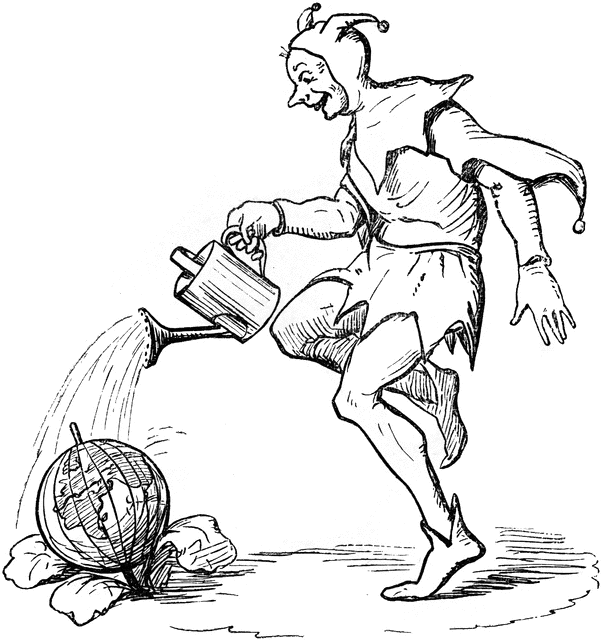
jester

A good jester will find humor in any situation, not just those that are obviously funny.

One of the steps to writing funny is seeing funny all around you. You can look at almost any situation and find something funny in it if you relax and try to experience it through calm, judgment-free observation.

A few months ago, someone (it might have been Erika Dreifus) pointed out this opinion piece by Silas House in the N.Y. Times:

We are a people who are forever moving, who do not have enough hours in the day, but while we are trying our best to be parents and partners, employees and caregivers, we must also remain writers.

There is no way to learn how to do this except by simply doing it. We must use every moment we can to think about the piece of writing at hand, to see the world through the point of view of our characters, to learn everything we can that serves the writing. We must notice details around us, while also blocking diversions and keeping our thought processes focused on our current poem, essay or book.

This way of being must be something that we have to turn off instead of actively turn on. It must be the way we live our lives.

Some people take this kind of remote observation a bit far. Silas House argues that the majority of a writer’s mind should be working on literary pursuits at any given time. I’d disagree. I try to turn this part of my brain off on Shabbat, during conversations with loved ones, and on date night, too. The key is not to remove yourself entirely from life around you, but to be able to see it calmly with a portion of your mind at will.

But that doesn’t mean that when on a stroll with my kids and I’m admiring your garden that I’m not noting which flowers are in bloom at this season so I can work them into the setting of my work in progress.

There’s a story Continue reading