Wavering

NaNoWriMo is National Novel Writing Month, running for the month of November each year. By November 30th, participants hope to finish writing a 50,000-word (approximately 175-page) novel. Some people try to fly solo, but most participants sign up on the official website. The website offers guidance about pacing, tracks your progress, and provides support. NaNoWriMo has resulted in some book sales for participants, but many others say it taught them discipline, skills and persistence that helped them with future projects.

If your book idea is Jewish and for kids, there’s also (mentioned in a previous blog) the “Write Your Own Megillah” event.

Truthfully, I have a few novel ideas out there, and it would be good to have an outside source telling me to crank out a draft in one month. But I’m still working on my last novel, still hoping to sell it, and still have deadlines for my magazine work to meet. Plus, I probably need to add another part-time job to my plate for financial reasons.

So I keep wavering. Should I or shouldn’t I? Should I or shouldn’t I? It’s like balancing two different categories of responsibility.

What’s harder than writing 1000 words a day?

Well, the kids are all in school, so I no longer have any excuses. I’ve been sitting at my desk daily and attempting to crank out a thousand words. This seems to be a pretty common goal for writers, and I seem to make it most days. Okay, some days. The days I’m not editing the stuff I wrote previously.

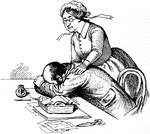
I guess he didn’t make it to 1000 words today.

On Friday, I set myself a different goal. I had written a piece a while back that the members of my writing group liked. However, when trying to market the piece, the best match for the story was a magazine that has strict word counts for each of its departments. I could only submit to one department at a time, and the piece would only be accepted if it met the qualifications listed. At 1500-ish words, my story didn’t fit in either department that matched the subject matter.

I had a choice with this piece. I could either beef it up to 2000 words, or cut it to 800 words.

So, Friday morning, I sat down to cut 700+ words from my article.

The piece had been well-edited before, and there were few passive constructions or the like to tighten up. At various points, I despaired that I would ever succeed. However, the process was extremely educational, and I’ll share a few of its lessons with you.

1) Think about showing vs. telling. I was able to cut several places where I found I was both showing and telling. The showing was enough. Let the readers make a couple inferences. It’s good for them.

2) Consider, “What it the main purpose of the story?” In a novel, there are often subplots or backstory that add to the narrative. Even a short story will often contain these elements. But in the short, short story (yes, it’s an actual genre), and even more in flash fiction, you have room to keep only the story elements that push the main narrative along. Yes, my little subplot was funny. Yes, I’d grown attached to it. But did it support the main idea? Not so much. Thus, it landed on the chopping block. Off went a couple hundred words.

3) Occasionally, adding a line will help you cut a dozen–or even more.I added a new ending (partly suggested to me by my friend Devorah Talia) and was able to eliminate a huge final scene that took up another two hundred words, or so.

Snip, snip!

4) How many adjectives and adverbs do you really need? After reading an article a year or so ago, I’d eliminated many adverbs from my writing vocabulary, switching to stronger, more precise verb usage. I had hardly any adverbs modifying verbs in the article. However, I seem to cling to the use of adverbs that modify adjectives. In this piece, the biggest offenders were the words “really,” “very,” “so” and the like. Also, the improved choice of nouns and verbs removed the necessity of using many adjectives.

5) Read aloud several times. I had read this piece to myself dozens of times already. Reading out loud was a very different experience. I was able to discern unnecessary material more readily, and often could think of natural substitutions for certain wordy idioms I’d used. Breaks in between allowed me to see the words with new eyes each time.

I submitted the piece this morning after cutting one more word. Let’s hope the exercise helps me sell the piece! Even if it doesn’t sell, the editing practice will have served me well.
More crazy ideas from yours truly

I’m sorta infamous among my friends for having lots of whacked-out, creative-but-slightly-off-kilter, usually (but not always) impractical ideas. Here’s my latest:

Rabbi Aryeh Leib Nivin–a motivational speaker/life coach/teacher/rabbi–speaks of everyone having a yeod, a unique life mission with which they are supposed to serve G-d (and people), and a tikkun, a soul correction they have to make in order to maximize their potential (by fulfilling their yeod). Also, a person has short-term lessons that must be learned as stepping stones to reach their yeod and tikkun. This self-development paradigm is very useful for those of us who want to build ourselves (especially now that we’re in Elul, the introspective month that leads up to Rosh HaShanah and Yom Kippur).

“That wacky Mrs. Klempner has some weird idea again!”

As I mentioned in a post last week, I’m going to be rewriting (yes, again!) the novel I wrote last year. One of the areas I want to focus on is character, really fleshing each one out better and more coherently. Many expert authors suggest strategies about developing character such as:

1) Learn about Myers-Briggs personality types and assign one to each of your characters.

2) Consider what each character most wants, most fears, their biggest secret, and what they have to learn.

3) Use drawing, cut-and-paste, or the like to assign an appearance for your character. Brainstorm their likes, dislikes, etc. Paste such items on your character chart.

4) Pretend to interview your character for a magazine.

All these strategies make sense, but they didn’t appeal so much to me. Then I thought, “Hey! Why don’t I apply Rav Nivin’s rules to fictional characters?” Assign a tafkid, a yeod, to each one, and a tikkun, as well?

So that’s what I think I’m going to be doing. Maybe not exclusively, but I think it will bring a Jewish approach to my mostly Jewish characters and subject matter.

Has anyone else out there tried “unorthodox” (pun definitely intended) ways of developing characters or doing other work that usually isn’t done in a “spiritual” or “religious” way?

Denial is more than a river in Egypt

Sorry for the corny post title. I’m starting to evaluate why my novel manuscript was rejected in preparation for revising it. The truth is, parts of it are original and thought-provoking, but parts are outright terrible.

1) I need to spend more time developing my setting and characters. My beta readers told me my characters were appealing, but are they believable? I’m not so sure. And the setting could be more convincing. I’m going to do some mapping out of additional material to flesh things out, plus do a few strategic cuts (or changes) to make each more consistent with their inner logic.

2) It’s too short. Yes, I am a champion of short novels, but this novel is TOO short. I need at least another 12,000 words so the speed isn’t so breakneck. In retrospect, there are plenty of scenes alluded to in conversation or flashback that could be fleshed out so there is more showing and less tell.

3) Parts are too pedantic. I’ve been reading some books which take a similar approach to serious topics (see previous post here), and have recognized that I could write my little sci-fi fable with a little lighter hand.

4) The book doesn’t always convey the exact message I intended. I think I changed my outlook a few times in the process of writing, and it shows. I have to have more focus and consistency.

I’m not really ashamed that my book is less than perfect, but BOY I’m glad I didn’t follow the advice of people who told me to self-publish. At least there are fewer than 10 people who have read the whole thing thus far.

EWN3DPDHS62A

What I was supposed to be doing this summer

I really intended to write my next novel this summer. Really. I have it all outlined. I even tweaked the outlined last week and diagrammed characters, settings, and the like. I did.

But life happens. I have all my kids and the stupendous Mr. Klempner all home this summer, and we’ve been busy tidepool-hopping and museum-visiting and swing-pushing and the like. Also, I had a few deadlines to meet on short pieces, so I haven’t been lazy.

Really.

It might be more realistic to keep outlining and diagramming until the kids all head back to school. At that point, I should have more time to sit at the computer and crank out 1,000 words a day. Plus, I want to set aside an hour a day to revise the recently-rejected previously-completed novel. Then I can justify agent hunting.

I’m trying to be patient with all the interruptions and distractions. Just one more month to go, and I should have plenty time to write.

At least, that’s the theory.

When you write about a place without really capturing its essence

There’s an interesting article by Janet Fitch in today’s L.A. Times discussing the way local (L.A.) writers fail to portray Los Angeles in an authentic way. “L.A. writers still must navigate the entrenched notion that we’re all out here lying by the pool with a margarita in one hand and a phone in the other,” she writes. Failure accurately describe our city in print, Fitch argues, will not only misrepresent the city in the eyes of readers, but in those of its citizens. “To write about this city is in some essential way to create it…An image that is, in its way, as important as the concrete place where people live and sleep and look for places to park” she explains. 

People remember the movie “L.A. Story”–which really is an ingenious satire of life here in the Southland–but seem to have forgotten that satire is about inflation and exaggeration. They remember the bored weatherman prerecording his reports of “sunny, sunny, sunny” three-day forecasts and believe that’s the reality. The reality is more complex–rainy winters, June gloom, droughts. Viewers remember “L.A. Story”‘s superficial actress wannabes and vicious agents, when many Angelenos have no more experience in Hollywood than someone from Wichita. They recall the characters who would rather drive than walk even one block, without realizing that our city maintains a fantastic public transit system which is widely used and growing more popular all the time. Maybe people assume that the average resident of Southern California goes to the beach daily, surfs, and maintains a perfect tan year-round, but they don’t get that the water in Santa Monica is freezing cold even in August, and that many of kids in the inner city never get to dip their toes in because their parents are too busy working two jobs a piece just to pay rent.


I think there are some authors who capture L.A. well. Ayelet Waldman’s Nanny Track mysteries depict many familiar landmarks more or less accurately (although I’ve caught a few geographic inaccuracies). Rochelle Krich manages to depict many L.A. neighborhoods in ways that accurately reflect my personal L.A. experiences. However, I think that by and large, I have to concur with Ms. Fitch’s comments.