Looking for a gift? 5 New books to consider this Chanukah season, including Red is My Rimon, Chanukah Guess Who?, The Torah Book of Opposites, The Wooden Sword, and The Tempest in the Tea Room

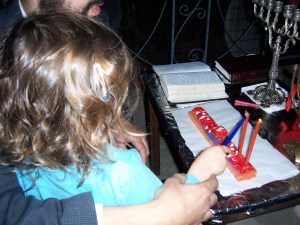
lighting chanukiah with abba

Chanukah is coming! Did you remember to get this cutie a gift?

In the upcoming Chanukah edition of CitySpirit Magazine (available here in L.A. within the next week or so), you’ll find reviews of four books either authored or illustrated by local L.A. talent. Any of them would make perfect gifts for Chanukah for kids. The books I reviewed for CitySpirit (with links to their pages on Amazon) are:

Red is My Rimon

Chanukah Guess Who?

The Torah Book of Opposites

The Wooden Sword

If you’re looking for a Chanukah gift for a teen or an adult reader, why don’t you check out Libi Astaire’s newest The Tempest in the Tea Room.  Continue reading

When is an author a Jewish author? Defining Jewish writing, Part 3

Last week was marked by big news in the book world. Famed-American Jewish author (Jewish meaning author’s ethnicity only, in this case–see previous posts on the subject) Philip Roth has declared that he’s retiring from writing. On the other hand, equally aged and famous American-Jewish author Herman Wouk has just put out another novel. Interestingly, these events didn’t just make headlines in Jewish publishing, but publishing as a whole.

The stereotypical Jew is considered “bookish,” pale due to the amount of time he spends indoors. We are called “the People of the Book.” How is it that Jews became inextricably interwoven with books? Continue reading

The 2 easiest ways to write books yet

 Snowflakes

Picture credit:
http://etc.usf.edu/clipart/24300/24305/snowflakes_24305.htm

For a while now, I’ve been a believer in the Snowflake Method. It was invented by Randy Ingermanson as a way to build your novel in a structured, yet streamlined way, and it does just that. I came late to it, as my novel had started off as a short story, then had expanded to much more than that. I wish I’d got to the Snowflake Method sooner–it would have prevented me from floundering about quite as much. There are other ways to create a novel with discipline and skill–but this has always seemed to me just about the easiest. There’s even a computer program that can help you with the method.

However, there’s new tool that makes creating a book possibly even easier. Building on a successful blogging format, the folks at PressBooks have designed a online tool that adapts the WordPress platform for the purpose of making a book. The writing process becomes as easy as managing a blog, using the same familiar, simple tools.

The webware is free, and can be used collaboratively (multiple authors can have access to your book-in-progress at once, just as with a blog). Each post is roughly one chapter. You can take your document and covert it to a PDF, epub, etc. It can also be used for a POD (Print On Demand) service, if that’s what you want to do. The design of the book is reportedly much more refined than in most do-it-yourself POD products.

I’m skeptical about its utility for novel-writing (although if you want your final product to seem like a fly-by-the seat-of-your-pant serial, where what happens next might surprise the author as much as the reader, it might be okay). It’s too linear, where a good novel is usually built in layers. However, if you are working on a non-fiction book project with colleagues, I imagine it would be outstanding. Check more about it out at: http://pressbooks.com/about

How to find a kosher book: Nifty bit in this week’s HaModia

There’s an article this week about Rabbi Alexander Seinfeld in HaModia, and it mentions almost as an aside that he and his 12 year old daughter have started a website with books for Jewish kids.
I visited the site, and the coolest thing is that it is SEARCHABLE! You can look up selections by subject and by age of reader, as well as title and author. However, it does not contain all the books out there. I’m assuming it is a work in progress and I’m very impressed with what they’ve done so far. It would be a great resource, for example, for those looking to buy a gift for a particular child or looking to stock up for a school or classroom library.
The link is in the list to the right of this blog, as well, and will remain there indefinitely.
In other “HaModia” news…my all-time favorite serial (aside from the one co-written by yours truly…) wrapped up in that magazine last week. Hopefully, This is America! will soon appear in novel format in Jewish bookstores. I really hope so, as it will deservingly find more readers this way.

How to Provide Books to the Needy

About thirty years ago, a linguistic anthropologist researched children’s literary experiences at home in three communities. In her famous article, “What No Bedtime Story Means,” Dr. S.B. Heath wrote about her findings. She reported that children who have books in their home and use them regularly have better literacy in school. Even if a child had books in the house, they had to be used…it was insufficient to have a beautiful book if it was treasured so much to the extent that it was left on the shelf as a display piece.

When I taught in So. L.A. nearly a decade ago, my students (mostly working class and Latino) often had no books of their own. Many didn’t visit the library unless on a school visit, although there was one in the neighborhood. Many parents, cash-strapped and not functionally literate themselves, chose to spend what little money they had on DVDs and video games. Others had a few books. These had often been received as gifts, and remained on the shelf so as not to be ruined (just as in Dr. Heath’s study). Alternatively, my students had books, but these were often t.v. tie-ins of questionable literary merit. And some of my students had parents who wanted to read, but were each working two jobs to make ends meet. These folks were simply too busy and too exhausted to read a bedtime story. Thus, my students often had very few literary experiences before they reached school.

Contrast this with the average Ashkenazy Jew in America: books cover the walls (content and language varies by religiosity); many books are so well used they have actually been “loved to death” and are in tatters; libraries are regularly visited; newborns are given copies of Baby Faces, Brown Bear, Brown Bear, and Blue Hat, Green Hat as gifts long before they can actually hold the books in their own tiny hands.

And people wonder why we are the people of the book?

In steps the wonderful organization, First Book. First Book has partnered with General Mills to distribute free books in Cheerios boxes at selected times of year. Plain Cheerios is a WIC friendly food, so putting them in that particular brand helps them reach their target audience, kids whose families may not be able to afford books, and who may not access public libraries. While these books are printed cheaply, they are high-quality literature. The authors have either won First Book’s annual writing competition for new writers or are established writers themselves…and the illustrations are fabulous.

Here’s a link to this wonderful organization. http://www.firstbook.org/