A couple months ago, I published about being farginen–taking pleasure in other people’s success. So today, I’m going to share reviews of two of my friends’ new books:
I’ve known Judy Gruen for at least a decade, and she’s as funny in print as she is in person, which is saying a lot. Her articles on Aish.com and in magazines are not only funny, but touch the experiences of women everywhere, which is one of the reasons her writing is so effective. Readers can’t help but identify with Judy.
Judy’s Till We Eat Again: a Second Helping is a rollicking trip through Judy’s attempt to shed 15 lbs prior to a reunion. We follow her struggle with conflicting and often wacky weigh-loss advice, the apathy of her spouse, and her children’s hatred of health food. Her self-deprecating humor allows us to laugh at our own propensity to cheat when confronted with chocolate or be jealous of the effortlessly and relentlessly thin among our friends. As the book progresses, Judy gets closer and closer to her momentous reunion, and her misadventures get progressively wackier. Fortunately, Judy survives her ordeal slightly thinner, but with her humor completely intact.
Note: this book is not even remotely an attempt to give accurate weight-loss advice. It’s more like a stand-up act. A very funny one (I almost fell off my bed at one part). Fellow warriors in the battle of the bulge will appreciate the humor and may even loose a couple ounces laughing. Also, some very conservative (little “c”) readers might not approve of a few very slightly racy situations. Until We Eat Again can be found on Amazon.com.
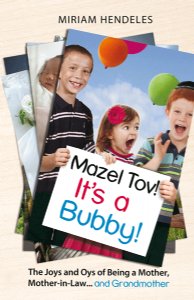
I’ve admired Miriam Hendeles’s work ever since she started out in the late magazine, Jewish Life Los Angeles. After she moved on to Binah Magazine, she became a friend, too, so it’s with great excitement that I’m reviewing her first book, Mazel Tov! It’s a Bubby!
Mrs. Hendeles is a native of New York, but has been an active member of our L.A. community since her marriage. A former Bais Yaakov teacher, she currently works as a music therapist. Even more importantly, she and her husband have—bli ayin hara—raised a family of several boys…boys who are steadily growing up, marrying, and starting their own families, providing plentiful material for her magazine columns. Mrs. Hendeles’s new book is a compilation of those columns, along with additional material touching on the life of the contemporary Blackberry-wielding, Skype-viewing, master’s-degree-holding mother-in-law and grandmother.
Mazel Tov! It’s a Bubby! is an upbeat book about a topic that is fraught with anxiety: the transformation from daughter-in-law and mother to mother-in-law and grandmother. Mrs. Hendeles’s self-deprecating humor and positive outlook set this book apart. She invites us along in her attempts to be a “Model In-Law” and “Model Grandparent.” Her efforts are usually successful, but occasionally flounder. She takes the missteps in stride, poking fun at her foibles, but also seizing the opportunity for introspection and improvement.
That’s not to say that Mazel Tov! It’s a Baby shies away from tumultuous emotions. We waver right along with her when she knows her “new couple” needs space but her hand keeps reaching for the phone. We see her mixed feelings about giving her adult children independence when her opinion just wants to leap out of her mouth. And we witness her nostalgia for her children’s youth as well as her hopes for their future. This is a book that touches the heartstrings as well as tickles the funny bone.
There is another common thread among the essays in Mazel tov! It’s a Bubby! In Judaism, particularly in the mussar tradition, we see the events and the challenges of life as opportunities for personal growth and character development. When the author writes, “Often, individuals refuse to think out of the box, since that may imply a perceived weakness…When we sense that we are spinning our wheels and getting stuck in the same patterns of thinking, perhaps we should ask ourselves, ‘Is it time for a change?’” she’s planting her book squarely in the mussar tradition. Mrs. Hendeles is urging her fellow in-laws and grandparents on to further self-improvement at a stage in life when some give up.
The opening chapters of Mazel Tov! It’s a Bubby! depict the typical milestones that follow the marriage of one’s first child. We smile as the entire Hendeles family debates the various merits (and demerits) of “Grandma,” “Oma,” and “Bubby” before the first grandchild is even born. Our heart flutters when the author reflects, “…something inside me longed for the good ol’ days of PTA meetings, play dates, Mommy-n-Me’s, and strolls to the playground.” And we giggle when the author suggests her teenage son lie down next to her grandchild to help the latter tolerate “tummy time” or when a well-planned, first-time sleep-over goes amok.
As the volume progresses, the stories branch out a bit, with increasing hilarity and insightfulness. The author struggles with keeping family traditions of letter-writing and multi-lingual proverb-spouting at the same time as embracing emails and text messages. She juggles the needs of her teenage son living at home with the young grandchild visiting there. I laughed along with Mrs. Hendeles’s list of preferred traits in mechutanim and her “Diary of a Shadchan Wannabe.” Mrs. Hendeles discovers that middle age—with its less rigorous daily demands—offers opportunities to branch out into new hobbies and professions.
Mazel Tov! It’s a Bubby! would make an excellent gift for the new—or not so new!—mother-in-law or grandmother in your life. However, it isn’t limited to that audience. As a woman whose oldest child is still in elementary school, I found plenty to enjoy in this book.
Mazel Tov! It’s a Bubby! is due in Jewish bookstores and at http://www.israelbookshoppublications.com on September 5th. (A version of the second review that appears above was published previously in CitySpirit Magazine.)



 Rebecca Klempner