A couple of months ago, I discovered an ad in HaModia for a newsletter called “Chevras Chaverim.” It’s a little magazine for Jewish kids with special needs. We’ve received the first two issues, one before Rosh HaShanah, one before Sukkot. Each newsletter contains several “departments,” tailored to the needs of kids with social skills problems, sensory processing disorder, and the like. The organizer loves feedback, and wants kids to submit things for publication. The subscription is free for now and you get it by emailing “Chevras Chaverim” at Chevraschaverim@gmail.com.
jewish
Flashes and foraging: where story ideas come from
I was reading this interesting little article a while back about the flashes of inspiration that triggered 10 authors to pen their most classic works. The article really focuses on novels that arose out of a spontaneous image or idea that popped into the author’s head. Perhaps the most dramatic was Gabriel Garcia Marquez’s inspiration for 100 Years of Solitude. His sudden insight prompted him to turn his car around and drive his family home to work on his new book instead of continuing towards the beach vacation they’d been headed for.
Now, I recognize that many stories are born that way–bolts of lighting unexpectedly sent from Above, and so on–and it has certainly happened to me before. An editor will select a topic for me to write on (1200-1400 words by next Thursday on this theme, please!) and I’ll sit stumped about how to approach it in some way that isn’t stale and predictable. Hours (or days) later, I’ll try to get back to sleep after someone’s car alarm has gone off and–zing!–HaShem will pop an idea into my brain. (Insert here a sound effect to emphasize the moment.) Sometimes, a detail of a conversation or picture in a book will provoke an entire story to arise almost fully formed from my imagination, with little effort on my part. Yes, this does happen.
Most of the time, however, I forage for ideas. I’ll flip through science news for a new discovery or technology that sounds too impossible to be true. I’ll read three novels all of the same genre or subject, and then compare them. I’ll snip articles out of my HaModia or Mishpacha or Ami. I’ll browse the pages of my journal for wacky things my kids do or things kids fight about, or scribble clusters of words that a topic evokes from my mind.
Once I collect these ideas, they require careful combination. At times the way to do this comes through hard work, strategically arranging plot elements based on the needs of the assignment. Other times, I sit and contemplate them and then let the ideas sorta drift together until something sounds right. I’ll meld a new technology with a situation my children recently dealt with. I’ll transport the subplot from a novel I liked into a fantastic setting, then give it a different ending. Sometimes, after sampling the rough draft, I’ll recognize there’s a missing ingredient and have to hunt around for something that adds just the right flavor. It’s not like there’s no Heavenly assistance involved…it’s just a lot more dramatic, with more input on my part.
In the HaModia Sukkos 5773 story supplement (out today!), you’ll find a piece by yours truly that was generated in just such a way. Discovering that earthbound scientists will likely be exploring new planets via remote-controlled robots, I filed it away for future contemplation. (This isn’t the original article, but it was about the same subject.) After a lot of publicity last winter and spring about how the internet and smart technologies affect human relationships, I revisited the initial idea and found a way to blend the two concepts into an entertaining (I hope!) sci-fi story. I’m hoping the readers enjoy it. It will be my first piece for adults in a magazine with an international circulation!
Silence is golden: how to be a writer without harming others
Shimon, the son of Rabban Gamliel, said:
“I was brought up all my life among the Sages,
and I have found nothing as good for the body as silence…”
(Pirkei Avot/The Sayings of our Fathers)
Sometimes a punch is less painful than a verbal blow.
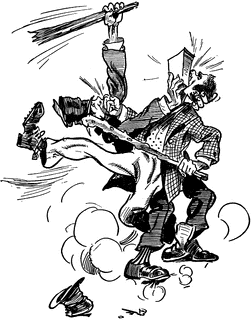
Usually, when we hear about the value of silence, we think about what literally comes out of our mouths. According to Jewish law, before speaking, we’re supposed to chose our words carefully, and use them to teach, to learn, to express love and gratitude, to connect with people and with G-d.
However, as we become more conscious of our speech, we discover how often we use our words to accomplish the opposite. How many people have we offended because we mouthed off with the first thing that came to our heads? How often many times have we said something hasty and then wished we could take it back? Are there people who don’t trust us because we let slip their secrets?
If we’re lucky, we learn–like Rabbi Shimon, above–to value the word that is withheld as much or more than the one that is expressed.
Recently, I’ve noticed that sometimes silence can be golden when it comes to writing, too. It’s striking that many writers out there will justify misusing words for “art” or for profit. In the news lately, we’ve seen writers paid to produce reviews of books and others who write college and graduate school essays for a fee. Both are misleading their intended audiences.
I once read a novel that portrayed a beloved historical figure as a murderer. I guess the author thought it was was okay because it was just “fiction,” but the personage has living relatives. If she were living, she could sue, but because she’s dead, there’s nothing to protect her reputation.
And think about all the memoirists who paint vengeful, unflattering one-sided pictures of their nearest and dearest “because it’s the truth.” It might feel great to tell everyone you were mistreated by your drunken father, but how does your sister feel? And what if dad decides to become sober and you patch things up…how will you be able to retract the words you published for all the world to see?
It’s interesting, but in Jewish law, you can say something that could be harmful to a person’s reputation if it is for a constructive purpose–but ONLY if it is for a constructive purpose. If you have even the slightest thought of vengeance when you write a review, or you take the smallest grain of pleasure in describing your neighbor’s foibles, you are not allowed to share them. Imagine if everyone held themselves to that standard.
With the new year approaching (at Rosh HaShanah), I’ve been considering how much a writer has to say…and what shouldn’t be written. Even the non-professional writer has moments wishing they could push “unsend” after sending an email or drop a fishing line into the mailbox in order to retract the angry letter they’d just posted. Let’s hope we all channel beauty and purity into the world through our pens and our keyboards in the coming year.
More crazy ideas from yours truly
I’m sorta infamous among my friends for having lots of whacked-out, creative-but-slightly-off-kilter, usually (but not always) impractical ideas. Here’s my latest:
Rabbi Aryeh Leib Nivin–a motivational speaker/life coach/teacher/rabbi–speaks of everyone having a yeod, a unique life mission with which they are supposed to serve G-d (and people), and a tikkun, a soul correction they have to make in order to maximize their potential (by fulfilling their yeod). Also, a person has short-term lessons that must be learned as stepping stones to reach their yeod and tikkun. This self-development paradigm is very useful for those of us who want to build ourselves (especially now that we’re in Elul, the introspective month that leads up to Rosh HaShanah and Yom Kippur).
“That wacky Mrs. Klempner has some weird idea again!”
As I mentioned in a post last week, I’m going to be rewriting (yes, again!) the novel I wrote last year. One of the areas I want to focus on is character, really fleshing each one out better and more coherently. Many expert authors suggest strategies about developing character such as:
1) Learn about Myers-Briggs personality types and assign one to each of your characters.
2) Consider what each character most wants, most fears, their biggest secret, and what they have to learn.
3) Use drawing, cut-and-paste, or the like to assign an appearance for your character. Brainstorm their likes, dislikes, etc. Paste such items on your character chart.
4) Pretend to interview your character for a magazine.
All these strategies make sense, but they didn’t appeal so much to me. Then I thought, “Hey! Why don’t I apply Rav Nivin’s rules to fictional characters?” Assign a tafkid, a yeod, to each one, and a tikkun, as well?
So that’s what I think I’m going to be doing. Maybe not exclusively, but I think it will bring a Jewish approach to my mostly Jewish characters and subject matter.
Has anyone else out there tried “unorthodox” (pun definitely intended) ways of developing characters or doing other work that usually isn’t done in a “spiritual” or “religious” way?
Good news and a helping Hand
Great news! My short story, “What Do You Really Want?” appears in this week’s Binah BeTween, the tween supplement of Binah Magazine! It’s available at Jewish bookstores and newstands nationwide. This is my first appearance in that magazine, making it especially exciting for me.
It’s also the story I’ve written on the shortest deadline (other than an academic paper). It proved quite harrowing, because the six days I was given included both Shabbat and the time difference between L.A. and Israel. However, baruch HaShem (thanks to the Source, G-d), the delay ended up working in my favor. Because I started work before the editor got back to me about what genre she preferred (it was Shabbat in Israel, but not here)…the resulting fantasy story was not what she planned, and at first I panicked. Thank G-d, the editor ended up thinking my unexpected approach worked out beautifully and accepted it after all. I hope all of you like it, too.
This leads me to contemplate how much I owe to Heavenly Assistance. When I was offered that piece on a short deadline, I had no idea where I wanted the story to go until an idea “just popped” into my head. Likewise, I was offered another job more recently. The deadline was much farther off, but I still needed to get an idea and get cracking. G-d aligned all sorts of experiences and conversations on the very theme that the editor had selected. Other times, I’ve awakened at 5 o’clock in the morning with the perfect solution to my stalled Work In Progress.
A rabbi once explained to me that the reason people like Dovid HaMelech (King David) were able to accomplish so much was because they knew their own limits and that their ultimate success depended entirely on G-d. They trusted in His assistance and the endowments He gave them (acknowledging the Source of those endowments) to accomplish things most people would give up on. I’m not on that level, but there are times when I look back and go, “How did I do that!” and know I didn’t do it on my own.
Does anyone else out there feel like G-d gives them the final push to get them to their goals?
Bitter with a touch of sweet
It’s the Three Weeks. For those in the know, this period (from the 17 of Tammuz through the 9th of Av) are historically the three saddest, most unlucky, dreadful weeks for the Jewish people. Both Temples destroyed. Declaration of the First Crusade. The Jews expelled from England. The beginning of the Spanish Inquisition. The deportation of the Jews of the Warsaw Ghetto to Treblinka. Bad, bad stuff.
My bad stuff does not compete. But of course, this had to be the week when I received a rejection letter from the first publisher I sent my novel to. In the end, it might not be bad news (maybe it’s sub-par, maybe the next publisher I send it to would be a better match…), but it feels like it right now. I’m not really down in the dumps–probably because of the 5 month delay–but it’s still a disappointment.
On the other hand, it’s tempered by some great news. I IY”H expect to have a short story in Binah BeTween this week, with a few other pieces placed for publication soon. As soon as they reach newstands, I’ll let everyone know.
 Rebecca Klempner