2 Major differences between writing a picture book and writing short stories

So the folktale project turned out to be an eye-opening experience for me.
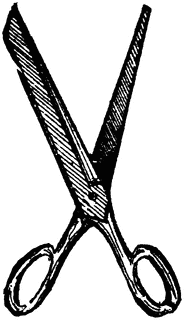
scissors

Am I a writer, or a barber?

When I first started writing for kids, I didn’t really understand the difference between short stories and picture books. I’d submit short stories to book publishers, and picture books to magazines who published short stories. Selling Raizy and being guided through revisions by Devorah Leah Rosenfeld, the editor at Hachai, schooled me in the differences between the two media. After a couple years, I started writing regularly for children’s magazines, and her lessons allowed me to jump between the two formats.

2 Major differences between picture books and short stories:


1) The length differs significantly in the two formats. Oddly, an entire picture book has about half the words (sometimes less) as a short story for a kids’ magazine.

2) The illustrations in a picture book replace almost all the description. And the only words that could appear in a picture book text are ones that drive the narrative forward. When I learned this lesson, my picture book writing attained a sharpness that it had previously lacked.
Continue reading

When good things happen to anxious people: the beginning of a new project

parakeet, lineated

I hope I say something original, for once.

I’m close to wrapping a piece for a magazine, and I’m waiting on the opinions of some of the beta readers of one of my WIPs, so Friday morning, I started rummaging though my old journals for some new-old project ideas. Among my scribbling, I found notes about a folktale that really appealed to me. A little research has indicated that there is only one picture book retelling of this story. Which is why, for the first time, I’m attempting a folktale retelling.

Good for me, right? It’s good to try something new, right? Continue reading

Review of My Very Own Mitzvah Hands–new from Bracha Goetz & just in time for Chanukah!

My Very Own Mitzvah Hands cover

The Latest from Bracha Goetz!

My friends know that I love to support writers and illustrators local to me in L.A., but this time I’m turning to a writer from my hometown (hint, I’m forever an Orioles fan).

Bracha Goetz is a well-known Jewish writer and the creator of the popular “What Do You See” series of boardbooks from Judaica Press. She’s now teamed up with them for a new series, of which the first book just came out.

My Very Own Mitzvah Hands follows two young children as they employ their hands in a variety of activities. This book is similar to the secular Hands Are Not for Hitting, but differs in two significant ways: 1) the emphasis is exclusively on the positive, 2) the actions are directly connected to using our hands to connect to the Almighty through His mitzvos.

Bracha Goetz’s text rhymes nicely, and uses simple, clear language which is appropriate to the youngest readers. Attractively and colorfully illustrated by Malka Wolf, children will find the pictures engaging, and they’ll particularly appreciate the final spread, which recaps all the actions discussed earlier in the book.

I very much liked the underlying message to children–just because your hands are little, doesn’t mean they can’t bring good into our world. This message is empowering, but it isn’t overpowering in its presentation.  My Very Own Mitzvah Hands lends itself also very well to two common parenting experiences:

1) If your child is using their hands for trouble (like creating murals on your wall with permanent marker or smacking the baby), you can use the rhymes in this book to redirect them or to remind them of better things to do with their hands.

2) Sometimes, children complain about being bored. Using this book as a springboard, parents can invite their children to brainstorm things they can do with their hands to alleviate that boredom.

Whether you’re still doing your Chanukah shopping or looking for books at other times of the year, I’d recommend this book. My Very Own Mitzvah Hands refers to several of elements of Jewish practice only engaged in on a daily basis by traditional and religious families, so I would describe the target audience as children 1-5 years from those backgrounds.