I haven’t been posting to this blog very much recently because I’ve been very, very busy. Among other things, I’ve been writing (I’ll post about that IY”H soon) and reading–reading to my kids, parallel to my kids, and on my own. Notably, I’ve recently read several books that are “message books”–books with a sincere moral message that the author wants readers to absorb. While many such books come across as heavy-handed, these do not. I’m highlighting these books because they definitely represent one of the directions I want to go with my writing–using speculative fiction to explore subjects that might not appeal to children or teens if approached more directly.
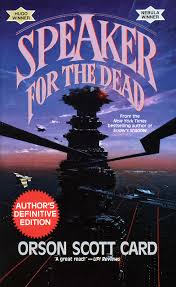 HIGH SCHOOL AND ABOVE Orson Scott Card (as a practicing Mormon, he often introduces ethical dilemmas and messages into his books) is most famous for his first novel, Ender’s Game. I recently read the first sequel Speaker for the Dead, and was sucked in right away by the introduction by the author. (In it, Card says that one of his motivations for writing the book was because he wanted to show a central character who is NOT an adolescent, or a drifter, or any other aloof, single man on the fringe of society who usually stars in sci-fi novels. Rather, he portrays a man ready to create a family, who really wants to build bridges between the members of communities.)
Speaker for the Dead follows the hero of Ender’s Game to the age of 35–although 3000 years have passed, he hasn’t aged because he has spent so much time travelling at nearly light speed, teaching people insights into the behavior of the dead, allowing people to walk in the shoes of people before judging them (as it says in Pirkei Avot/The Ethics of the Fathers). This is his personal tikkun (rectification of error) following his (SPOILER ALERT) near-destruction of the species of Buggers at the climax of the last novel. Now, Ender’s sister and travel companion, Valentine, is expecting her first child. Her travels are over, and he realizes he wants his to end, too. But he has one last mission–to find out why members of another alien race have started killing the scientists (actually xenologists–like anthropologists, but studying aliens instead of humans) who have befriended them and studied them.
This novel provides a nuanced discussion about a new kind moral relativism–not that right and wrong are relative, but that our ability to judge them is. The story is a little focused on one side of the argument, and I was able to guess the mysterious cause of the aliens’ behavior right off–but that might be because I 1) am a writer myself and 2) hold a master’s degree in anthropology. However, I really enjoyed the book and it would be an excellent stepping off point for discussion in a classroom, book club, or around the dinner table.
MIDDLE GRADE Vivian Vande Velde’s middle-grade novel, Three Good Deeds, tells the story of Howard, a rowdy boy who spends several months as a goose. Howard’s transformation is at the hands of the local witch, who feels he is a selfish child more interested in his own entertainment than the needs or wants of others. The only way out of the curse is for Howard to complete three genuinely good deeds.
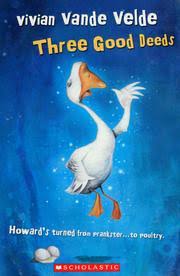
Three Good Deeds uses fantasy, a charming although obnoxious anti-hero, and plenty of droll humor to draw the audience (ages 8 and up) into the story. Despite the light treatment, the message–that a person should be a giver and not a taker–is beautifully interwoven into the text. Warning: the end is a bit of a tear-jerker for softies (it mentions chessed shel emes).
PICTURE BOOK Paul Budnitz’s The Hole in the Middle takes a fantastic approach, as well, to teach its lesson. Morgan quite literally has a hole in his middle. He tries to fill it up with superficial and self-centered pursuits. However, it only shrinks when he does chessed (kindness) for his friend Yumi.
The fanciful, metaphorical style of this book ALMOST overpowers the moral. My 3-year-old and not-quite-5-year-old children laughed at the story outright–it’s just so outlandish. But when I asked the older of the two about the message, she had indeed absorbed it!
I’m wondering if the wackiness of the set-up might make the book so memorable that even if a younger child doesn’t quite understand the message at the time she reads it, she’ll draw on its memory to guide her after she reaches a stage where it’s no longer over her head.




 Rebecca Klempner