2 Major differences between writing a picture book and writing short stories

So the folktale project turned out to be an eye-opening experience for me.
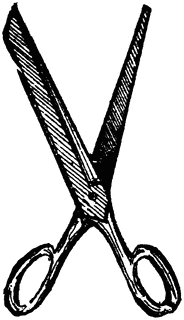
scissors

Am I a writer, or a barber?

When I first started writing for kids, I didn’t really understand the difference between short stories and picture books. I’d submit short stories to book publishers, and picture books to magazines who published short stories. Selling Raizy and being guided through revisions by Devorah Leah Rosenfeld, the editor at Hachai, schooled me in the differences between the two media. After a couple years, I started writing regularly for children’s magazines, and her lessons allowed me to jump between the two formats.

2 Major differences between picture books and short stories:


1) The length differs significantly in the two formats. Oddly, an entire picture book has about half the words (sometimes less) as a short story for a kids’ magazine.

2) The illustrations in a picture book replace almost all the description. And the only words that could appear in a picture book text are ones that drive the narrative forward. When I learned this lesson, my picture book writing attained a sharpness that it had previously lacked.
Continue reading

When good things happen to anxious people: the beginning of a new project

parakeet, lineated

I hope I say something original, for once.

I’m close to wrapping a piece for a magazine, and I’m waiting on the opinions of some of the beta readers of one of my WIPs, so Friday morning, I started rummaging though my old journals for some new-old project ideas. Among my scribbling, I found notes about a folktale that really appealed to me. A little research has indicated that there is only one picture book retelling of this story. Which is why, for the first time, I’m attempting a folktale retelling.

Good for me, right? It’s good to try something new, right? Continue reading

Tragedy! My lonely old maid of a story has been rejected once again.

I’m sure I’ve blogged about rejection numerous times at this point, but since I continue to collect rejection letters, why not continue blogging about them?

boy with letter

Mom! I think you just got another rejection letter!

Over the summer, I wrote a story that my husband adored. He likes almost all my stories, but this one he really, really liked. He particularly enjoyed the nasty anti-hero at the center of the story and the unhappy ending.

On the other hand, I didn’t like the way I’d originally executed my idea, so I set it aside for a couple months. Eventually, I brushed it off and polished it up a bit before sharing it with my writing group. They provided extensive feedback, and I acted on it, hoping that the new, much improved story would dazzle the editors. Continue reading

Patience is a virtue–Submit when it’s perfect, and then prepare to wait

As I mentioned in a previous post, I’ve been picking up the pace of my submissions, and also broadening the variety of publishers I’ve been submitting to. What I didn’t realize when I committed to this strategy is how much this would test my patience.

waiting - image courtesy of microsoft

You might as well take a seat…this is going to take a while.

Let me explain. Usually, I write for Jewish magazines. If I submit a book, it’s usually a picture book involving Jewish subject matter. The world of Jewish publishers is very small, and the editors receive fewer submissions than those who handle secular material. The response time in the Jewish publishing world is much faster than in the secular publishing world. Moreover, some of the editors have gotten to know me over the years because they’ve employed me, read me online, or just like my style. I suspect that my subs don’t always go in the slush pile, at least in certain offices, B”H & bli ayin hara. Yes, I have to wait for a response from editors, but the wait is relatively short.

Re-entering the realm of secular publishing is a wake-up call to the realities of that world. Continue reading

Am I brilliant or not so much? A writer’s self-confidence bounces on a po-go stick.

Yesterday, I was reading the daily post of a great blogger, Bottleworder. His topic? The benefits of being dumb. It’s worth reading.

Today, I’m not going to write about the benefits of being dumb, but something that afflicts many writers: feeling dumb.

“Have you read this yet, Eugenia? It’s brilliant, I tell you! That Rebecca Klempner’s going to win a prize one of these days!”

When I read something I’ve written in the past, I usually have one of two reactions:

1) That was brilliant! I wrote THAT? Was I channeling or something? Wow.

2) I can’t believe I wrote that. Why, oh why didn’t I (insert suggested improvement here) before I submitted? It could have been so much better. People are reading this drech?  And my name’s attached to it? Can I hide now?

I think that writers like me have the self-confidence of a pogo stick. Up-down-up-down. If this were just a matter of my self-esteem, I’d keep this discussion to myself, but it actually affects my decision-making skills relative to my writing.

When do I submit? Is it good enough? Will it be accepted as it is, or will some editor laugh at my sub and then tell his buddy in the next cubicle about how terrible it was.

Is what I wrote actually funny, or did the members of my writing group (and my darling husband) only laugh because of the intonation of my voice while I was reading? Or because they were feeling punchy after too little sleep?

You catch my drift. Continue reading

Did I write that book?

I just had yet another one of those heart-stopping moments where I saw a book title, then read the review of the book and thought:

OMG! I WROTE THAT BOOK!

I’m pretty disgusted with my reaction. I’m sure my idea isn’t so original that no one else could’ve had that same one. Yes, I had my idea before that book was published—but what if that author thought of it first? Or maybe she didn’t think of it first, but she executed it better?

-sniff-

I’m chalking this up as another exercise in, “I’m only responsible for my effort, not my success.” If I was meant to sell that manuscript (I did shop it around a bit), then I would have sold it.

The end. Now it’s time to suck it up.