Why you should do what you love to do, even if you’re no expert (and never will be)

I am no Picasso.

I am no Michelangelo or deVinci.

And I’m never going to be.

My girlfriend at MoiMeMoi posted last week about doing things we love even when we are less than expert at them. Her words struck a chord, because recently, I’ve started drawing again after years and years of avoiding it.

For my entire grade school career, I was considered “artsy.” I drew and painted better than my peers, mostly out of a smidgen of natural talent, but also because I applied myself in art classes and loved to read art books. It was a hobby that I hoped might turn into something more.

Then I hit 12th grade and had the sudden realization that I was good, but I wasn’t great and might very well never be great. That smidgen of talent was just a smidgen. So I threw my hands up in the air and gave up drawing and painting and pottery–the whole shebang.

Occasionally, I’d startle my husband when I had to draw something to show my kids how, or my students would respond to a diagram I’d drawn with admiration. At such moments, I felt like my past was leaking out. My family knew about my “artistic” past, and even suggested I illustrate my books, but I’ve always felt like I’m not good enough to do it and never will be.

Maybe that’s true. However, lately, I’ve gone back to drawing. At times, I sketch still lives, other times, I draw my kids while they sleep, or from a photo (because they are rarely still). I’ve also drawn a couple cartoons. I mourn years of no practice–my skills could have grown, but they didn’t. Sometimes, I get very frustrated. But it’s fun. It’s a hobby, and it’ll probably stay that way.

G-d-willing, I’ll share some more about my renewed hobby soon, with the help of my handy-dandy scanner.

What skills and hobbies have you neglected over the years?  Would you ever go back to them?
Thank the folks who’ve rejected you–a radical suggestion for writers this Thanksgiving

Thanksgiving is upon us here in the U.S., and this is a wonderful opportunity to reflect upon gratitude, whether you celebrate the holiday or not. I’m a big fan of Rabbi Zelig Pliskin and also of Rabbi Shalom Arush, and I’m going to combine their approaches for this writing exercise appropriate to the Thanksgiving season and year-round. This exercise is useful whether you’re Jewish or not–please don’t get turned off to it just because it was inspired by a couple of rabbis.

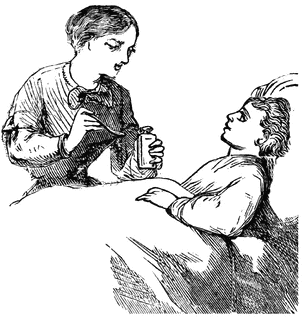
mother offering child medicine

Be grateful for the medicine–it’s good for you.

Rejection is just about the hardest thing to cope with when you decide you’re going to become a writer, but it’s something that you need to learn to accept graciously. When that rejection letter first comes, you are often overwhelmed by feelings of resentment, anger, and frustration. You might lash out, calling the editors idiots or saying that the publisher doesn’t know what good writing is. You might despair, consider yourself a failure, or even give up writing.

But here’s the truth–you were meant to be rejected, at least in this specific instance. Continue reading

More crazy ideas from yours truly

I’m sorta infamous among my friends for having lots of whacked-out, creative-but-slightly-off-kilter, usually (but not always) impractical ideas. Here’s my latest:

Rabbi Aryeh Leib Nivin–a motivational speaker/life coach/teacher/rabbi–speaks of everyone having a yeod, a unique life mission with which they are supposed to serve G-d (and people), and a tikkun, a soul correction they have to make in order to maximize their potential (by fulfilling their yeod). Also, a person has short-term lessons that must be learned as stepping stones to reach their yeod and tikkun. This self-development paradigm is very useful for those of us who want to build ourselves (especially now that we’re in Elul, the introspective month that leads up to Rosh HaShanah and Yom Kippur).

“That wacky Mrs. Klempner has some weird idea again!”

As I mentioned in a post last week, I’m going to be rewriting (yes, again!) the novel I wrote last year. One of the areas I want to focus on is character, really fleshing each one out better and more coherently. Many expert authors suggest strategies about developing character such as:

1) Learn about Myers-Briggs personality types and assign one to each of your characters.

2) Consider what each character most wants, most fears, their biggest secret, and what they have to learn.

3) Use drawing, cut-and-paste, or the like to assign an appearance for your character. Brainstorm their likes, dislikes, etc. Paste such items on your character chart.

4) Pretend to interview your character for a magazine.

All these strategies make sense, but they didn’t appeal so much to me. Then I thought, “Hey! Why don’t I apply Rav Nivin’s rules to fictional characters?” Assign a tafkid, a yeod, to each one, and a tikkun, as well?

So that’s what I think I’m going to be doing. Maybe not exclusively, but I think it will bring a Jewish approach to my mostly Jewish characters and subject matter.

Has anyone else out there tried “unorthodox” (pun definitely intended) ways of developing characters or doing other work that usually isn’t done in a “spiritual” or “religious” way?

Identifying Your Life’s Mission

Identifying Your Life’s Mission

The above article (by Sara Yocheved Rigler and appearing this week on Aish.com) explains how to find your “tafkid,” that little sliver of the world that constitutes your mission in life. I encourage you to read it before Rosh HaShanah. I found it very inspirational and the perfect complement to a shiur I attended over the weekend.
Rabbi Simcha Weinberg was visiting our shul over this Shabbos. At seudat shlisheet, he explained that the Yomim Noraim (the Days of Awe) are the when we should not only think about what we’ve done wrong in the past year, but what would it look like if we did it right in the year ahead. He suggested that we should not imagine what we want, but what HaShem’s dream is for us. What does He want from us? Then we can establish some steps to take to get us there.
Of course, He wants us to make peace with other Jews (including family members!). Of course, He wants us to improve in how we follow his mitzvot.
 
But He also wants us to be the best people we can be, using our talents and skills. The article by Sara Yocheved Rigler will inspire you to do just that. What gets you excited about life? How can you use that talent and passion to improve your family, your community, your world?

The secret to finding happiness: Using your talents

A few years ago, a group called Mishmeres HaShalom (now called Tiferes) sent out a DVD of Rabbi Noah Orlowek on the topic of Happiness. Happiness is a particularly apropos topic at this time of year. We’re now in Adar, and “When Adar enters, joy increases,” as the Sages said.

According to Rabbi Orlowek, people are happiest (animals, too) when they are fufilling that which they were created for. A person should 1) consider their talents and abilities, then 2) use them for the purposes of a mitzvah.
There’s a famous story (I think it appears in the the Gemara) of a gentleman who had a beautiful singing voice. When he would travel on pilgrimage to Jerusalem every year, he’d lead the prayer services. One year, he just didn’t feel like doing so. He was punished by G-d, since G-d had given him this magnificent voice for it to be used in Heavenly service.
When I heard the lecture by Rav Orlowek, I thought about my own talents. At the time, I’d sold a book (it hadn’t yet come out), but had no additional publishing success. I was frustrated about how much work I was doing–writing, researching, submitting–with little to show for it.
I decided to use my writing as a chessed. I sent goofy poetry to relatives. I prepared the newsletter for one of my son’s nursery school. I wrote an article for a local magazine about a community issue that needed attention. I began to think about my writing not just as a way to express myself or a way (I hoped) to make a little money, but as a responsibility.
Maybe we can all think about our talents and choose one thing we do well to bring assistance or joy to others.