Reading local-to-L.A. authors

One of my favorite things to do is to promote the work of Jewish writers with West Coast connections. Here are a few I’ve read in the last couple months:

Hands-On How To’s for the Home & Heart by Tova Younger (Shemtov Press 2012)

TOVA YOUNGER final cover

Tova Younger’s recent release

Tova Younger is a former Angeleno who settled in Kiryat Sefer in 2004. Her new book, Hands-On How To’s for the Home & Heart, contains friendly and very practical advice of all types for the Jewish wife.

When I was first living on my own, someone gave me a book, Where’s Mom Now That I Need Her: Surviving Away from Home. That cookbook/home repair/car repair/first aid/ and just about everything else manual got me through a lot of tough situations. Younger’s book is almost a Jewish version of that secular classic—chock full of basic information that every Jewish homemaker can benefit from.

Divided up into four primary sections:

  • For the Heart
  • For the Home
  • Handy Tips
  • recipes

Hands-On How To’s for the Home & Heart offers advice about everything from maintaining proper kavana (focus) to proper laundering; from how to make conversation with the relatives to whom we owe kavod (honor), to recipes for basics like beet salad and cornflake quiche.

Younger’s book would make a terrific gift for seminary girls, the newly married, and even seasoned homemakers. You can find it on discount right now at Jewish e-Books.

Bells & Pomegranates by Rachel Pomerantz (Menucha Publishers 2012)

bells and pomegranates

Rachel Pomerantz’s latest

Well-known Orthodox author Rachel Pomerantz frequently travels to SoCal to visit her brother and mother, who live near San Andreas. Her latest serial novelization, Bells & Pomegranates, follows the shidduch process of various characters (introduced in previous books), all of whom have life circumstances that present hurdles in their quest for a mate.

There are step-siblings Yoel and Devora, who have been adopted, and the twins Rina and Gila, who converted as children and grew up in a single parent home. There’s foster child Ronny, whose mother is mentally ill, and Yossi, the child of baalei teshuva. Sarah’s got great yichus, but she’s an orphan. These characters and others start off the shidduch process with considerable challenges—but as the novel progresses, Pomerantz throws additional complications into their paths, lending drama and suspense to their intermingled stories.

Bells & Pomegranates is more than kosher entertainment for a rainy afternoon. In describing the family dramas of her characters, Pomerantz invites us to question our own preferences and prejudices. How do my assumptions affect my judgment? How involved should parents and grandparents be in the shidduch process? What are legitimate reasons to call off a prospective match? These questions and others lingered with me after I finished the book.

On This Night: the Steps of the Seder in Rhyme by Nancy Steiner (HaChai 2013)

on this night

While a seasoned freelance author, Nancy Steiner is new to picture book writing. Her first kids’ title, On This Night, will likely prove to be a classic. In cheerful—but unforced—rhyme, Steiner leads readers through the steps of the seder. Her language is perfectly accessible for young readers and will prepare them for the Pesach experience.

The darling illustrations by Wendy Edelson depict an adorable family celebrating their seder. Edelson portrays the family members from a variety of angles, adding to the visual interest. From the twinkly-eyed zeide to the drowsy preschooler on the final page, the pictures (and text) are sure to engage kids aged 2 to 6.

Also of note:

L.A. resident Sarah Bunin Benor’s new book, Becoming Frum (Rutgers University Press 2012), considers the ways newly religious Jews adapt to the language of the mainstream Orthodox world. While an academic book rather than a religious one, Bunin Benor bases her conclusions largely on research conducted here in L.A., and her book will be of great interest of those engaged in the baalei teshuva phenomenon. I participated in her initial online survey, which piqued my interest in her work. I hope to write an entire post devoted to Bunin Benor’s book (and her spin-off website) soon.
Home decorating with bibliophiles: what your books say about you

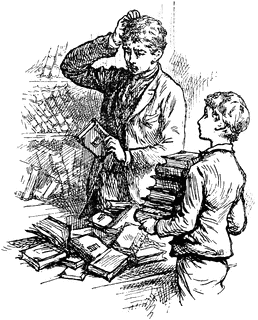
Yesterday’s L.A. Times had a wonderful article by book critic David Ulin about his book collecting habits. His home is packed floor to ceiling with shelves and shelves of books. Periodically, he arranges them in alphabetical order.

Ulin shares many reasons for his enormous book collection. Here’s his chief one:

They are part of my present, yes, but also part of my past, my history: three-dimensional memories.

Among their appeals is that they opened up a world view, which is what the most essential writing does. Yet equally important is their resonance as objects, carried with me, shelf to shelf, apartment to apartment, over decades, physical reminders of who I was and who I am and of my process of becoming, blurring the line between inside and out.

This led me to think about what the Klempner family book collection means about us.

  • World view – Klempner adults are cheapskates. We love borrowing from libraries more than buying books. We still have a lot of books, but not relative to the amount of reading that goes on around here. Most of the books we actually own are Jewish books, especially for adults–books of prayer, Torah, character-building, and so on. The secular adult books we own are mostly practical.
  • Life history – You can see what my husband learned in classes ten or fifteen years ago by checking which volumes of the Gemara we own. You can tell I studied anthropology in graduate school and that one of us reads French (speaking is another matter…). You can tell we’re both teachers, and that we’re the kind of parents that like to read a lot about how to parent. On the kids’ shelves, you can track all of my eldest child’s special interests since age 5.

What do your books say about you?

2 Major differences between writing a picture book and writing short stories

So the folktale project turned out to be an eye-opening experience for me.

scissors

Am I a writer, or a barber?

When I first started writing for kids, I didn’t really understand the difference between short stories and picture books. I’d submit short stories to book publishers, and picture books to magazines who published short stories. Selling Raizy and being guided through revisions by Devorah Leah Rosenfeld, the editor at Hachai, schooled me in the differences between the two media. After a couple years, I started writing regularly for children’s magazines, and her lessons allowed me to jump between the two formats.

2 Major differences between picture books and short stories:


1) The length differs significantly in the two formats. Oddly, an entire picture book has about half the words (sometimes less) as a short story for a kids’ magazine.

2) The illustrations in a picture book replace almost all the description. And the only words that could appear in a picture book text are ones that drive the narrative forward. When I learned this lesson, my picture book writing attained a sharpness that it had previously lacked.

Continue reading

Library Love – Bibliophiles and the places they frequent

father and son in the library

Hey, kiddo! Do you really need this one, to? Good thing I don’t have to pay for all of these.

When I was a teenager, I lived across the street from the library. I did homework there, typed most of my college applications on their noisy electric typewriter (10 cents for each 15 minutes, I think), and perused the shelves for hours on end. I’d already developed a taste for books by that age, but there’s no doubt in my mind that my family’s proximity to the library solidified my attachment to books, reading, and libraries, in general.

Now that I’m older, I live in a family fully of bibliophiles. We read to learn Torah. We read for entertainment; we read to learn how to do new things; we read for school assignments. We read because otherwise we’d go into withdrawal and start twitching in a dark room. Continue reading

Review of My Very Own Mitzvah Hands–new from Bracha Goetz & just in time for Chanukah!

My Very Own Mitzvah Hands cover

The Latest from Bracha Goetz!

My friends know that I love to support writers and illustrators local to me in L.A., but this time I’m turning to a writer from my hometown (hint, I’m forever an Orioles fan).

Bracha Goetz is a well-known Jewish writer and the creator of the popular “What Do You See” series of boardbooks from Judaica Press. She’s now teamed up with them for a new series, of which the first book just came out.

My Very Own Mitzvah Hands follows two young children as they employ their hands in a variety of activities. This book is similar to the secular Hands Are Not for Hitting, but differs in two significant ways: 1) the emphasis is exclusively on the positive, 2) the actions are directly connected to using our hands to connect to the Almighty through His mitzvos.

Bracha Goetz’s text rhymes nicely, and uses simple, clear language which is appropriate to the youngest readers. Attractively and colorfully illustrated by Malka Wolf, children will find the pictures engaging, and they’ll particularly appreciate the final spread, which recaps all the actions discussed earlier in the book.

I very much liked the underlying message to children–just because your hands are little, doesn’t mean they can’t bring good into our world. This message is empowering, but it isn’t overpowering in its presentation.  My Very Own Mitzvah Hands lends itself also very well to two common parenting experiences:

1) If your child is using their hands for trouble (like creating murals on your wall with permanent marker or smacking the baby), you can use the rhymes in this book to redirect them or to remind them of better things to do with their hands.

2) Sometimes, children complain about being bored. Using this book as a springboard, parents can invite their children to brainstorm things they can do with their hands to alleviate that boredom.

Whether you’re still doing your Chanukah shopping or looking for books at other times of the year, I’d recommend this book. My Very Own Mitzvah Hands refers to several of elements of Jewish practice only engaged in on a daily basis by traditional and religious families, so I would describe the target audience as children 1-5 years from those backgrounds.