Library Love – Bibliophiles and the places they frequent

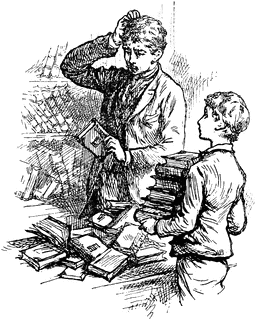
father and son in the library

Hey, kiddo! Do you really need this one, to? Good thing I don’t have to pay for all of these.

When I was a teenager, I lived across the street from the library. I did homework there, typed most of my college applications on their noisy electric typewriter (10 cents for each 15 minutes, I think), and perused the shelves for hours on end. I’d already developed a taste for books by that age, but there’s no doubt in my mind that my family’s proximity to the library solidified my attachment to books, reading, and libraries, in general.

Now that I’m older, I live in a family fully of bibliophiles. We read to learn Torah. We read for entertainment; we read to learn how to do new things; we read for school assignments. We read because otherwise we’d go into withdrawal and start twitching in a dark room. Continue reading

Review of My Very Own Mitzvah Hands–new from Bracha Goetz & just in time for Chanukah!

My Very Own Mitzvah Hands cover

The Latest from Bracha Goetz!

My friends know that I love to support writers and illustrators local to me in L.A., but this time I’m turning to a writer from my hometown (hint, I’m forever an Orioles fan).

Bracha Goetz is a well-known Jewish writer and the creator of the popular “What Do You See” series of boardbooks from Judaica Press. She’s now teamed up with them for a new series, of which the first book just came out.

My Very Own Mitzvah Hands follows two young children as they employ their hands in a variety of activities. This book is similar to the secular Hands Are Not for Hitting, but differs in two significant ways: 1) the emphasis is exclusively on the positive, 2) the actions are directly connected to using our hands to connect to the Almighty through His mitzvos.

Bracha Goetz’s text rhymes nicely, and uses simple, clear language which is appropriate to the youngest readers. Attractively and colorfully illustrated by Malka Wolf, children will find the pictures engaging, and they’ll particularly appreciate the final spread, which recaps all the actions discussed earlier in the book.

I very much liked the underlying message to children–just because your hands are little, doesn’t mean they can’t bring good into our world. This message is empowering, but it isn’t overpowering in its presentation.  My Very Own Mitzvah Hands lends itself also very well to two common parenting experiences:

1) If your child is using their hands for trouble (like creating murals on your wall with permanent marker or smacking the baby), you can use the rhymes in this book to redirect them or to remind them of better things to do with their hands.

2) Sometimes, children complain about being bored. Using this book as a springboard, parents can invite their children to brainstorm things they can do with their hands to alleviate that boredom.

Whether you’re still doing your Chanukah shopping or looking for books at other times of the year, I’d recommend this book. My Very Own Mitzvah Hands refers to several of elements of Jewish practice only engaged in on a daily basis by traditional and religious families, so I would describe the target audience as children 1-5 years from those backgrounds.
A picture is worth a thousand words: what photojournalists don’t want you to know about their images

Two recent articles are worth a peek for what the reveal both about contemporary politics and about the nature of photography itself.

The pieces–one in the Washington Post, the other on Breitbart.com–describe misleading pictures published during the recent Gaza conflict. Most notably, photos of dead and maimed children were used by pro-Palestinian journalists in order to accuse the Israelis of being brutal assassins of the young. Whether you feel Israel’s actions were justified or not, Palestinian children were hurt and killed during battle (and so were Israeli children). However, further investigation revealed that one of the photos–said to portray a Palestinian child gravely wounded by Israelis–was in fact a child attacked by Syrian forces in the conflict in that country. And another child, supposedly killed by Israelis, was most likely killed by a Palestinian rocket that misfired. These are only two among many “photo-ops” that were intentionally mislabeled for political purposes.

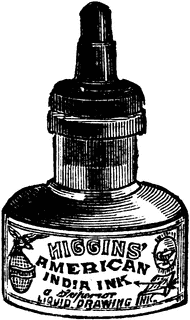
ink bottle

If I spill some ink from this bottle, what will you see?

Of course, as the Washington Post article points out, the misrepresentation isn’t always by the pro-Palestinian side (although usually Israeli press just doesn’t publish images of Palestinians who are hurt or injured). And I don’t really want to get into the political aspects of this case. What I would like to do is point out how this issue goes far beyond the Israeli-Palestinian conflict. Continue reading

Be childlike, not childish–What we can learn about writing from kids

We now—joyfully—have 2 1/2 literate kids in our household. (The 1/2 is only 5. Cut her some slack.) One of the interesting things in my life lately has been watching them become writers, as well. I think we adults can learn a thing or two from their learning curve.

1) Kids enjoy writing about what they like. However, one of the things that makes them better writers is writing about things outside their comfort zone.  It’s a lot easier to get my 10 year old to write about cars or maps, but his writing skills have been built up greatly by writing all those friendly letters, book reports, essays, and so on that get assigned as homework or classwork. When was the last time you wrote something outside YOUR comfort zone? I know professional writers who only write personal essays, or those who have always exclusively written for kids. Try a little of everything. Mix it up. It’ll surprise you.

Watch out! Your bookworm might just become a writer!

2) Kids try to copy what they like to read. They’ll borrow liberally from Captain Underpants, Tintin, and the like. They recognize excellence and strive to emulate it. Of course, we want writers to develop their own voice (and never, ever plagiarize), but there’s nothing wrong from learning from the greats. So do a little pastiche–you’ll get a childlike pleasure from it, and brush up your skills, too.

3) There might be obstacles in the way. The right tools can help. One of my kids has a graphomotor problem. Upon advice, we bought him pencils with fatter leads. What a difference. And now he usually types writing assignments. So much easier for him. Another of my kids is so young, she hasn’t learned to spell yet. Relying on invented spelling allows her to communicate on paper, and she’s so pleased with the result she does a little dance (really, she does). If your inner kid has problems with writing, break it down and see if there’s a solution. Don’t just give up. Continue reading

A Friendly Newsletter for Special Kids

A couple of months ago, I discovered an ad in HaModia for a newsletter called “Chevras Chaverim.” It’s a little magazine for Jewish kids with special needs. We’ve received the first two issues, one before Rosh HaShanah, one before Sukkot. Each newsletter contains several “departments,” tailored to the needs of kids with social skills problems, sensory processing disorder, and the like. The organizer loves feedback, and wants kids to submit things for publication. The subscription is free for now and you get it by emailing “Chevras Chaverim” at Chevraschaverim@gmail.com.