Kveller writers talk G-d with their kids

The Jewish parenting website Kveller is running a series right now on parenting. They’ve got 5 perspectives so far, and I have to admit I have mixed feelings.

They seem to have picked some extreme situations–a mom who clearly has OCD, a kid who has chosen Communism over Judaism–but also some pretty normal ones, like the soon-to-be dad finally realizes the fate of his unborn child is out of his hands and chats with G-d about protecting him and (this had me laughing both out of amusement and empathy) the mother whose kids imitate G-d saying, “No!” to each and every request she makes at a trying stage of life.

What surprised me most is that so far most of the parents seem to not have thought about what they would say about G-d before talking about Him with the kids. Some of the stories are frankly depressing, like watching the blind leading the blind. Not surprisingly, their fumbling responses get some pretty sad results.

But I just love that a non-Orthodox (at least, not only Orthodox) Jewish website is hitting this issue, which largely goes undiscussed in polite American circles. And we’re getting a real glimpse into American Jewish households to see what’s going on in there.

It’s pretty harrowing.

Sure G-d says, “No,” an awful lot. But what about all the times it turned out good for you?

What about saying, “Thanks, G-d!” every time you experiences a moment of joy? “Thanks for the parking space!” and “Thanks for there being exactly enough cupcakes for us all!” make an impression on kids as much as all those heaven-sent No’s.

What about discussing with your co-parent about how you’ll represent G-d to your kids ahead of the “Big Talk?” Because it’s as much of a Talk as the more famous one, and requires at least as much forethought.

Something that surprised me also was that no one really mentioned sharing books about G-d with their kids. A lot of the what I’ve communicated with my own kids about G-d has come from books and magazines, like  Where are You Hashem?, The Invisible Book, and Hashem is Truly Everywhere.

Do any readers out there have literature they like to share with their kids to enhance their “G-d Talk?”

Soul-bearing writing–writing personal essays that are a little too personal for comfort

Tablet published a new piece of mine today, about the untidy family life of a person who is an Orthodox Jew with relatives who are devout Christians. The comments are busy, and no trolls have appeared so far (meaning that anyone who disagrees with me does so with politeness and reflection).

I’ve published the piece because the problem I described in the article is a surprisingly common one  (among the “baalei teshuvos” who come to religiosity as adults) that most people ignore.

It’s sorta mortifying. This is a problem that is very private for me, and–like many who share it–it is a source of pain that I usually sweep under the rug. I’ve had to explain the absence of half of my family to many people over the years, and it’s never comfortable. Now the entire world can read about it (and share! and comment!).

In general, I don’t write about my family unless it is 100% positive. I felt that this needed to be an exception, in order to support people who share this type of situation. I intentionally omitted the name of my father’s family, and I tried to protect their identities. I wanted not to expose them, but the problem. Nonetheless, one of the commenters pointed out that I was still airing my family’s laundry in public.

I’d love it if readers weighed in here (in a comment below) or in the comments section on Tablet.

<a href=”http://www.makealivingwriting.com/?p=2538″><img src=”http://www.makealivingwriting.com/wp-content/uploads/2013/04/MALW_linkparty1.jpg”/></a&gt;

Believe it or not! Writing reality that’s stranger than fiction

Tablet just published a personal essay about my grandfather.  Please check it out. (And share, and like, and comment!)

Passover seder has been a bit spooky (in a good way) for me ever since childhood, when my sister and I were convinced Elijah the Prophet was none other than the Bogey Man.

And then we had a real ethereal visitor during Pesach.

It’s one of those stories that you tell and people think you are making it up. I probably would have thought that it was a figment of my imagination if my husband hadn’t recalled the event, as well. I feel a little more confident about the subject matter now, too, since the daughter of Rabbi Chaim Pinchas Scheinberg (zt”l) described a similar encounter by her parents in a recent issue of Binah Magazine. 

Have you ever written a piece of non-fiction about something readers might not believe is possible?

Seeing the world through a writer’s eyes

I’ve been thinking a little bit more about my theme of a couple posts ago, “how to be funny.”

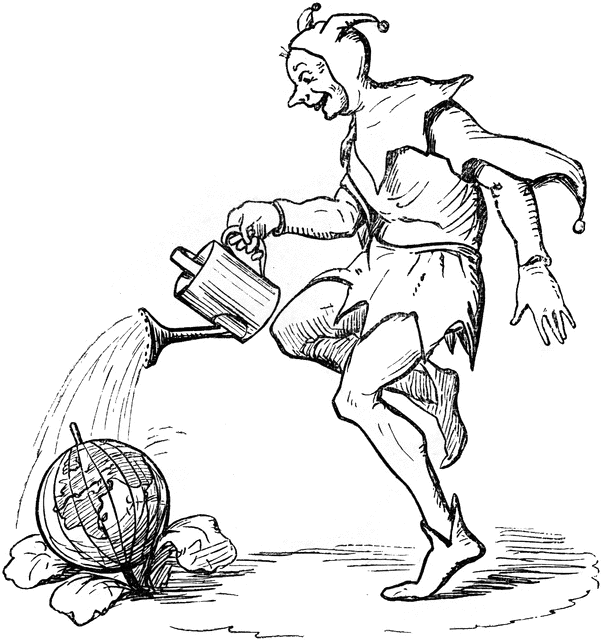
jester

A good jester will find humor in any situation, not just those that are obviously funny.

One of the steps to writing funny is seeing funny all around you. You can look at almost any situation and find something funny in it if you relax and try to experience it through calm, judgment-free observation.

A few months ago, someone (it might have been Erika Dreifus) pointed out this opinion piece by Silas House in the N.Y. Times:

We are a people who are forever moving, who do not have enough hours in the day, but while we are trying our best to be parents and partners, employees and caregivers, we must also remain writers.

There is no way to learn how to do this except by simply doing it. We must use every moment we can to think about the piece of writing at hand, to see the world through the point of view of our characters, to learn everything we can that serves the writing. We must notice details around us, while also blocking diversions and keeping our thought processes focused on our current poem, essay or book.

This way of being must be something that we have to turn off instead of actively turn on. It must be the way we live our lives.

Some people take this kind of remote observation a bit far. Silas House argues that the majority of a writer’s mind should be working on literary pursuits at any given time. I’d disagree. I try to turn this part of my brain off on Shabbat, during conversations with loved ones, and on date night, too. The key is not to remove yourself entirely from life around you, but to be able to see it calmly with a portion of your mind at will.

But that doesn’t mean that when on a stroll with my kids and I’m admiring your garden that I’m not noting which flowers are in bloom at this season so I can work them into the setting of my work in progress.

There’s a story Continue reading

Background on my new story: “Just Perfect” (or why I believe we all live in a Magical Reality)

This week, Hamodia‘s Inyan Magazine published my new short story (and it’s actually for adults!), entitled “Just Perfect.”

The original version of the story was explicitly a piece of fantasy, but as I mentioned in a previous post, I transformed the story into an example of magical realism rather than fantasy in order to address the concerns of my lovely and knowledgeable editor at Hamodia. 

In the original version, then called “Easy as Pie,” the transformation of Libby’s life occurred after she bumped into a little old lady who offered her a slice of peach pie at a party. The pie made Libby’s life–well, just peachy. But my editor felt the little old lady was a little unbelievable. Could I cut her? The only problem was that her brief appearance at the beginning and the end of the story explained the wacky events in between.

I wracked my brains for a way to ditch the old lady but save the rest of the silliness. There had to be an explanation for it, after all. I did a bit of experimentation and research. Finally, I decided that maybe Libby should just pray–and then G-d answers.

Even after I found my “magically real” solution, I initially balked at making the change. It was an elegant solution, so my reaction puzzled me. I had to think about it a lot, and I think my conclusion is worth sharing. Continue reading

Thank the folks who’ve rejected you–a radical suggestion for writers this Thanksgiving

Thanksgiving is upon us here in the U.S., and this is a wonderful opportunity to reflect upon gratitude, whether you celebrate the holiday or not. I’m a big fan of Rabbi Zelig Pliskin and also of Rabbi Shalom Arush, and I’m going to combine their approaches for this writing exercise appropriate to the Thanksgiving season and year-round. This exercise is useful whether you’re Jewish or not–please don’t get turned off to it just because it was inspired by a couple of rabbis.

mother offering child medicine

Be grateful for the medicine–it’s good for you.

Rejection is just about the hardest thing to cope with when you decide you’re going to become a writer, but it’s something that you need to learn to accept graciously. When that rejection letter first comes, you are often overwhelmed by feelings of resentment, anger, and frustration. You might lash out, calling the editors idiots or saying that the publisher doesn’t know what good writing is. You might despair, consider yourself a failure, or even give up writing.

But here’s the truth–you were meant to be rejected, at least in this specific instance. Continue reading