To outline, or not to outline, that is the question.

I just viewed this interesting slideshow on Flavorwire containing outlines by famous writers. I use “outlines” in a broad sense–several were more like graphic organizers than true outlines. I had a weird reaction to the piece.

Usually, I start stories with clusters or notes, not with actual outlines, unless we’re talking something big–a serial (even a mini-serial) or a novel. Sometimes, I cross out and draw arrows to rearrange the elements so often, I end up rewriting the whole thing a few times because I no longer can read my own diagrams.

In most cases, these scribbles remain private. However, I happen to be working on a project right now where the publisher requested an outline first, but that’s never really happened before.

Several of my friends tell me they just start writing. They skip the outlines, diagrams, and charts and words just start to flow.

This slideshow bizarrely made some part of my brain do a superiority dance. “I am in good company with other prewriters,” it seems to say. “Just look at me with the likes of Henry Miller, William Faulkner, Sylvia Plath and Joseph Heller!”

This is utter nonsense. Plenty of writers do just fine without scribbling diagrams, outlines, or the like first, particularly if they are writing short form.

Are you an outliner? Why or why not?

It’s the week of Shavuos!

Things have been a bit crazy in the Klempner household as of late. We’re already in the week of the Jewish holiday of Shavuos, the subject of my picture book, A Dozen Daisies for Raizy.

A few weeks ago, in honor of the 5th anniversary of Raizy, I asked librarians, teachers, and parents about how they’ve reacted to Raizy. Here are some of the responses:

From fabulous librarian Davida Levin, of the Torah Day School of Atlanta:

I love using the book every Shavuos with my K-2 library groups, and was delighted that several of the 1st and 2nd grade girls said that they also own the book.

This year we talked about what the daisies meant to the recipient and decided that they meant “I like you” or “I care about you”. The second graders were able to  say that the flowers were a reminder of Raizy’s invitation or offer of help.  This year I gave the girls the attached pages to fill in during check out time–one even suggested that you could send them to Hashem, but another was sure that Hashem can make His own flowers.

Here’s a copy of the handout she used. Feel free to borrow it, but give credit to Davida, okay?
Regular Binah and Inyan writer Rochel Burstyn says of Raizy:
I worked a few years ago in a playgroup and it was one of the kiddies’ favorite and the only ‘long’ one I could sit through!
Another fan of Raizy, Chani Fischman, wrote me to say:[m]y daughter has brought your book, A Dozen Daisies for Raizy, home from her school library a few times and we’ve enjoyed reading it together at bedtime. I like the fact that 1. The book is not too wordy (I hate wordy children’s books) 2. The pictures are vivid. 3. Subtraction becomes so clear to children without them realizing that they are actually doing a mathematical operation.

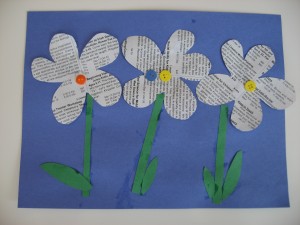
Last year, I gave out a couple craft ideas to create daisies for Shavuos following a school visit I did here in L.A. Here are a few more last-minute ideas, with an emphasis on projects that are particularly kid-friendly and can be done mostly with stuff you can find around the house:

daisy craft

Recycled kid’s project for Shavuos.

Have a great holiday everyone!

Kveller writers talk G-d with their kids

The Jewish parenting website Kveller is running a series right now on parenting. They’ve got 5 perspectives so far, and I have to admit I have mixed feelings.

They seem to have picked some extreme situations–a mom who clearly has OCD, a kid who has chosen Communism over Judaism–but also some pretty normal ones, like the soon-to-be dad finally realizes the fate of his unborn child is out of his hands and chats with G-d about protecting him and (this had me laughing both out of amusement and empathy) the mother whose kids imitate G-d saying, “No!” to each and every request she makes at a trying stage of life.

What surprised me most is that so far most of the parents seem to not have thought about what they would say about G-d before talking about Him with the kids. Some of the stories are frankly depressing, like watching the blind leading the blind. Not surprisingly, their fumbling responses get some pretty sad results.

But I just love that a non-Orthodox (at least, not only Orthodox) Jewish website is hitting this issue, which largely goes undiscussed in polite American circles. And we’re getting a real glimpse into American Jewish households to see what’s going on in there.

It’s pretty harrowing.

Sure G-d says, “No,” an awful lot. But what about all the times it turned out good for you?

What about saying, “Thanks, G-d!” every time you experiences a moment of joy? “Thanks for the parking space!” and “Thanks for there being exactly enough cupcakes for us all!” make an impression on kids as much as all those heaven-sent No’s.

What about discussing with your co-parent about how you’ll represent G-d to your kids ahead of the “Big Talk?” Because it’s as much of a Talk as the more famous one, and requires at least as much forethought.

Something that surprised me also was that no one really mentioned sharing books about G-d with their kids. A lot of the what I’ve communicated with my own kids about G-d has come from books and magazines, like  Where are You Hashem?, The Invisible Book, and Hashem is Truly Everywhere.

Do any readers out there have literature they like to share with their kids to enhance their “G-d Talk?”

I stepped up to the challenge…but did I succeed?

Well.

A couple months ago, I challenged writers to try something new: a new genre, new POV, new publication, anything that would help us to stretch our wings.

Since I threw down the gauntlet, I had to participate in this challenge, right? So I thought about a couple possible places to sub a feature, a genre I hadn’t published in at least two years. Then I brainstormed a few feature ideas, and I sent our queries based on them.

Guess what.

I got nada.

I know that my ultimate success isn’t in my hands, so I feel like I did my share and can take no responsibility for the rest. And I plan to try for features and other new things, too. In fact, I heard about a poetry contest that sounds so interesting, I’m thinking of attempting serious poetry for the first time in many years.

So, is this a success–because I did try something new–or is this a failure–because I didn’t get responses to my queries?

What do you think? (Please post comments below.)

rocket failure

Never made it off the launch pad.

Soul-bearing writing–writing personal essays that are a little too personal for comfort

Tablet published a new piece of mine today, about the untidy family life of a person who is an Orthodox Jew with relatives who are devout Christians. The comments are busy, and no trolls have appeared so far (meaning that anyone who disagrees with me does so with politeness and reflection).

I’ve published the piece because the problem I described in the article is a surprisingly common one  (among the “baalei teshuvos” who come to religiosity as adults) that most people ignore.

It’s sorta mortifying. This is a problem that is very private for me, and–like many who share it–it is a source of pain that I usually sweep under the rug. I’ve had to explain the absence of half of my family to many people over the years, and it’s never comfortable. Now the entire world can read about it (and share! and comment!).

In general, I don’t write about my family unless it is 100% positive. I felt that this needed to be an exception, in order to support people who share this type of situation. I intentionally omitted the name of my father’s family, and I tried to protect their identities. I wanted not to expose them, but the problem. Nonetheless, one of the commenters pointed out that I was still airing my family’s laundry in public.

I’d love it if readers weighed in here (in a comment below) or in the comments section on Tablet.

<a href=”http://www.makealivingwriting.com/?p=2538″><img src=”http://www.makealivingwriting.com/wp-content/uploads/2013/04/MALW_linkparty1.jpg”/></a&gt;