How to optimize your Goodreads “To-Read” list

A few weeks back, I posted about how we select the books we want to read now, next and never.

On a related theme, I just spent an hour culling unwanted books from my Goodreads “To-Read” list. 

Because what good is a “To-Read” list if you don’t really want to read the books on it?

After my very well-intentioned husband took the aforementioned list to the library and returned with many of the books it contained, I discovered few were readable in the land of Mrs. Rebecca Klempner. Three offended my (admittedly rather sensitive) sensibilities so much that I immediately took them out to our van and left them there to be returned to the library. Ugh.

How do such books get on my “To-Read” list in the first place? Continue reading

Creating convincing inner conflict in characters

Literary inspiration comes from some weird places.

Case in point: What I learned about writing from mussar

On Shabbat, I mostly stick to reading materials with Jewish content. This is just one of the ways I make it distinct from the other days of the week. Over the last several months, I’ve been nickel and diming it through Strive for Truth, Rabbi Aryeh Carmell’s English translation of the Michtav Me’Eliyahu by Rabbi Eliyahu Dessler. This book is considered a classic of mussar, the refinement of character through the lens of Torah.

When I say “nickel and diming it,” I mean this: read a couple pages, realize I didn’t really get it, re-read. Take a nap, shmooze with my husband, or hang out with the kids; pick up the book again. Realize I don’t remember how we got to this part of the essay, then backtrack and again re-read the last couple paragraphs before hitting some new material and starting all over again.

Kinda like reading Durkheim. Really heavy stuff.

Anyway, this week, when I picked up Strive for Truth after Shabbat dinner, I was forced to re-read the first half of the essay I’d begun last week. The essay is about free will. Continue reading

The Rejection Letter that’s Good for You

Yesterday, I got a rejection letter.

Yes, it happens a lot.

I’ve argued in the past that rejection letters are good for you, and I’ve gotten better at taking them in stride, but this one went even further. Its timing couldn’t have been more perfect.

You see, last night was my monthly writers’ workshop. All morning, I’d been trying to decide on a piece to bring and share. When that rejection letter appeared in my inbox around noon, I decided it was a sign.

No, not that kind of sign.

Not just a sign, but a Sign — “This is the piece you should bring to your writers’ workshop tonight.”

So, I did.

And it was magical.

Our group was smaller than usual, consisting of just three of us (usually, we’re four or five). But the two other ladies present gave me so much insight about what worked in my story and what did not, feedback that I might have been less open to, had I not just received the rejection letter. I spent a good chunk of this morning working on revisions, and plan to wrap them up tomorrow in between baking my challah and roasting my chicken.

I’m still hoping that the next time I hear from an editor, they send an acceptance letter. (To say that I pray for acceptance letters is no exaggeration.) But this experience is definitely going to help me embrace the next rejection letter.

Because another will surely come.

“You knew you wanted to do it, but you’d never had the courage…:” Writing in the second person

For some people, it’s bungee-jumping. For others, it’s swimming with dolphins, getting a tattoo, or eating fugu.

What am I talking about?

The thing you’ve always wanted to do, but were too chicken to try.

For me, it’s writing in the second person. When it’s done well, it’s so, so compelling. The reader is naturally drawn into the narrative, as they are a part of it. But when it’s bad, it’s like a poor imitation of a Choose Your Own Adventure book (I loved them as a kid, by the way). I remember reading a book that teaches writing which suggested that only the most gifted of writers should attempt writing in the second person.

Over the last few months, the second person narrative has appeared on my radar quite a bit. And for the first time, it’s in non-fiction.

I’m a huge fan of Erika Dreifus’s blogs, and that led me to some of her other writing. Among her corpus of work are several interlocked true short stories about her (yikes!) mugging in Central Park.

(You can read them, too:

What really interested me about the stories was Dreifus’s handling of her misadventure. While the events actually happened to her, she writes them as if they happened to the reader. Whether this was intentional or serendipitous, she discovered a way of writing about a traumatic event that happened to her with greater objectivity.

My new POV

A couple months back, I wrote a very self-revelatory story. It was the kind of thing that is so embarrassing to myself that I can’t be at all objective about it. When I wrote piece, I thought it was completely unpublishable, but shared it at my writing group nonetheless.

Surprise! Several members of the group had a very strong reaction to it, not because it was exceptionally well-written (it wasn’t), but because they felt the feelings I portrayed were very universal. So, they encouraged me to revise it.

Struggling to handle material that was a little too close for comfort, I tried Dreifus’s technique and rewrote my story entirely in the second person. I’d describe it as highly therapeutic. I was able to laugh at my foibles and not take the behavior that elicited my negative response so personally. I have no idea if the story will ever make it to publication. But the process definitely gave me a new perspective on my behavior.

The process also gave me a bit more confidence in writing the second-person. Now, I’m looking for the right opportunity to use it again.

Have you read notable works in the second person? Have you ever tried to write in the second person? Share your experiences as a reader or a writer below.

My first foray into playwriting: lessons learned about writing and directing plays for kids

As I mentioned last week in passing, I spent a good chunk of time between Rosh Hashanah and Yom Kippur preparing a play for the kids at my synagogue. The topic: the story of Jonah, which is read during the afternoon of Yom Kippur.

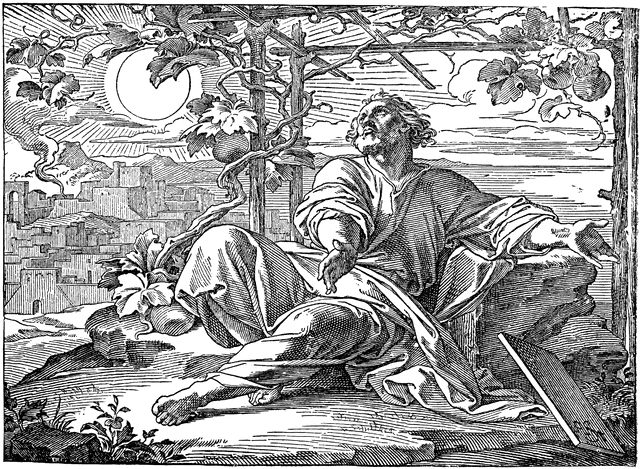
Jonah sheltered by the vine

Yonah waiting to see if Nineveh gets destroyed. He’s kinda hoping it does. How’s that for schadenfreude?

Now, I’ve always thought this story was packed with humor. I mean, G-d singles Jonah out for a little tete-a-tete and he hops on a boat headed in the opposite direction as the mission G-d sent him on? Then he sleeps through the ginormous storm that has everyone else aboard freaking out and get swallowed by a giant fish. Come on!

And when Jonah finally makes it to Nineveh, it gets even wackier. Continue reading