Thank the folks who’ve rejected you–a radical suggestion for writers this Thanksgiving

Thanksgiving is upon us here in the U.S., and this is a wonderful opportunity to reflect upon gratitude, whether you celebrate the holiday or not. I’m a big fan of Rabbi Zelig Pliskin and also of Rabbi Shalom Arush, and I’m going to combine their approaches for this writing exercise appropriate to the Thanksgiving season and year-round. This exercise is useful whether you’re Jewish or not–please don’t get turned off to it just because it was inspired by a couple of rabbis.

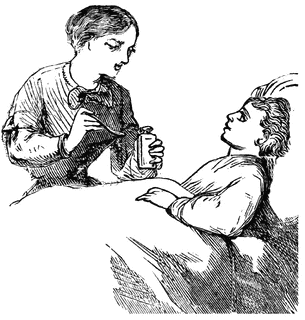
mother offering child medicine

Be grateful for the medicine–it’s good for you.

Rejection is just about the hardest thing to cope with when you decide you’re going to become a writer, but it’s something that you need to learn to accept graciously. When that rejection letter first comes, you are often overwhelmed by feelings of resentment, anger, and frustration. You might lash out, calling the editors idiots or saying that the publisher doesn’t know what good writing is. You might despair, consider yourself a failure, or even give up writing.

But here’s the truth–you were meant to be rejected, at least in this specific instance. Continue reading

Patience is a virtue–Submit when it’s perfect, and then prepare to wait

As I mentioned in a previous post, I’ve been picking up the pace of my submissions, and also broadening the variety of publishers I’ve been submitting to. What I didn’t realize when I committed to this strategy is how much this would test my patience.

waiting - image courtesy of microsoft

You might as well take a seat…this is going to take a while.

Let me explain. Usually, I write for Jewish magazines. If I submit a book, it’s usually a picture book involving Jewish subject matter. The world of Jewish publishers is very small, and the editors receive fewer submissions than those who handle secular material. The response time in the Jewish publishing world is much faster than in the secular publishing world. Moreover, some of the editors have gotten to know me over the years because they’ve employed me, read me online, or just like my style. I suspect that my subs don’t always go in the slush pile, at least in certain offices, B”H & bli ayin hara. Yes, I have to wait for a response from editors, but the wait is relatively short.

Re-entering the realm of secular publishing is a wake-up call to the realities of that world. Continue reading

Finding Inspirational Words from Sarah Shapiro–Defining Jewish Writing, Part 2

A couple of weeks ago, some of the comments on a post I wrote about defining Jewish writing revolved around the introduction to Sarah Shapiro’s All of Our Lives. I took a workshop with Sarah–who writes, edits, and teaches amazing writing workshops that have inspired many fledgling Jewish writers–and have a lot of respect for her opinions, so I borrowed the book from a friend (thanks Miriam!) in order to more accurately represent Sarah’s opinions here.

Sarah’s essay “The Writer’s I” reflects several of the issues I discussed in my original post. Jewish Writing can be defined by the author’s identity, by its subject matter, or can be considered a completely arbitrary label. She personally feels that “all three are right,” but admits the difficulty in establishing a single definition.

Sarah goes on to say that attempts to identify or define specifically Orthodox Jewish writing are even more complicated. Continue reading

Be childlike, not childish–What we can learn about writing from kids

We now—joyfully—have 2 1/2 literate kids in our household. (The 1/2 is only 5. Cut her some slack.) One of the interesting things in my life lately has been watching them become writers, as well. I think we adults can learn a thing or two from their learning curve.

1) Kids enjoy writing about what they like. However, one of the things that makes them better writers is writing about things outside their comfort zone.  It’s a lot easier to get my 10 year old to write about cars or maps, but his writing skills have been built up greatly by writing all those friendly letters, book reports, essays, and so on that get assigned as homework or classwork. When was the last time you wrote something outside YOUR comfort zone? I know professional writers who only write personal essays, or those who have always exclusively written for kids. Try a little of everything. Mix it up. It’ll surprise you.

Watch out! Your bookworm might just become a writer!

2) Kids try to copy what they like to read. They’ll borrow liberally from Captain Underpants, Tintin, and the like. They recognize excellence and strive to emulate it. Of course, we want writers to develop their own voice (and never, ever plagiarize), but there’s nothing wrong from learning from the greats. So do a little pastiche–you’ll get a childlike pleasure from it, and brush up your skills, too.

3) There might be obstacles in the way. The right tools can help. One of my kids has a graphomotor problem. Upon advice, we bought him pencils with fatter leads. What a difference. And now he usually types writing assignments. So much easier for him. Another of my kids is so young, she hasn’t learned to spell yet. Relying on invented spelling allows her to communicate on paper, and she’s so pleased with the result she does a little dance (really, she does). If your inner kid has problems with writing, break it down and see if there’s a solution. Don’t just give up. Continue reading

Flashes and foraging: where story ideas come from

I was reading this interesting little article a while back about the flashes of inspiration that triggered 10 authors to pen their most classic works. The article really focuses on novels that arose out of a spontaneous image or idea that popped into the author’s head. Perhaps the most dramatic was Gabriel Garcia Marquez’s inspiration for 100 Years of Solitude. His sudden insight prompted him to turn his car around and drive his family home to work on his new book instead of continuing towards the beach vacation they’d been headed for.

Now, I recognize that many stories are born that way–bolts of lighting unexpectedly sent from Above, and so on–and it has certainly happened to me before. An editor will select a topic for me to write on (1200-1400 words by next Thursday on this theme, please!) and I’ll sit stumped about how to approach it in some way that isn’t stale and predictable. Hours (or days) later, I’ll try to get back to sleep after someone’s car alarm has gone off and–zing!–HaShem will pop an idea into my brain. (Insert here a sound effect to emphasize the moment.) Sometimes, a detail of a conversation or picture in a book will provoke an entire story to arise almost fully formed from my imagination, with little effort on my part. Yes, this does happen.

Most of the time, however, I forage for ideas. I’ll flip through science news for a new discovery or technology that sounds too impossible to be true. I’ll read three novels all of the same genre or subject, and then compare them. I’ll snip articles out of my HaModia or Mishpacha or Ami. I’ll browse the pages of my journal for wacky things my kids do or things kids fight about, or scribble clusters of words that a topic evokes from my mind.

Once I collect these ideas, they require careful combination. At times the way to do this comes through hard work, strategically arranging plot elements based on the needs of the assignment. Other times, I sit and contemplate them and then let the ideas sorta drift together until something sounds right. I’ll meld a new technology with a situation my children recently dealt with. I’ll transport the subplot from a novel I liked into a fantastic setting, then give it a different ending. Sometimes, after sampling the rough draft, I’ll recognize there’s a missing ingredient and have to hunt around for something that adds just the right flavor. It’s not like there’s no Heavenly assistance involved…it’s just a lot more dramatic, with more input on my part.

In the HaModia Sukkos 5773 story supplement (out today!), you’ll find a piece by yours truly that was generated in just such a way. Discovering that earthbound scientists will likely be exploring new planets via remote-controlled robots, I filed it away for future contemplation. (This isn’t the original article, but it was about the same subject.) After a lot of publicity last winter and spring about how the internet and smart technologies affect human relationships, I revisited the initial idea and found a way to blend the two concepts into an entertaining (I hope!) sci-fi story. I’m hoping the readers enjoy it. It will be my first piece for adults in a magazine with an international circulation!

What’s harder than writing 1000 words a day?

Well, the kids are all in school, so I no longer have any excuses. I’ve been sitting at my desk daily and attempting to crank out a thousand words. This seems to be a pretty common goal for writers, and I seem to make it most days. Okay, some days. The days I’m not editing the stuff I wrote previously.

I guess he didn’t make it to 1000 words today.

On Friday, I set myself a different goal. I had written a piece a while back that the members of my writing group liked. However, when trying to market the piece, the best match for the story was a magazine that has strict word counts for each of its departments. I could only submit to one department at a time, and the piece would only be accepted if it met the qualifications listed. At 1500-ish words, my story didn’t fit in either department that matched the subject matter.

I had a choice with this piece. I could either beef it up to 2000 words, or cut it to 800 words.

So, Friday morning, I sat down to cut 700+ words from my article.

The piece had been well-edited before, and there were few passive constructions or the like to tighten up. At various points, I despaired that I would ever succeed. However, the process was extremely educational, and I’ll share a few of its lessons with you.

1) Think about showing vs. telling. I was able to cut several places where I found I was both showing and telling. The showing was enough. Let the readers make a couple inferences. It’s good for them.

2) Consider, “What it the main purpose of the story?” In a novel, there are often subplots or backstory that add to the narrative. Even a short story will often contain these elements. But in the short, short story (yes, it’s an actual genre), and even more in flash fiction, you have room to keep only the story elements that push the main narrative along. Yes, my little subplot was funny. Yes, I’d grown attached to it. But did it support the main idea? Not so much. Thus, it landed on the chopping block. Off went a couple hundred words.

3) Occasionally, adding a line will help you cut a dozen–or even more.I added a new ending (partly suggested to me by my friend Devorah Talia) and was able to eliminate a huge final scene that took up another two hundred words, or so.

Snip, snip!

4) How many adjectives and adverbs do you really need? After reading an article a year or so ago, I’d eliminated many adverbs from my writing vocabulary, switching to stronger, more precise verb usage. I had hardly any adverbs modifying verbs in the article. However, I seem to cling to the use of adverbs that modify adjectives. In this piece, the biggest offenders were the words “really,” “very,” “so” and the like. Also, the improved choice of nouns and verbs removed the necessity of using many adjectives.

5) Read aloud several times. I had read this piece to myself dozens of times already. Reading out loud was a very different experience. I was able to discern unnecessary material more readily, and often could think of natural substitutions for certain wordy idioms I’d used. Breaks in between allowed me to see the words with new eyes each time.

I submitted the piece this morning after cutting one more word. Let’s hope the exercise helps me sell the piece! Even if it doesn’t sell, the editing practice will have served me well.