Looking for a gift? 5 New books to consider this Chanukah season, including Red is My Rimon, Chanukah Guess Who?, The Torah Book of Opposites, The Wooden Sword, and The Tempest in the Tea Room

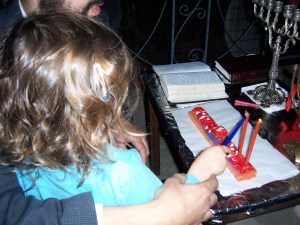
lighting chanukiah with abba

Chanukah is coming! Did you remember to get this cutie a gift?

In the upcoming Chanukah edition of CitySpirit Magazine (available here in L.A. within the next week or so), you’ll find reviews of four books either authored or illustrated by local L.A. talent. Any of them would make perfect gifts for Chanukah for kids. The books I reviewed for CitySpirit (with links to their pages on Amazon) are:

Red is My Rimon

Chanukah Guess Who?

The Torah Book of Opposites

The Wooden Sword

If you’re looking for a Chanukah gift for a teen or an adult reader, why don’t you check out Libi Astaire’s newest The Tempest in the Tea Room.  Continue reading

When is an author a Jewish author? Defining Jewish writing, Part 3

Last week was marked by big news in the book world. Famed-American Jewish author (Jewish meaning author’s ethnicity only, in this case–see previous posts on the subject) Philip Roth has declared that he’s retiring from writing. On the other hand, equally aged and famous American-Jewish author Herman Wouk has just put out another novel. Interestingly, these events didn’t just make headlines in Jewish publishing, but publishing as a whole.

The stereotypical Jew is considered “bookish,” pale due to the amount of time he spends indoors. We are called “the People of the Book.” How is it that Jews became inextricably interwoven with books? Continue reading

3 Ways to use your words charitably–How to help people in need from far away

Yesterday, it took me hours to get myself writing. Instead of typing at my keyboard, I was numb with fear for the residents of Israel (and, in fact, for the children of Gaza, whose safety is in jeopardy–regardless of who is jeopardizing it, which is a political question I refuse to address here). It’s only a couple weeks since Superstorm Sandy hit the eastern seaboard of the U.S. People lost homes, places of worship, jobs, every material good they possessed. And here I sit in California, comfortable and in no immediate threat of danger. There are no sirens warning of incoming rockets blasting in my neighborhood, and the rain outside is just a sprinkle.

On this blog, I write about words, and how to employ them. Today, I’m going take a break from discussing professional writing to give 3 ways you can use your words to help people in Israel and the victims of Hurricane Sandy.

1) You can blog to raise money for a (legitimate) charitably organization who will be helping the victims of Sandy (such as the Jewish charity Achiezer and the secular  American Red Cross).

2) You can write a letter or email (or post on a Facebook page) to a friend in Israel or in New York (or other Sandy-affected area). If you don’t know what to say, just say, “I want you to know I’m thinking about you. I’m far away, but you are not forgotten.”

3) You can write something to bring goodness in the world–a letter apologizing to someone you hurt, intentionally or not; a letter to someone lonely; something kind and beautiful. Then mail it.
 

Finding Inspirational Words from Sarah Shapiro–Defining Jewish Writing, Part 2

A couple of weeks ago, some of the comments on a post I wrote about defining Jewish writing revolved around the introduction to Sarah Shapiro’s All of Our Lives. I took a workshop with Sarah–who writes, edits, and teaches amazing writing workshops that have inspired many fledgling Jewish writers–and have a lot of respect for her opinions, so I borrowed the book from a friend (thanks Miriam!) in order to more accurately represent Sarah’s opinions here.

Sarah’s essay “The Writer’s I” reflects several of the issues I discussed in my original post. Jewish Writing can be defined by the author’s identity, by its subject matter, or can be considered a completely arbitrary label. She personally feels that “all three are right,” but admits the difficulty in establishing a single definition.

Sarah goes on to say that attempts to identify or define specifically Orthodox Jewish writing are even more complicated. Continue reading

Did I write that book?

I just had yet another one of those heart-stopping moments where I saw a book title, then read the review of the book and thought:

OMG! I WROTE THAT BOOK!

I’m pretty disgusted with my reaction. I’m sure my idea isn’t so original that no one else could’ve had that same one. Yes, I had my idea before that book was published—but what if that author thought of it first? Or maybe she didn’t think of it first, but she executed it better?

-sniff-

I’m chalking this up as another exercise in, “I’m only responsible for my effort, not my success.” If I was meant to sell that manuscript (I did shop it around a bit), then I would have sold it.

The end. Now it’s time to suck it up.

How to teach people while you entertain them: Modern-day Moshels

To those unfamiliar with the term, a “moshel” is the Hebrew term for a parable, a story told with the intent to illustrate a lesson (usually a moral or theological one). I equate moshels with the soda your mom would offer you as a chaser after taking whatever foul-tasting medicine the doctor had prescribed you. It makes it easier to get the lesson down, and you might even look forward to the next dose.

Moshels–particularly those of the Baal Shem Tov, Rebbe Nachman of Breslov, and the Ben Ish Chai–are familiar to most readers with a Jewish education. They often appear in Rabbis’ drashos, and they sometimes make their way into children’s books. Several authors have recently attempted to update classic moshels and make them more appealing to tweens and teens–most successfully, perhaps, Steve Sheinkin in his entertaining Rabbi Harvey series, which take place in the Old West. One of the most challenging aspects of this genre is that you want to convey the lesson accurately without sounding pedantic, boring, or preachy. Also, some of the settings and situations detailed in traditional moshels don’t appeal to contemporary readers, or (more often) are so unfamiliar as to complicate comprehension of them.

I have my own spin on the Modern-day Moshel that I’ve been trying to market, which I’m not sharing here (because, like many authors, I’m terrified of people copying my idea before I can sell it myself–see this post). However, I thought I’d provide a heads-up to my readers what I’m thinking about right now.