How to optimize your Goodreads “To-Read” list

A few weeks back, I posted about how we select the books we want to read now, next and never.

On a related theme, I just spent an hour culling unwanted books from my Goodreads “To-Read” list. 

Because what good is a “To-Read” list if you don’t really want to read the books on it?

After my very well-intentioned husband took the aforementioned list to the library and returned with many of the books it contained, I discovered few were readable in the land of Mrs. Rebecca Klempner. Three offended my (admittedly rather sensitive) sensibilities so much that I immediately took them out to our van and left them there to be returned to the library. Ugh.

How do such books get on my “To-Read” list in the first place? Continue reading

Prejudices, or how we pick what we want to read now, next or never

My sister attended Conservative rabbinical school here in L.A. back when I was a California greenhorn, still getting confused because the ocean was to the west instead of east, that people called flip-flops slippers and jimmies, sprinkles. At the time, I was exploring Orthodoxy, but shared many of my sister’s friends from the UJ (now American Jewish University) and her Conservative synagogue. Despite my move to Orthodoxy, I remain friendly with many of her friends and colleagues.

Recently, one of my sister’s classmates came out with a book. Naturally, I was excited, so I checked read the synopsis on Amazon.

Within 30 seconds, I decided that I couldn’t and wouldn’t read the book. Continue reading

Different strokes for different folks: How one book can inspire so many others

A while back, someone my husband respects very much encouraged him to read this book:

Stop Surviving Start Living Shafier

Rabbi Shafier’s book, based largely on Mesillas Yesharim

The first time I read Rabbi Shafier’s book, Stop Surviving, Start Living, I just didn’t get it. Not the content of the book — the content was clear as day, written lucidly by Rabbi Shafier, with nice anecdotes and everything. What I didn’t get was that it was based on a book my husband had already read. This one: Mesillas Yesharim, known in English as The Path of the Just, one of the most foundational texts in the Mussar world.

Mesillas Yesharim by the RAMCHAL

The original. So inspirational…and a bit scary for the uninitiated.

Why, I asked my husband, write a book based on another one, a book that you actually want people to read (because you’re such a fan yourself)? Continue reading

New Jewish year, new books by Jewish authors!

The new Jewish year is marked this time around with several new book releases that have me very excited:

1) After being mesmerized by The World to Come and In the Image, I can’t wait to read Dara Horn’s newest, A Guide for the Perplexed, which was officially published today. An essay by the author appeared in The New York Times this week, reminding of the book’s release. The topic was the role of memory in literature — particularly in Jewish literature — which Horn tied to Rosh Hashanah. (The holiday falls later this week, and it’s also known as “The Day of Remembrance.”) Her new novel reportedly draws on this theme as it follows two contemporary characters obsessed with the work of the Rambam.

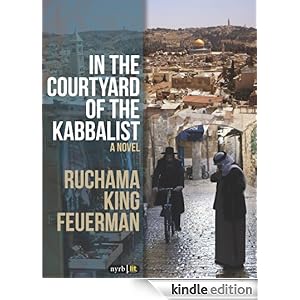
in the courtyard of the kabbalist

Ruchama King Feuerman’s latest, just out

2) Ruchama King Feuerman’s In the Courtyard of the Kabbalist follows an assortment of characters in Jerusalem. I’m very blessed that the author has sent me an advance copy — a review here on the blog will be forthcoming. I was a big fan of her last book, Seven Blessings, as well as some of her more recent, shorter work. Feuerman has been called “a Jewish Jane Austen,” probably because her character portraits so marvelously balance positive and negative qualities. I’m already a few dozen pages in to the new book and really getting into it. For a recent review, see here.

3) Ofir Touche Gafla’s The World of the End will soon be published in English. Continue reading

Books–still better than TV?

Liel Liebovitz, on Tablet Magazine this week, argues that TV is for Dummies.

old TV

Photo of Sanyo TV courtesy of Kevin Simpson via Flickr

Like most titles, this one exaggerates Mr. Liebovitz statement: that even if TV has achieved more creative sophistication than ever before, it still fails to reach the majesty of the written word (or something to that effect). In his mind, books are still king. He bases his argument, as I understand it, on the inability of a visual art form to capture the interior life of characters, using a passage written by Henry James as evidence. In the first hour online, Mr. Liebovitz has received 19 comments on his article.

Well, I haven’t had a TV set in my home since 2000, so I can’t really attest to the increase quality of television programming in the last few years. Continue reading

To outline, or not to outline, that is the question.

I just viewed this interesting slideshow on Flavorwire containing outlines by famous writers. I use “outlines” in a broad sense–several were more like graphic organizers than true outlines. I had a weird reaction to the piece.

Usually, I start stories with clusters or notes, not with actual outlines, unless we’re talking something big–a serial (even a mini-serial) or a novel. Sometimes, I cross out and draw arrows to rearrange the elements so often, I end up rewriting the whole thing a few times because I no longer can read my own diagrams.

In most cases, these scribbles remain private. However, I happen to be working on a project right now where the publisher requested an outline first, but that’s never really happened before.

Several of my friends tell me they just start writing. They skip the outlines, diagrams, and charts and words just start to flow.

This slideshow bizarrely made some part of my brain do a superiority dance. “I am in good company with other prewriters,” it seems to say. “Just look at me with the likes of Henry Miller, William Faulkner, Sylvia Plath and Joseph Heller!”

This is utter nonsense. Plenty of writers do just fine without scribbling diagrams, outlines, or the like first, particularly if they are writing short form.

Are you an outliner? Why or why not?