My 5 Favorite Things Currently on the Web

I spend most of my time on the internet doing work, but every once in a while, I stumble upon something I love and have to keep coming back for more. Here are links to my current favs so you can check them out and get obsessed, too.

1) Space Rabbi – I love the brothers Taub and have enjoyed their various projects on Chabad.org for years. Episode 1 gets off to a slow start, but it’s all wackiness from then on, from the retro “futuristic” design elements, to the HAL references, to the bizarre characterizations of all the electronic gadgets that come to life and interact with Rabbi Blastoffski.

Yes, the main character is actually called Rabbi Blastoffski. How cool is that?

2) Pop Chassid – Currently, my favorite Jewish blog on the internet. Elad Nehorai reflects on Judaism, Chassidus, the arts, and modern life. Not only are his posts insightful, but he has some wonderful followers who post great comments.

3) Hanan Harchol – I first got wind of this guy through a bit he had up on Aish.com.  Most of the videos are animated dialogues between Hanan and (his impersonation of) his father and contain reflections about Jewish philosophy. Utterly charming and thought-provoking.

4) Verplanck – I’m not sure how long these guys are going to be around, because they need to raise funds for their project, but part 6 of their Orthodox online comedy is simply hilarious. (Although you probably need to be religious to get the jokes.) It’s awesome if you’re home sick and are too old for Agent Emes. You will laugh yourself healthy.

5) Shtar – Because they rock. Literally. (Okay, sometimes it’s more like hip-hop. Or maybe techno. Or maybe just cool.) “Wonderland” should be used in commercials by the Ministry of Tourism to encourage travel to Israel.

(My first runner-up is G-dcast, video interpretations of Jewish texts that aren’t always Orthodox, but always creative. Check out Avoiding the Mud for a Chassidishe meise, or The Rise of Yavneh for the story of Kamsa and Bar Kamsa and destruction of the Temple.)

Throwing down the gauntlet: I challenge you to write something different!

knight in armor

Be careful! If this guy throws down the gauntlet, it’ll probably hurt.

So yesterday I read this post by the Rubber Ducky Copywriter. In it, she posts about her first rejection letter after going out on a limb and submitting a short story. Despite her success as a copywriter, fiction is a new endeavor for her, and rejection hurt.

First of all, I’d like to cheer her on. Despite the rejection letter (and my readers will know I’m no stranger to them), the Rubber Ducky Copywriter did something a lot of us writers don’t do: try something new.

A lot of us avoid writing new things, especially after we find success (especially financial) in a particular niche. I know that it took me a long time to start writing for adults after I’d succeeded with kids’ lit. Other changes were also scary, because they carry risk. What if you invest time and emotions and no one ever publishes it?

But the pay-off can be big.

For years, I focused on my fiction. When I ventured on occasion to write a personal essay, it would inevitably face a quick rejection. Out of frustration, I gave up writing personal essays for a long time.

But, when I came back to it, I did better. My years of practicing fiction helped me hone my storytelling abilities. The first personal essay I’ve had published shows this and found a much wider audience than my fiction thus far has.

So here’s my creative writing challenge:
Continue reading

Home decorating with bibliophiles: what your books say about you

Yesterday’s L.A. Times had a wonderful article by book critic David Ulin about his book collecting habits. His home is packed floor to ceiling with shelves and shelves of books. Periodically, he arranges them in alphabetical order.

Ulin shares many reasons for his enormous book collection. Here’s his chief one:

They are part of my present, yes, but also part of my past, my history: three-dimensional memories.

Among their appeals is that they opened up a world view, which is what the most essential writing does. Yet equally important is their resonance as objects, carried with me, shelf to shelf, apartment to apartment, over decades, physical reminders of who I was and who I am and of my process of becoming, blurring the line between inside and out.

This led me to think about what the Klempner family book collection means about us.

  • World view – Klempner adults are cheapskates. We love borrowing from libraries more than buying books. We still have a lot of books, but not relative to the amount of reading that goes on around here. Most of the books we actually own are Jewish books, especially for adults–books of prayer, Torah, character-building, and so on. The secular adult books we own are mostly practical.
  • Life history – You can see what my husband learned in classes ten or fifteen years ago by checking which volumes of the Gemara we own. You can tell I studied anthropology in graduate school and that one of us reads French (speaking is another matter…). You can tell we’re both teachers, and that we’re the kind of parents that like to read a lot about how to parent. On the kids’ shelves, you can track all of my eldest child’s special interests since age 5.

What do your books say about you?

Better Writing vs Better Sales: What makes a better writer?

Today’s post from The Write Practice got me thinking. In it, Joe Bunting suggests that we worry too much about sales, and even about how good our writing is.

I love these two lines:

Does the fact that more people have read Twilight than have read [any book by] Mark Twain mean Stephenie Meyer is a better writer?

More important for us, does the fact that we are all less known than E.L. James (as far as I know) mean our stories aren’t as good?

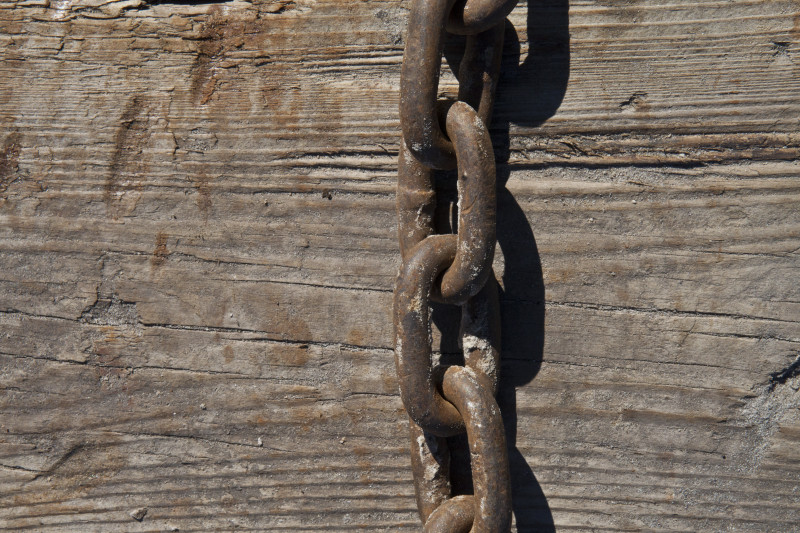
metal chain

Your writing can be the chain that binds people together.

Bunting suggests we think “Connection” (with readers) over “Competition” (with other writers).

What Bunting says really appealed to me. Of all the kinds of feedback I get from my stories and articles, the ones that mean the most are the ones where people tell me that they identified with some aspect of what I’d written–particularly if the person is really different from me. This the kind of thing that bonds together humanity. Bunting would call this kind of connection literary success.

I’d call it something else: a measuring stick to use if you want to judge your writing’s moral quotient: will this writing bind people together, or will it tear them apart with strife? In that sense, “Good Writing” has a quality beyond the writer’s style or storytelling ability. It’s “Good” in the moral sense, as well.

What do you think?

Background on my new story: “Just Perfect” (or why I believe we all live in a Magical Reality)

This week, Hamodia‘s Inyan Magazine published my new short story (and it’s actually for adults!), entitled “Just Perfect.”

The original version of the story was explicitly a piece of fantasy, but as I mentioned in a previous post, I transformed the story into an example of magical realism rather than fantasy in order to address the concerns of my lovely and knowledgeable editor at Hamodia. 

In the original version, then called “Easy as Pie,” the transformation of Libby’s life occurred after she bumped into a little old lady who offered her a slice of peach pie at a party. The pie made Libby’s life–well, just peachy. But my editor felt the little old lady was a little unbelievable. Could I cut her? The only problem was that her brief appearance at the beginning and the end of the story explained the wacky events in between.

I wracked my brains for a way to ditch the old lady but save the rest of the silliness. There had to be an explanation for it, after all. I did a bit of experimentation and research. Finally, I decided that maybe Libby should just pray–and then G-d answers.

Even after I found my “magically real” solution, I initially balked at making the change. It was an elegant solution, so my reaction puzzled me. I had to think about it a lot, and I think my conclusion is worth sharing. Continue reading