Why I think speculative fiction is just SO Jewish (& you should, too)

One of the things I most like to write (and find it hard to sell) is Jewish speculative fiction. Speculative fiction is a wide-ranging label that includes genres like fantasy, science-fiction, and horror. Basically, in speculative fiction, the author suggests a scenario that proposes the question: “What if_______?”

What if…

…you found out that you weren’t a friendless orphan but a powerful wizard with many supporters? (Harry Potter)

…you discovered the back of the wardrobe led into a magical realm where you became royalty? (Narnia)

…you discovered there was a way to communicate with aliens through your dental work? (Fat Men From Space)

…you accidentally returned to the time of the Holocaust during your Pesach Seder? (The Devil’s Arithmetic)

While Isaac Asimov, Jane Yolen, Harlan Ellison, Daniel Manus Pinkwater, and many other secular Jewish Americans (as well as the Orthodox writer, Michael Burstein and the Israeli writers Lavie Tidhar and Nir Yaniv) have written speculative fiction to great acclaim–even Jewish speculative fiction–specifically Orthodox Jewish speculative fiction is much harder to find. As I have mentioned previously on my blog (and again, and again), there has been movement into this direction. But still, I get a lot of funny looks when I tell people what I most like to write.

But I don’t get it. I think speculative fiction is just SO Jewish, and so should you. Here’s why: Continue reading

When is an author a Jewish author? Defining Jewish writing, Part 3

Last week was marked by big news in the book world. Famed-American Jewish author (Jewish meaning author’s ethnicity only, in this case–see previous posts on the subject) Philip Roth has declared that he’s retiring from writing. On the other hand, equally aged and famous American-Jewish author Herman Wouk has just put out another novel. Interestingly, these events didn’t just make headlines in Jewish publishing, but publishing as a whole.

The stereotypical Jew is considered “bookish,” pale due to the amount of time he spends indoors. We are called “the People of the Book.” How is it that Jews became inextricably interwoven with books? Continue reading

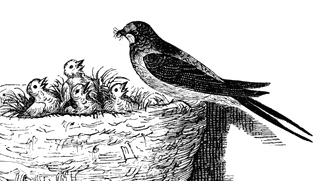
Early birds and the people who hate them–the writing habits of a morning person

Swallow feeding worms to her chicks

I may be an early bird, but I promise I don’t feed worms to my kids for breakfast.

I’m almost ashamed to admit it, but I am a morning person. Why the shame? Because I have discovered that there is nothing that night owls hate as much as the behavior of us early birds. And it seems that there are a lot of night owls around, judging but the fuzzy eyeballs cast in my direction at 7 am, when I smile and bounce and chirp, “Good morning!” at them.

When I lived in that sleep-deprived state induced by having an infant at home, my natural biorhythms were completely disrupted. Continue reading

Cold shoulder or pit bulls? On Peter Beinart, the Atlanta Jewish Book Fair and how to act when you disagree with a writer

I don’t often comment on news items, but this one is both Jewish and book-related, so I thought it would be worth mentioning.

Earlier this year, Peter Beinart–blogger and professor–wrote a book blaming the lack of peace in Israel on the Israelis. Even to someone whose politics are somewhat atypical for an Orthodox Jewish American, I found the premise of Beinart’s book both offensive and intellectually flimsy.

Should we set the dogs on ‘im?

This week Atlanta’s JCC hosts 10,000 visitors at its annual Jewish Book Fair. Initially, Peter Beinart was scheduled to appear there to promote his book. But, due to the outrage of many Atlantans who disagree with his public attacks of the Israeli government, Beinart will no longer be welcome to speak at the book fair. Instead, he’s speaking this evening at a different venue. (For more coverage, see here.)

Was this the right reaction? Continue reading

10 Ways to show your favorite authors just how much you love them

Pretend you’ve just opened up your favorite magazine. You see a name–the name of your favorite writer, whose articles you always like. You flip right to the page with their latest story and start to read.

Or maybe there’s an author you like so much that you head for the book shop as soon as their newest title comes out. Or perhaps your librarian knows they are your favorite writer and steers you to all their books.

Or maybe there’s a book you always recommend to friends, but no one’s ever heard of that author or that book before.

How do you love me (and my blog), let me count the ways…

I’ve been doing research about marketing and SEO (search engine optimization) in the last few weeks, and what’s interesting is that for writers, many of the best ways to promote our work are free—but depend on the participation of our fans to succeed.

How can you help writers like the ones I described above improve their sales and market visibility?

Here are a few steps. Continue reading

Finding Inspirational Words from Sarah Shapiro–Defining Jewish Writing, Part 2

A couple of weeks ago, some of the comments on a post I wrote about defining Jewish writing revolved around the introduction to Sarah Shapiro’s All of Our Lives. I took a workshop with Sarah–who writes, edits, and teaches amazing writing workshops that have inspired many fledgling Jewish writers–and have a lot of respect for her opinions, so I borrowed the book from a friend (thanks Miriam!) in order to more accurately represent Sarah’s opinions here.

Sarah’s essay “The Writer’s I” reflects several of the issues I discussed in my original post. Jewish Writing can be defined by the author’s identity, by its subject matter, or can be considered a completely arbitrary label. She personally feels that “all three are right,” but admits the difficulty in establishing a single definition.

Sarah goes on to say that attempts to identify or define specifically Orthodox Jewish writing are even more complicated. Continue reading