New Jewish year, new books by Jewish authors!

The new Jewish year is marked this time around with several new book releases that have me very excited:

1) After being mesmerized by The World to Come and In the Image, I can’t wait to read Dara Horn’s newest, A Guide for the Perplexed, which was officially published today. An essay by the author appeared in The New York Times this week, reminding of the book’s release. The topic was the role of memory in literature — particularly in Jewish literature — which Horn tied to Rosh Hashanah. (The holiday falls later this week, and it’s also known as “The Day of Remembrance.”) Her new novel reportedly draws on this theme as it follows two contemporary characters obsessed with the work of the Rambam.

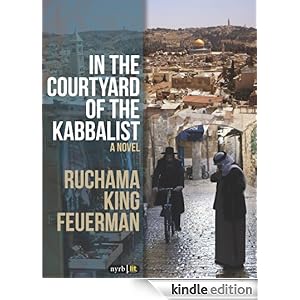
in the courtyard of the kabbalist

Ruchama King Feuerman’s latest, just out

2) Ruchama King Feuerman’s In the Courtyard of the Kabbalist follows an assortment of characters in Jerusalem. I’m very blessed that the author has sent me an advance copy — a review here on the blog will be forthcoming. I was a big fan of her last book, Seven Blessings, as well as some of her more recent, shorter work. Feuerman has been called “a Jewish Jane Austen,” probably because her character portraits so marvelously balance positive and negative qualities. I’m already a few dozen pages in to the new book and really getting into it. For a recent review, see here.

3) Ofir Touche Gafla’s The World of the End will soon be published in English. Continue reading

It’s the week of Shavuos!

Things have been a bit crazy in the Klempner household as of late. We’re already in the week of the Jewish holiday of Shavuos, the subject of my picture book, A Dozen Daisies for Raizy.

A few weeks ago, in honor of the 5th anniversary of Raizy, I asked librarians, teachers, and parents about how they’ve reacted to Raizy. Here are some of the responses:

From fabulous librarian Davida Levin, of the Torah Day School of Atlanta:

I love using the book every Shavuos with my K-2 library groups, and was delighted that several of the 1st and 2nd grade girls said that they also own the book.

This year we talked about what the daisies meant to the recipient and decided that they meant “I like you” or “I care about you”. The second graders were able to  say that the flowers were a reminder of Raizy’s invitation or offer of help.  This year I gave the girls the attached pages to fill in during check out time–one even suggested that you could send them to Hashem, but another was sure that Hashem can make His own flowers.

Here’s a copy of the handout she used. Feel free to borrow it, but give credit to Davida, okay?
Regular Binah and Inyan writer Rochel Burstyn says of Raizy:
I worked a few years ago in a playgroup and it was one of the kiddies’ favorite and the only ‘long’ one I could sit through!
Another fan of Raizy, Chani Fischman, wrote me to say:[m]y daughter has brought your book, A Dozen Daisies for Raizy, home from her school library a few times and we’ve enjoyed reading it together at bedtime. I like the fact that 1. The book is not too wordy (I hate wordy children’s books) 2. The pictures are vivid. 3. Subtraction becomes so clear to children without them realizing that they are actually doing a mathematical operation.

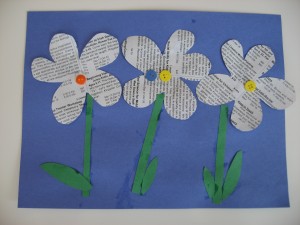
Last year, I gave out a couple craft ideas to create daisies for Shavuos following a school visit I did here in L.A. Here are a few more last-minute ideas, with an emphasis on projects that are particularly kid-friendly and can be done mostly with stuff you can find around the house:

daisy craft

Recycled kid’s project for Shavuos.

Have a great holiday everyone!

Save the books for L.A. Jewish kids!

The local Jewish children’s library here in L.A. will be closing in a month and a half. It gets plenty of visitors, but the Federation wants to let the Zimmer Museum (a bigger money-maker) use the space.

pout

Think she heard the Jewish Library is closing? (Picture available through Creative Commons–rumolay on Flickr)

Regular patrons like me are grumbling. How else can we feed the voracious literary appetites of our Jewish kids without breaking the bank? PJ Library is a fabulous resource, but has three drawbacks:

  1. Kids can’t select their own titles to read.
  2. Kids can only receive books for a small window of childhood.
  3. Kids get only one book a month.

This past Sunday, the Jewish library was packed for the monthly Read with Dogs event, and the parents bemoaned the closure. We’re upset that the amazing librarian, Amy, will lose her job, and will miss the books and activities that we’ve enjoyed there.

There’s a Facebook Page for the effort to save the book collection at a new location. If anyone has the link, please post it below in the comments. It’ll only work through grassroots efforts.

Reading local-to-L.A. authors

One of my favorite things to do is to promote the work of Jewish writers with West Coast connections. Here are a few I’ve read in the last couple months:

Hands-On How To’s for the Home & Heart by Tova Younger (Shemtov Press 2012)

TOVA YOUNGER final cover

Tova Younger’s recent release

Tova Younger is a former Angeleno who settled in Kiryat Sefer in 2004. Her new book, Hands-On How To’s for the Home & Heart, contains friendly and very practical advice of all types for the Jewish wife.

When I was first living on my own, someone gave me a book, Where’s Mom Now That I Need Her: Surviving Away from Home. That cookbook/home repair/car repair/first aid/ and just about everything else manual got me through a lot of tough situations. Younger’s book is almost a Jewish version of that secular classic—chock full of basic information that every Jewish homemaker can benefit from.

Divided up into four primary sections:

  • For the Heart
  • For the Home
  • Handy Tips
  • recipes

Hands-On How To’s for the Home & Heart offers advice about everything from maintaining proper kavana (focus) to proper laundering; from how to make conversation with the relatives to whom we owe kavod (honor), to recipes for basics like beet salad and cornflake quiche.

Younger’s book would make a terrific gift for seminary girls, the newly married, and even seasoned homemakers. You can find it on discount right now at Jewish e-Books.

Bells & Pomegranates by Rachel Pomerantz (Menucha Publishers 2012)

bells and pomegranates

Rachel Pomerantz’s latest

Well-known Orthodox author Rachel Pomerantz frequently travels to SoCal to visit her brother and mother, who live near San Andreas. Her latest serial novelization, Bells & Pomegranates, follows the shidduch process of various characters (introduced in previous books), all of whom have life circumstances that present hurdles in their quest for a mate.

There are step-siblings Yoel and Devora, who have been adopted, and the twins Rina and Gila, who converted as children and grew up in a single parent home. There’s foster child Ronny, whose mother is mentally ill, and Yossi, the child of baalei teshuva. Sarah’s got great yichus, but she’s an orphan. These characters and others start off the shidduch process with considerable challenges—but as the novel progresses, Pomerantz throws additional complications into their paths, lending drama and suspense to their intermingled stories.

Bells & Pomegranates is more than kosher entertainment for a rainy afternoon. In describing the family dramas of her characters, Pomerantz invites us to question our own preferences and prejudices. How do my assumptions affect my judgment? How involved should parents and grandparents be in the shidduch process? What are legitimate reasons to call off a prospective match? These questions and others lingered with me after I finished the book.

On This Night: the Steps of the Seder in Rhyme by Nancy Steiner (HaChai 2013)

on this night

While a seasoned freelance author, Nancy Steiner is new to picture book writing. Her first kids’ title, On This Night, will likely prove to be a classic. In cheerful—but unforced—rhyme, Steiner leads readers through the steps of the seder. Her language is perfectly accessible for young readers and will prepare them for the Pesach experience.

The darling illustrations by Wendy Edelson depict an adorable family celebrating their seder. Edelson portrays the family members from a variety of angles, adding to the visual interest. From the twinkly-eyed zeide to the drowsy preschooler on the final page, the pictures (and text) are sure to engage kids aged 2 to 6.

Also of note:

L.A. resident Sarah Bunin Benor’s new book, Becoming Frum (Rutgers University Press 2012), considers the ways newly religious Jews adapt to the language of the mainstream Orthodox world. While an academic book rather than a religious one, Bunin Benor bases her conclusions largely on research conducted here in L.A., and her book will be of great interest of those engaged in the baalei teshuva phenomenon. I participated in her initial online survey, which piqued my interest in her work. I hope to write an entire post devoted to Bunin Benor’s book (and her spin-off website) soon.
Why I think speculative fiction is just SO Jewish (& you should, too)

One of the things I most like to write (and find it hard to sell) is Jewish speculative fiction. Speculative fiction is a wide-ranging label that includes genres like fantasy, science-fiction, and horror. Basically, in speculative fiction, the author suggests a scenario that proposes the question: “What if_______?”

What if…

…you found out that you weren’t a friendless orphan but a powerful wizard with many supporters? (Harry Potter)

…you discovered the back of the wardrobe led into a magical realm where you became royalty? (Narnia)

…you discovered there was a way to communicate with aliens through your dental work? (Fat Men From Space)

…you accidentally returned to the time of the Holocaust during your Pesach Seder? (The Devil’s Arithmetic)

While Isaac Asimov, Jane Yolen, Harlan Ellison, Daniel Manus Pinkwater, and many other secular Jewish Americans (as well as the Orthodox writer, Michael Burstein and the Israeli writers Lavie Tidhar and Nir Yaniv) have written speculative fiction to great acclaim–even Jewish speculative fiction–specifically Orthodox Jewish speculative fiction is much harder to find. As I have mentioned previously on my blog (and again, and again), there has been movement into this direction. But still, I get a lot of funny looks when I tell people what I most like to write.

But I don’t get it. I think speculative fiction is just SO Jewish, and so should you. Here’s why: Continue reading

How to teach people while you entertain them: Modern-day Moshels

To those unfamiliar with the term, a “moshel” is the Hebrew term for a parable, a story told with the intent to illustrate a lesson (usually a moral or theological one). I equate moshels with the soda your mom would offer you as a chaser after taking whatever foul-tasting medicine the doctor had prescribed you. It makes it easier to get the lesson down, and you might even look forward to the next dose.

Moshels–particularly those of the Baal Shem Tov, Rebbe Nachman of Breslov, and the Ben Ish Chai–are familiar to most readers with a Jewish education. They often appear in Rabbis’ drashos, and they sometimes make their way into children’s books. Several authors have recently attempted to update classic moshels and make them more appealing to tweens and teens–most successfully, perhaps, Steve Sheinkin in his entertaining Rabbi Harvey series, which take place in the Old West. One of the most challenging aspects of this genre is that you want to convey the lesson accurately without sounding pedantic, boring, or preachy. Also, some of the settings and situations detailed in traditional moshels don’t appeal to contemporary readers, or (more often) are so unfamiliar as to complicate comprehension of them.

I have my own spin on the Modern-day Moshel that I’ve been trying to market, which I’m not sharing here (because, like many authors, I’m terrified of people copying my idea before I can sell it myself–see this post). However, I thought I’d provide a heads-up to my readers what I’m thinking about right now.