Background on my new story: “Just Perfect” (or why I believe we all live in a Magical Reality)

This week, Hamodia‘s Inyan Magazine published my new short story (and it’s actually for adults!), entitled “Just Perfect.”

The original version of the story was explicitly a piece of fantasy, but as I mentioned in a previous post, I transformed the story into an example of magical realism rather than fantasy in order to address the concerns of my lovely and knowledgeable editor at Hamodia. 

In the original version, then called “Easy as Pie,” the transformation of Libby’s life occurred after she bumped into a little old lady who offered her a slice of peach pie at a party. The pie made Libby’s life–well, just peachy. But my editor felt the little old lady was a little unbelievable. Could I cut her? The only problem was that her brief appearance at the beginning and the end of the story explained the wacky events in between.

I wracked my brains for a way to ditch the old lady but save the rest of the silliness. There had to be an explanation for it, after all. I did a bit of experimentation and research. Finally, I decided that maybe Libby should just pray–and then G-d answers.

Even after I found my “magically real” solution, I initially balked at making the change. It was an elegant solution, so my reaction puzzled me. I had to think about it a lot, and I think my conclusion is worth sharing. Continue reading

Fans, friends, and trolls–publishing my first piece on Tablet

So, Tablet published a piece of mine this week. It’s been a crazy experience.

In the first place, writing the piece was a bit out of my comfort zone. While I usually write fiction, this is a personal essay. In brief, the story is about confronting my inner teenager as I’m approaching 40 and relates an episode where I thought a younger man was checking me out in a cafe.

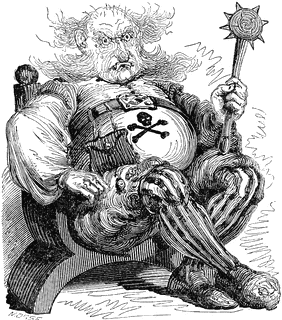
Troll

Trolls don’t only live under bridges.

The subject matter was outside the editorial policies of the chareidi magazines that comprise my usual stomping grounds, so I had to find an alternative publisher. Afraid I might embarrass my husband, I almost decided not to publish it at all, but he assured me that he didn’t mind. And when I shared an early draft with writing friends, the strongly positive reaction encouraged me further.

Tablet accepted my query, then the completed essay. They had it up in a matter of days. Whoa. It didn’t leave me much time to prepare myself. And, boy, did I have to prepare myself.

You see, there’s a lot of differences between a Jewish, but broad-spectrum, online magazine like Tablet and print magazines in the chareidi world. The biggest difference is the comments section.

In a print magazine, there is no comments section. Continue reading

3 Tricks for magazine writers: How to write on a theme and still make your deadline

keyboard

Before you start to type, you might want to try one of these 3 things.

One of my writing jobs is penning teen and tween stories for Jewish magazines. Before getting this gig, I had to learn an important lesson: most kids’ magazines select one theme per issue, and they are only open to stories on those themes. That means you have to write what they want, when they want it–but you’ve got to still tap into your creativity to make your story fresh, fun, and readable.

NOTE: Writing contests (although many are scams, there are plenty of legit ones) and classroom assignments frequently require that submissions/assignments include a specific topic or theme and have a deadline, as well. You don’t have to write for magazines to benefit from these 3 tips.

Sometimes, I get the heads-up on what story the editor wants on what theme a month in advance. But sometimes it’s a lot less. How do I come up with a story on short notice?  Continue reading

New story out! “Long Lost” in this week’s Binyan

Have you ever met someone who shared your last name, and wondered whether you were long-lost relatives? That’s the set up for my new story for teens in this week’s Binyan (inside the Parshas Shemos issue of Hamodia), “Long Lost.”  Check it out if you get the chance.

I used a remarkable incident from my own family history to add interest to the story. Have you ever adapted incidents from your family’s past into a fictional story? Please share your comments below.

Jewish magazines still jockeying for market share

Hamodia front page.jpgYated Neeman
In the last few years, English-language Orthodox (charedi) periodicals have proliferated. (A little disclosure is appropriate here–I’ve written for both Aim! and Mishpacha Junior, am a long-time subscriber to HaModia.) Interestingly, as new publications show up, the older ones change formats (sometimes repeatedly) in order to improve their market share.
For example: HaModia came out with an online edition and now so has the Yated (honestly, I don’t know which happened first, but I heard about HaModia’s first). HaModia came out with a unique format for the kids’ mag that competes more with Weekly Reader than with any other charedi publication and sets it apart. Supplements targeted towards kosher “foodies” are in vogue almost across the board. Most recently, I noticed that Binah Bunch is now divided in two–one half “Clubhouse” (which seems designed to compete with Mishpacha Junior) and one half a tween magazine (more similar to Aim!).
Watching these “renovations” is sometimes entertaining (trying to guess the reasons behind different editorial decisions, for example), but it’s also a little depressing because these magazines HAVE to compete in order to make money. I enjoy all of them, but I can’t afford to purchase all of them on a regular basis. Neither can the average Jewish consumer, so these magazines and newspapers have to compete for our subscriptions.
It also has implications for us writers. If there’s more variety out there, there are more niches writers can develop for their writing…which is fabulous. But if everyone just tries to do the same thing, just better, (how many food magazines do we really need?) writers get locked in. I’ve seen a little of both in these format changes.
On a happier note, I think the competition has forced all the magazines to strive for a level of excellence that I don’t think has been reached before. Not only are there more magazines, but they are better than ever, I think.