Thank the folks who’ve rejected you–a radical suggestion for writers this Thanksgiving

Thanksgiving is upon us here in the U.S., and this is a wonderful opportunity to reflect upon gratitude, whether you celebrate the holiday or not. I’m a big fan of Rabbi Zelig Pliskin and also of Rabbi Shalom Arush, and I’m going to combine their approaches for this writing exercise appropriate to the Thanksgiving season and year-round. This exercise is useful whether you’re Jewish or not–please don’t get turned off to it just because it was inspired by a couple of rabbis.

mother offering child medicine

Be grateful for the medicine–it’s good for you.

Rejection is just about the hardest thing to cope with when you decide you’re going to become a writer, but it’s something that you need to learn to accept graciously. When that rejection letter first comes, you are often overwhelmed by feelings of resentment, anger, and frustration. You might lash out, calling the editors idiots or saying that the publisher doesn’t know what good writing is. You might despair, consider yourself a failure, or even give up writing.

But here’s the truth–you were meant to be rejected, at least in this specific instance. Continue reading
Early birds and the people who hate them–the writing habits of a morning person

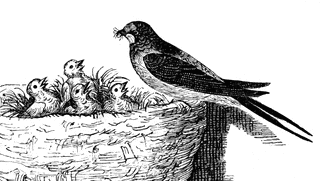
Swallow feeding worms to her chicks

I may be an early bird, but I promise I don’t feed worms to my kids for breakfast.

I’m almost ashamed to admit it, but I am a morning person. Why the shame? Because I have discovered that there is nothing that night owls hate as much as the behavior of us early birds. And it seems that there are a lot of night owls around, judging but the fuzzy eyeballs cast in my direction at 7 am, when I smile and bounce and chirp, “Good morning!” at them.

When I lived in that sleep-deprived state induced by having an infant at home, my natural biorhythms were completely disrupted. Continue reading

Patience is a virtue–Submit when it’s perfect, and then prepare to wait

As I mentioned in a previous post, I’ve been picking up the pace of my submissions, and also broadening the variety of publishers I’ve been submitting to. What I didn’t realize when I committed to this strategy is how much this would test my patience.

waiting - image courtesy of microsoft

You might as well take a seat…this is going to take a while.

Let me explain. Usually, I write for Jewish magazines. If I submit a book, it’s usually a picture book involving Jewish subject matter. The world of Jewish publishers is very small, and the editors receive fewer submissions than those who handle secular material. The response time in the Jewish publishing world is much faster than in the secular publishing world. Moreover, some of the editors have gotten to know me over the years because they’ve employed me, read me online, or just like my style. I suspect that my subs don’t always go in the slush pile, at least in certain offices, B”H & bli ayin hara. Yes, I have to wait for a response from editors, but the wait is relatively short.

Re-entering the realm of secular publishing is a wake-up call to the realities of that world. Continue reading

3 Ways to use your words charitably–How to help people in need from far away

Yesterday, it took me hours to get myself writing. Instead of typing at my keyboard, I was numb with fear for the residents of Israel (and, in fact, for the children of Gaza, whose safety is in jeopardy–regardless of who is jeopardizing it, which is a political question I refuse to address here). It’s only a couple weeks since Superstorm Sandy hit the eastern seaboard of the U.S. People lost homes, places of worship, jobs, every material good they possessed. And here I sit in California, comfortable and in no immediate threat of danger. There are no sirens warning of incoming rockets blasting in my neighborhood, and the rain outside is just a sprinkle.

On this blog, I write about words, and how to employ them. Today, I’m going take a break from discussing professional writing to give 3 ways you can use your words to help people in Israel and the victims of Hurricane Sandy.

1) You can blog to raise money for a (legitimate) charitably organization who will be helping the victims of Sandy (such as the Jewish charity Achiezer and the secular  American Red Cross).

2) You can write a letter or email (or post on a Facebook page) to a friend in Israel or in New York (or other Sandy-affected area). If you don’t know what to say, just say, “I want you to know I’m thinking about you. I’m far away, but you are not forgotten.”

3) You can write something to bring goodness in the world–a letter apologizing to someone you hurt, intentionally or not; a letter to someone lonely; something kind and beautiful. Then mail it.


10 Ways to show your favorite authors just how much you love them

Pretend you’ve just opened up your favorite magazine. You see a name–the name of your favorite writer, whose articles you always like. You flip right to the page with their latest story and start to read.

Or maybe there’s an author you like so much that you head for the book shop as soon as their newest title comes out. Or perhaps your librarian knows they are your favorite writer and steers you to all their books.

Or maybe there’s a book you always recommend to friends, but no one’s ever heard of that author or that book before.

How do you love me (and my blog), let me count the ways…

I’ve been doing research about marketing and SEO (search engine optimization) in the last few weeks, and what’s interesting is that for writers, many of the best ways to promote our work are free—but depend on the participation of our fans to succeed.

How can you help writers like the ones I described above improve their sales and market visibility?

Here are a few steps. Continue reading

Finding Inspirational Words from Sarah Shapiro–Defining Jewish Writing, Part 2

A couple of weeks ago, some of the comments on a post I wrote about defining Jewish writing revolved around the introduction to Sarah Shapiro’s All of Our Lives. I took a workshop with Sarah–who writes, edits, and teaches amazing writing workshops that have inspired many fledgling Jewish writers–and have a lot of respect for her opinions, so I borrowed the book from a friend (thanks Miriam!) in order to more accurately represent Sarah’s opinions here.

Sarah’s essay “The Writer’s I” reflects several of the issues I discussed in my original post. Jewish Writing can be defined by the author’s identity, by its subject matter, or can be considered a completely arbitrary label. She personally feels that “all three are right,” but admits the difficulty in establishing a single definition.

Sarah goes on to say that attempts to identify or define specifically Orthodox Jewish writing are even more complicated. Continue reading