Is poetry as we know it dead? Goldsmith speculates the “meme machine” has taken over.

This week, The New Yorker book blog published a post by Kenneth Goldsmith about the proliferation of rather un-poetic  “poetry” spreading across the internet. He writes:

[T]he Canadian media scholar Darren Wershler…has been making some unexpected connections between meme culture and contemporary poetry. “These artifacts,” Wershler claims, “aren’t conceived of as poems; they aren’t produced by people who identify as poets; they circulate promiscuously, sometimes under anonymous conditions; and they aren’t encountered by interpretive communities that identify them as literary.”

…It’s not uncommon to see blogs that recount someone’s every sneeze since 2007, or of a man who shoots exactly one second of video every day and strings the clips together in time-lapsed mashups. Continue reading

In case you need to feel validated for writing literary fiction, science will back you up

I’m not usually the type to post an hour before Shabbos starts, but this news item (first heard this morning during the break between some Mozart and some Corelli on KUSC) is just too wonderful to wait.

In case you feel defensive because you still think high-quality literature belongs in schools, or you’re trying to encourage quality over quantity in your own writing (thus spending way more time on each piece than seems wise), a new study indicates that reading literary fiction (Jane Austen, Don DiLillo, Chekov, or Alice Munro) temporarily enhances a reader’s emotional intelligence.

For more, read the study’s abstract here and a New York Times piece about it here.

My first foray into playwriting: lessons learned about writing and directing plays for kids

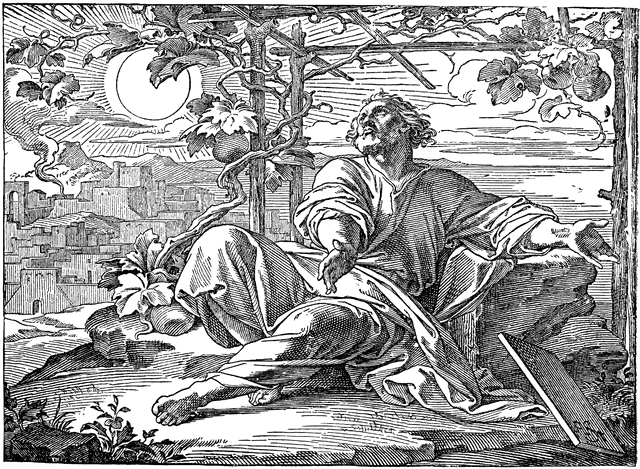
As I mentioned last week in passing, I spent a good chunk of time between Rosh Hashanah and Yom Kippur preparing a play for the kids at my synagogue. The topic: the story of Jonah, which is read during the afternoon of Yom Kippur.

Jonah sheltered by the vine

Yonah waiting to see if Nineveh gets destroyed. He’s kinda hoping it does. How’s that for schadenfreude?

Now, I’ve always thought this story was packed with humor. I mean, G-d singles Jonah out for a little tete-a-tete and he hops on a boat headed in the opposite direction as the mission G-d sent him on? Then he sleeps through the ginormous storm that has everyone else aboard freaking out and get swallowed by a giant fish. Come on!

And when Jonah finally makes it to Nineveh, it gets even wackier. Continue reading

Do your feelings about an author affect your feelings about his or her work?

Today’s post from Erika Dreifus deserves a look-see. She comments on a recent NY Times essay by Margot Rabb entitled “Fallen Idols,” then adds her own reflections, touching on various writers with Anti-Zionist or antisemitic beliefs, such as T.S. Eliot and Alice Walker (the latter of whom has recently made headlines). I invite you to read both pieces (the links are embedded above).

An interesting aspect of the writer-reader relationship that Rabb touches on is that readers get to step inside the brains of authors. For this reason, there are some Chareidim who only allow their children to read books written by people who are either Orthodox Jews themselves, or are otherwise respected and considered to have good character. While I don’t have this “policy” myself, I do understand that it’s reflecting a genuine concern. Authors don’t have to have a conscious agenda to slip all sorts of allusions to their beliefs in their work. For example, English authors are particularly well known for their antisemitism, which pops up in all sorts of weird places (Georgette Heyer’s The Great Sophy, several works by Dickens, and so on). The science-fiction/fantasy author Phillip Pullman is a proud atheist, and his work reflects this viewpoint.

Then again, if an author uses their money to donate to causes we don’t agree with, a political cause that does not have anything to do with their writing, is that a reason shun their work? Or, to take it a step further, protest their work?

One of the commentators on Erika Dreifus’s blog mentions Orson Scott Card. There are people who want to picket the movie adaptation of his book, Ender’s Game, because they disagree with his political and religious beliefs. (I happen to not agree with the commentator’s assessment of Card, but he’s a good example.) Ender’s Game does not mention the particular beliefs that the protesters find repulsive in Card’s public statements.

Personally, I can see forgoing a trip to the theater, or skipping a book, if you disagree with an author or artist. But a public protest seems excessive to me unless the novel/play/whatever is actively preaching the message you disagree with in that particular piece of work.

How likely are you to read a book by someone whose character is deeply flawed or who espouses beliefs you find repugnant?

I stepped up to the challenge…but did I succeed?

Well.

A couple months ago, I challenged writers to try something new: a new genre, new POV, new publication, anything that would help us to stretch our wings.

Since I threw down the gauntlet, I had to participate in this challenge, right? So I thought about a couple possible places to sub a feature, a genre I hadn’t published in at least two years. Then I brainstormed a few feature ideas, and I sent our queries based on them.

Guess what.

I got nada.

I know that my ultimate success isn’t in my hands, so I feel like I did my share and can take no responsibility for the rest. And I plan to try for features and other new things, too. In fact, I heard about a poetry contest that sounds so interesting, I’m thinking of attempting serious poetry for the first time in many years.

So, is this a success–because I did try something new–or is this a failure–because I didn’t get responses to my queries?

What do you think? (Please post comments below.)

rocket failure

Never made it off the launch pad.

Reading local-to-L.A. authors

One of my favorite things to do is to promote the work of Jewish writers with West Coast connections. Here are a few I’ve read in the last couple months:

Hands-On How To’s for the Home & Heart by Tova Younger (Shemtov Press 2012)

TOVA YOUNGER final cover

Tova Younger’s recent release

Tova Younger is a former Angeleno who settled in Kiryat Sefer in 2004. Her new book, Hands-On How To’s for the Home & Heart, contains friendly and very practical advice of all types for the Jewish wife.

When I was first living on my own, someone gave me a book, Where’s Mom Now That I Need Her: Surviving Away from Home. That cookbook/home repair/car repair/first aid/ and just about everything else manual got me through a lot of tough situations. Younger’s book is almost a Jewish version of that secular classic—chock full of basic information that every Jewish homemaker can benefit from.

Divided up into four primary sections:

  • For the Heart
  • For the Home
  • Handy Tips
  • recipes

Hands-On How To’s for the Home & Heart offers advice about everything from maintaining proper kavana (focus) to proper laundering; from how to make conversation with the relatives to whom we owe kavod (honor), to recipes for basics like beet salad and cornflake quiche.

Younger’s book would make a terrific gift for seminary girls, the newly married, and even seasoned homemakers. You can find it on discount right now at Jewish e-Books.

Bells & Pomegranates by Rachel Pomerantz (Menucha Publishers 2012)

bells and pomegranates

Rachel Pomerantz’s latest

Well-known Orthodox author Rachel Pomerantz frequently travels to SoCal to visit her brother and mother, who live near San Andreas. Her latest serial novelization, Bells & Pomegranates, follows the shidduch process of various characters (introduced in previous books), all of whom have life circumstances that present hurdles in their quest for a mate.

There are step-siblings Yoel and Devora, who have been adopted, and the twins Rina and Gila, who converted as children and grew up in a single parent home. There’s foster child Ronny, whose mother is mentally ill, and Yossi, the child of baalei teshuva. Sarah’s got great yichus, but she’s an orphan. These characters and others start off the shidduch process with considerable challenges—but as the novel progresses, Pomerantz throws additional complications into their paths, lending drama and suspense to their intermingled stories.

Bells & Pomegranates is more than kosher entertainment for a rainy afternoon. In describing the family dramas of her characters, Pomerantz invites us to question our own preferences and prejudices. How do my assumptions affect my judgment? How involved should parents and grandparents be in the shidduch process? What are legitimate reasons to call off a prospective match? These questions and others lingered with me after I finished the book.

On This Night: the Steps of the Seder in Rhyme by Nancy Steiner (HaChai 2013)

on this night

While a seasoned freelance author, Nancy Steiner is new to picture book writing. Her first kids’ title, On This Night, will likely prove to be a classic. In cheerful—but unforced—rhyme, Steiner leads readers through the steps of the seder. Her language is perfectly accessible for young readers and will prepare them for the Pesach experience.

The darling illustrations by Wendy Edelson depict an adorable family celebrating their seder. Edelson portrays the family members from a variety of angles, adding to the visual interest. From the twinkly-eyed zeide to the drowsy preschooler on the final page, the pictures (and text) are sure to engage kids aged 2 to 6.

Also of note:

L.A. resident Sarah Bunin Benor’s new book, Becoming Frum (Rutgers University Press 2012), considers the ways newly religious Jews adapt to the language of the mainstream Orthodox world. While an academic book rather than a religious one, Bunin Benor bases her conclusions largely on research conducted here in L.A., and her book will be of great interest of those engaged in the baalei teshuva phenomenon. I participated in her initial online survey, which piqued my interest in her work. I hope to write an entire post devoted to Bunin Benor’s book (and her spin-off website) soon.