Tragedy! My lonely old maid of a story has been rejected once again.

I’m sure I’ve blogged about rejection numerous times at this point, but since I continue to collect rejection letters, why not continue blogging about them?

boy with letter

Mom! I think you just got another rejection letter!

Over the summer, I wrote a story that my husband adored. He likes almost all my stories, but this one he really, really liked. He particularly enjoyed the nasty anti-hero at the center of the story and the unhappy ending.

On the other hand, I didn’t like the way I’d originally executed my idea, so I set it aside for a couple months. Eventually, I brushed it off and polished it up a bit before sharing it with my writing group. They provided extensive feedback, and I acted on it, hoping that the new, much improved story would dazzle the editors. Continue reading
When is an author a Jewish author? Defining Jewish writing, Part 3

Last week was marked by big news in the book world. Famed-American Jewish author (Jewish meaning author’s ethnicity only, in this case–see previous posts on the subject) Philip Roth has declared that he’s retiring from writing. On the other hand, equally aged and famous American-Jewish author Herman Wouk has just put out another novel. Interestingly, these events didn’t just make headlines in Jewish publishing, but publishing as a whole.

The stereotypical Jew is considered “bookish,” pale due to the amount of time he spends indoors. We are called “the People of the Book.” How is it that Jews became inextricably interwoven with books? Continue reading

Thank the folks who’ve rejected you–a radical suggestion for writers this Thanksgiving

Thanksgiving is upon us here in the U.S., and this is a wonderful opportunity to reflect upon gratitude, whether you celebrate the holiday or not. I’m a big fan of Rabbi Zelig Pliskin and also of Rabbi Shalom Arush, and I’m going to combine their approaches for this writing exercise appropriate to the Thanksgiving season and year-round. This exercise is useful whether you’re Jewish or not–please don’t get turned off to it just because it was inspired by a couple of rabbis.

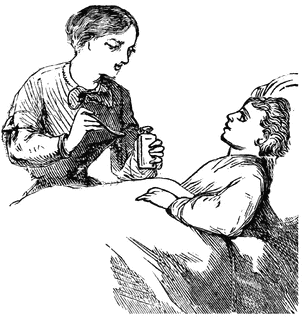
mother offering child medicine

Be grateful for the medicine–it’s good for you.

Rejection is just about the hardest thing to cope with when you decide you’re going to become a writer, but it’s something that you need to learn to accept graciously. When that rejection letter first comes, you are often overwhelmed by feelings of resentment, anger, and frustration. You might lash out, calling the editors idiots or saying that the publisher doesn’t know what good writing is. You might despair, consider yourself a failure, or even give up writing.

But here’s the truth–you were meant to be rejected, at least in this specific instance. Continue reading

Patience is a virtue–Submit when it’s perfect, and then prepare to wait

As I mentioned in a previous post, I’ve been picking up the pace of my submissions, and also broadening the variety of publishers I’ve been submitting to. What I didn’t realize when I committed to this strategy is how much this would test my patience.

waiting - image courtesy of microsoft

You might as well take a seat…this is going to take a while.

Let me explain. Usually, I write for Jewish magazines. If I submit a book, it’s usually a picture book involving Jewish subject matter. The world of Jewish publishers is very small, and the editors receive fewer submissions than those who handle secular material. The response time in the Jewish publishing world is much faster than in the secular publishing world. Moreover, some of the editors have gotten to know me over the years because they’ve employed me, read me online, or just like my style. I suspect that my subs don’t always go in the slush pile, at least in certain offices, B”H & bli ayin hara. Yes, I have to wait for a response from editors, but the wait is relatively short.

Re-entering the realm of secular publishing is a wake-up call to the realities of that world. Continue reading

10 Ways to show your favorite authors just how much you love them

Pretend you’ve just opened up your favorite magazine. You see a name–the name of your favorite writer, whose articles you always like. You flip right to the page with their latest story and start to read.

Or maybe there’s an author you like so much that you head for the book shop as soon as their newest title comes out. Or perhaps your librarian knows they are your favorite writer and steers you to all their books.

Or maybe there’s a book you always recommend to friends, but no one’s ever heard of that author or that book before.

How do you love me (and my blog), let me count the ways…

I’ve been doing research about marketing and SEO (search engine optimization) in the last few weeks, and what’s interesting is that for writers, many of the best ways to promote our work are free—but depend on the participation of our fans to succeed.

How can you help writers like the ones I described above improve their sales and market visibility?

Here are a few steps. Continue reading

Using books to build the emotional intelligence of children: Innovative programming at Aleinu/JFS this week

Aleinu Family Services here in Los Angeles will be integrating literature into parenting classes over the next few weeks. Parents attend with children in tow. The Aleinu therapists have selected picture books that effectively communicate social and personal skills to children, then developed discussions and art activities for parent(s) to share with their child(ren) to reinforce those ideas. Many teachers do this in classrooms, and some parents do this will their own children, but this is the first time I’ve seen this in a therapeutic setting like this. Very creative! See the flyer below for details. * UPDATE: THE TIME FOR THE SECOND AND THIRD PARTS OF THE PROGRAM HAVE BEEN CHANGED TO 6-7:15 p.m.