Learn to empathize with real people…and fictional ones

So, I was having one of those days when it’s not yet 10 a.m., and I was already having a pity party for myself. There was something I’d really wanted to get…and I didn’t get it. I was dragging myself down the street, and I realized that I was fixating on all the things that I wanted out of life. And the truth was that what I didn’t get…maybe I wanted it, but I didn’t really need it. I thought about the things that other people wanted and how often what they didn’t have was a need. Or something that I personally did have. And that I should basically stop feeling sorry for myself.

How I Emerged from the Fog

As I mentioned, as this mental inventory was taking place, I was walking down the street. Continue reading

Telling kids about storytelling

I’m very excited to be visiting one of the local day schools tomorrow. For a change, I won’t be doing a read-aloud of Raizy. Raizy may not even come up, due to the age of the kids involved. Instead I’ll be talking about “Storytelling,” to coincide with the current unit the students are studying in school.

Fishing for a few stories on this fine morning

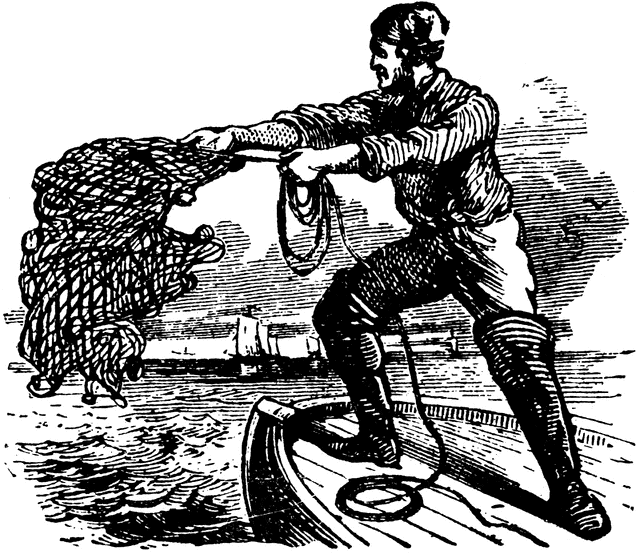
Breaking down storytelling in forty-five minutes will be challenging, especially at the upper-elementary school level. After a little intro, I plan on making an extended metaphor connecting storytellers to fishermen. I’m hoping it will be both instructive and age-appropriate. I’ve spent quite a bit of time preparing and concocted a whole series of visuals, and the like.

How is a good storyteller like a fisherman?

The truth is, everyone is a storyteller. Continue reading

Writing for Children: not for those who want glory, fame, or big bucks

Last week’s Hamodia/Inyan Magazine had an article by one of my favorite columnists, Rabbi Fishel Schachter entitled “Guided by Tale Winds.” While today Rabbi Schachter is well-known in the Torah world for essays and presentations for adults about the weekly Torah portion, parenting, and other subjects, he first gained popularity as a rebbi and storyteller to students in Jewish day schools.

Rabbi Schachter explains in the article that one of the adults in his audience told him many years ago that he had to choose between teaching grown-ups or kids — and he indicated that the natural choice for a man of Rabbi Schachter’s talent and intelligence was to teach adults.

Turning to his own rebbi for guidance, Rabbi Schachter asked if teaching kids was really beneath him? Were all the silly voices and so on undermining his stature?

Continue reading

How writing a novel differs from writing a screenplay: my last post on STORY

After reading my earlier posts on STORY, you might think I’m 100% sold on the book. I have to admit that I’m a fan, but I do have some quibbles, largely on the adoption of screenwriting techniques for short story or novel writing.

Differences between writing for readers and for viewers that limit the utility of STORY:

1) (The only one I noticed pointed out by McKee) You may get inside the characters heads and explore their thoughts in literature. This creates a greater intimacy between the narrator and the reader. It also means the conflict can be much more subtle and much more interior.

2) Some readers like descriptive, sensory details that can’t be experienced with film — smell and touch can be better evoked, for example (unless you’re viewing in smell-o-rama).

3) The audience must work harder when reading print–in a good way.

4) When contrasted with other useful literary guides, you see some shortfalls. Continue reading