2 Major differences between writing a picture book and writing short stories

So the folktale project turned out to be an eye-opening experience for me.
scissors

Am I a writer, or a barber?

When I first started writing for kids, I didn’t really understand the difference between short stories and picture books. I’d submit short stories to book publishers, and picture books to magazines who published short stories. Selling Raizy and being guided through revisions by Devorah Leah Rosenfeld, the editor at Hachai, schooled me in the differences between the two media. After a couple years, I started writing regularly for children’s magazines, and her lessons allowed me to jump between the two formats.

2 Major differences between picture books and short stories:


1) The length differs significantly in the two formats. Oddly, an entire picture book has about half the words (sometimes less) as a short story for a kids’ magazine.

2) The illustrations in a picture book replace almost all the description. And the only words that could appear in a picture book text are ones that drive the narrative forward. When I learned this lesson, my picture book writing attained a sharpness that it had previously lacked.
Continue reading

When good things happen to anxious people: the beginning of a new project

parakeet, lineated

I hope I say something original, for once.

I’m close to wrapping a piece for a magazine, and I’m waiting on the opinions of some of the beta readers of one of my WIPs, so Friday morning, I started rummaging though my old journals for some new-old project ideas. Among my scribbling, I found notes about a folktale that really appealed to me. A little research has indicated that there is only one picture book retelling of this story. Which is why, for the first time, I’m attempting a folktale retelling.

Good for me, right? It’s good to try something new, right? Continue reading

But what about my Voice!?! What a writer should do when an editor asks for “a few changes.”

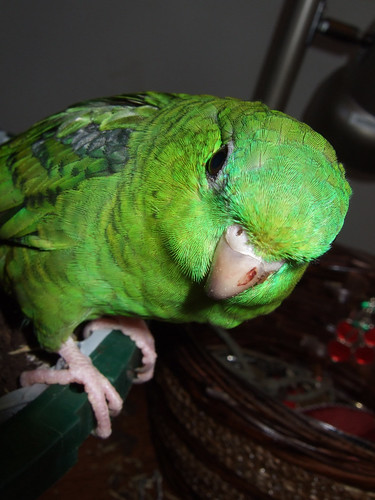
parakeet

Hey, buddy! What about my voice?

Last week, I got an email from an editor (she’ll be the heroine of this story, but will remain nameless nonetheless). She asked me to make one change–one very small change–to the story that I had submitted.

Because I trust this editor–she’s very good at what she does and has built a friendly relationship with me–I said I’d make the teeny-tiny change she’d requested.

And then I panicked.  Continue reading

Do writers hibernate? How long winter nights might affect your work habits

In the last couple weeks, my productivity level has dropped dramatically. At first, I couldn’t tell what was going on with me. Was it because I was fighting a cold? The outcome of my flu shot? Too many days with a kid home sick or Thanksgiving vacation?

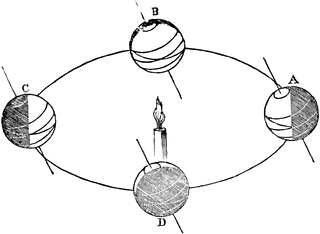
the four seasons experiment

an experiment to demonstrate the change of seasons

Then I realized that this happens to me every December–the winter doldrums. Like many others, the lack of daylight in the winter months drops my energy level drastically. I feel like a bear who wants to return to my cave to hibernate.

It’s harder to focus. I’m working more slowly, and I’m a mite less sharp. For someone who likes to accomplish a lot each day, it’s hard not to be disappointed with myself. It’s hard not to feel like a dummy when your mind goes all fuzzy by mid afternoon, and a mild case of the blues makes it hard to be my normal optimistic self. Continue reading

When is an author a Jewish author? Defining Jewish writing, Part 3

Last week was marked by big news in the book world. Famed-American Jewish author (Jewish meaning author’s ethnicity only, in this case–see previous posts on the subject) Philip Roth has declared that he’s retiring from writing. On the other hand, equally aged and famous American-Jewish author Herman Wouk has just put out another novel. Interestingly, these events didn’t just make headlines in Jewish publishing, but publishing as a whole.

The stereotypical Jew is considered “bookish,” pale due to the amount of time he spends indoors. We are called “the People of the Book.” How is it that Jews became inextricably interwoven with books? Continue reading

Thank the folks who’ve rejected you–a radical suggestion for writers this Thanksgiving

Thanksgiving is upon us here in the U.S., and this is a wonderful opportunity to reflect upon gratitude, whether you celebrate the holiday or not. I’m a big fan of Rabbi Zelig Pliskin and also of Rabbi Shalom Arush, and I’m going to combine their approaches for this writing exercise appropriate to the Thanksgiving season and year-round. This exercise is useful whether you’re Jewish or not–please don’t get turned off to it just because it was inspired by a couple of rabbis.

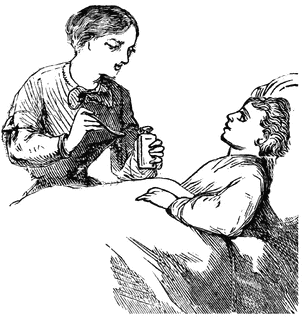
mother offering child medicine

Be grateful for the medicine–it’s good for you.

Rejection is just about the hardest thing to cope with when you decide you’re going to become a writer, but it’s something that you need to learn to accept graciously. When that rejection letter first comes, you are often overwhelmed by feelings of resentment, anger, and frustration. You might lash out, calling the editors idiots or saying that the publisher doesn’t know what good writing is. You might despair, consider yourself a failure, or even give up writing.

But here’s the truth–you were meant to be rejected, at least in this specific instance. Continue reading