Background on my new story: “Just Perfect” (or why I believe we all live in a Magical Reality)

This week, Hamodia‘s Inyan Magazine published my new short story (and it’s actually for adults!), entitled “Just Perfect.”

The original version of the story was explicitly a piece of fantasy, but as I mentioned in a previous post, I transformed the story into an example of magical realism rather than fantasy in order to address the concerns of my lovely and knowledgeable editor at Hamodia. 

In the original version, then called “Easy as Pie,” the transformation of Libby’s life occurred after she bumped into a little old lady who offered her a slice of peach pie at a party. The pie made Libby’s life–well, just peachy. But my editor felt the little old lady was a little unbelievable. Could I cut her? The only problem was that her brief appearance at the beginning and the end of the story explained the wacky events in between.

I wracked my brains for a way to ditch the old lady but save the rest of the silliness. There had to be an explanation for it, after all. I did a bit of experimentation and research. Finally, I decided that maybe Libby should just pray–and then G-d answers.

Even after I found my “magically real” solution, I initially balked at making the change. It was an elegant solution, so my reaction puzzled me. I had to think about it a lot, and I think my conclusion is worth sharing. Continue reading

Lights to the Nations: Two Jewish thinkers release their books for the secular–even non-Jewish–audience

Wow.

That’s pretty much all I could say. I read an amazing blog post by Ann Koffsky this morning (thanks Ann for sending me the link!) where she interviews the unforgettable writer Gila Manolson. The interview is chock full of advice to writers, advice to parents, and other neat stuff. But the biggest revelation to me is that Manolson has created a website to promote her upcoming book–her first book for a non-Jewish audience.

Manolson is not alone. Continue reading

How to write funny: what you can learn from Isaac Asimov

Asimov on Humor

A must-read for anyone who wants to write humor

When I first married my husband, I was delighted to discover among his possessions a copy of Isaac Asimov’s Treasury of Humor. I had read the book in high school and enjoyed reading it again, this time discussing it extensively with my husband.

Not only does this book contain jokes–great, classic ones–but Asimov explains why they’re funny, how to tell them, the origin of them, and if there are different versions. He explains the differences between shaggy dog stories, puns, black/gallows humor, and so on, and what makes each type tick. Asimov does this all in a chatty way that reminds you of your great-uncle shmoozing with you–it’s just so much fun.

Flash forward a few years. Continue reading

2 Major differences between writing a picture book and writing short stories

So the folktale project turned out to be an eye-opening experience for me.

scissors

Am I a writer, or a barber?

When I first started writing for kids, I didn’t really understand the difference between short stories and picture books. I’d submit short stories to book publishers, and picture books to magazines who published short stories. Selling Raizy and being guided through revisions by Devorah Leah Rosenfeld, the editor at Hachai, schooled me in the differences between the two media. After a couple years, I started writing regularly for children’s magazines, and her lessons allowed me to jump between the two formats.

2 Major differences between picture books and short stories:


1) The length differs significantly in the two formats. Oddly, an entire picture book has about half the words (sometimes less) as a short story for a kids’ magazine.

2) The illustrations in a picture book replace almost all the description. And the only words that could appear in a picture book text are ones that drive the narrative forward. When I learned this lesson, my picture book writing attained a sharpness that it had previously lacked.

Continue reading

Library Love – Bibliophiles and the places they frequent

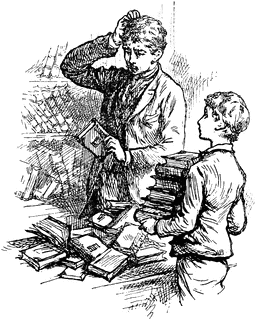
father and son in the library

Hey, kiddo! Do you really need this one, to? Good thing I don’t have to pay for all of these.

When I was a teenager, I lived across the street from the library. I did homework there, typed most of my college applications on their noisy electric typewriter (10 cents for each 15 minutes, I think), and perused the shelves for hours on end. I’d already developed a taste for books by that age, but there’s no doubt in my mind that my family’s proximity to the library solidified my attachment to books, reading, and libraries, in general.

Now that I’m older, I live in a family fully of bibliophiles. We read to learn Torah. We read for entertainment; we read to learn how to do new things; we read for school assignments. We read because otherwise we’d go into withdrawal and start twitching in a dark room. Continue reading