Kveller writers talk G-d with their kids

The Jewish parenting website Kveller is running a series right now on parenting. They’ve got 5 perspectives so far, and I have to admit I have mixed feelings.

They seem to have picked some extreme situations–a mom who clearly has OCD, a kid who has chosen Communism over Judaism–but also some pretty normal ones, like the soon-to-be dad finally realizes the fate of his unborn child is out of his hands and chats with G-d about protecting him and (this had me laughing both out of amusement and empathy) the mother whose kids imitate G-d saying, “No!” to each and every request she makes at a trying stage of life.

What surprised me most is that so far most of the parents seem to not have thought about what they would say about G-d before talking about Him with the kids. Some of the stories are frankly depressing, like watching the blind leading the blind. Not surprisingly, their fumbling responses get some pretty sad results.

But I just love that a non-Orthodox (at least, not only Orthodox) Jewish website is hitting this issue, which largely goes undiscussed in polite American circles. And we’re getting a real glimpse into American Jewish households to see what’s going on in there.

It’s pretty harrowing.

Sure G-d says, “No,” an awful lot. But what about all the times it turned out good for you?

What about saying, “Thanks, G-d!” every time you experiences a moment of joy? “Thanks for the parking space!” and “Thanks for there being exactly enough cupcakes for us all!” make an impression on kids as much as all those heaven-sent No’s.

What about discussing with your co-parent about how you’ll represent G-d to your kids ahead of the “Big Talk?” Because it’s as much of a Talk as the more famous one, and requires at least as much forethought.

Something that surprised me also was that no one really mentioned sharing books about G-d with their kids. A lot of the what I’ve communicated with my own kids about G-d has come from books and magazines, like  Where are You Hashem?, The Invisible Book, and Hashem is Truly Everywhere.

Do any readers out there have literature they like to share with their kids to enhance their “G-d Talk?”
Save the books for L.A. Jewish kids!

The local Jewish children’s library here in L.A. will be closing in a month and a half. It gets plenty of visitors, but the Federation wants to let the Zimmer Museum (a bigger money-maker) use the space.

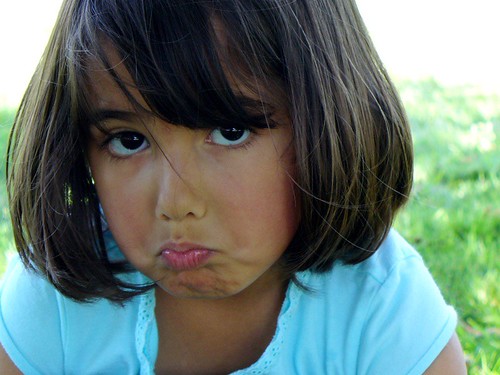
pout

Think she heard the Jewish Library is closing? (Picture available through Creative Commons–rumolay on Flickr)

Regular patrons like me are grumbling. How else can we feed the voracious literary appetites of our Jewish kids without breaking the bank? PJ Library is a fabulous resource, but has three drawbacks:

  1. Kids can’t select their own titles to read.
  2. Kids can only receive books for a small window of childhood.
  3. Kids get only one book a month.

This past Sunday, the Jewish library was packed for the monthly Read with Dogs event, and the parents bemoaned the closure. We’re upset that the amazing librarian, Amy, will lose her job, and will miss the books and activities that we’ve enjoyed there.

There’s a Facebook Page for the effort to save the book collection at a new location. If anyone has the link, please post it below in the comments. It’ll only work through grassroots efforts.

Pesach is just a couple weeks away! Here’s a post from three years ago, with wacky Pesach songs I created for our seder. I’ve long wanted to add another couple songs, perhaps for the story of the rabbis in Bnei Brak, but not sure I’ll get to it this year.

Do you have other songs or traditions that liven up your family’s seder? Please share them in the comments below!

beccakinla's avatarRebecca Klempner

The central mitzvah of the Passover seder is “L’higgadeta L’vincha”—to relate the story of our redemption to children.This means the section of the haggadah called “Maggid” is the most essential portion of it.However, most of the exciting songs and actions of the seder come before or after “Maggid”. Some children, even some adults, don’t really enjoy this part of the seder for that reason.

I know Pesach is long past, but it’s never too early to get ready for next year…

Here is a supplement to the haggadah to be used during “Maggid”.Here are the best songs that I wrote this year to help tell the story of our first Pesach. My original lyrics are sung to familiar children’s songs for ease of use, and I tried to be true to the original text.Please enjoy and tizku l’mitzvos!

To the tune of “Oh, Susanna”

Oh…

View original post 222 more words

Which part is historical and which part is fiction? My Semi-official 39 Clues Rant

Book 10: Into The Gauntlet

It’s by the fantastic writer Margaret Peterson Haddix. What’s there not to like?

This post might get me in trouble with my kids, but so be it.

In case you don’t know The 39 Clues is a book series for middle grade readers (roughly kids 8-12). I think the initial target audience was older, but that’s who’s reading this series in my neck of the woods.

Kids love these books. They are exciting and are so engaging as to be addictive. Tweens clamor for more titles, which are delivered to bookstores at an astonishing rate. They are written by some top names in kids’ lit, like Rick Riordan, Margaret Peterson Haddix, and (one of my faves) Linda Sue Park. What’s there to dislike?

Here’s my beef.

The 39 Clues series freely borrows from historical fact, then elaborates on this to create a thrilling adventure for kids. Continue reading

2 Major differences between writing a picture book and writing short stories

So the folktale project turned out to be an eye-opening experience for me.

scissors

Am I a writer, or a barber?

When I first started writing for kids, I didn’t really understand the difference between short stories and picture books. I’d submit short stories to book publishers, and picture books to magazines who published short stories. Selling Raizy and being guided through revisions by Devorah Leah Rosenfeld, the editor at Hachai, schooled me in the differences between the two media. After a couple years, I started writing regularly for children’s magazines, and her lessons allowed me to jump between the two formats.

2 Major differences between picture books and short stories:


1) The length differs significantly in the two formats. Oddly, an entire picture book has about half the words (sometimes less) as a short story for a kids’ magazine.

2) The illustrations in a picture book replace almost all the description. And the only words that could appear in a picture book text are ones that drive the narrative forward. When I learned this lesson, my picture book writing attained a sharpness that it had previously lacked.

Continue reading