The Rejection Letter that’s Good for You

Yesterday, I got a rejection letter.

Yes, it happens a lot.

I’ve argued in the past that rejection letters are good for you, and I’ve gotten better at taking them in stride, but this one went even further. Its timing couldn’t have been more perfect.

You see, last night was my monthly writers’ workshop. All morning, I’d been trying to decide on a piece to bring and share. When that rejection letter appeared in my inbox around noon, I decided it was a sign.

No, not that kind of sign.

Not just a sign, but a Sign — “This is the piece you should bring to your writers’ workshop tonight.”

So, I did.

And it was magical.

Our group was smaller than usual, consisting of just three of us (usually, we’re four or five). But the two other ladies present gave me so much insight about what worked in my story and what did not, feedback that I might have been less open to, had I not just received the rejection letter. I spent a good chunk of this morning working on revisions, and plan to wrap them up tomorrow in between baking my challah and roasting my chicken.

I’m still hoping that the next time I hear from an editor, they send an acceptance letter. (To say that I pray for acceptance letters is no exaggeration.) But this experience is definitely going to help me embrace the next rejection letter.

Because another will surely come.

On Writing About Writing: a guest post by Miriam Hendeles, author of Mazel Tov, It’s a Bubby!

Mazel Tov! It's a Bubby!

Miriam’s Book!

Today’s guest post is from my partner in crime writing, Miriam Hendeles.

What do writers write about? We write about our lives and our families. Some of us write about our struggles and triumphs. Others write about philosophies and opinions; hope and dreams.

We tell stories, and conduct interviews; we compose lists and craft essays.

We even write about “Writing.” Now what is there to tell, conduct, compose and craft about Writing?

So much. We can write about the writing process, solutions to writer’s block, publishing opportunities, strategies for success, online writing techniques, SEO, PLR and myriad other acronyms. Bloggers and gurus craft advice to the masses on how to become the most polished, pithy, and popular Writer. You see, many writers choose to write about Writing, because if we write about Writing, we know we are guaranteed an audience, comprised of the following loyal and faithful readers:

Writers. Wannabe writers. Bloggers. Publishers. Agents. Editors.

But when we do not write about Writing? Then who is our audience?

Random Interested Persons of Non-Writing topic.

For example, Continue reading

The 2 Best Ways to Improve Your Writing Skills (with a little backup from Anne Lamott)

I’m going to offer some advice today that seems simplistic, so basic as to be ridiculous. Yet recently, I’ve experienced people who have neglected these 2 important strategies that are pretty much guaranteed to improve their writing abilities. So here I am repeating them.

Almost every book about writing offers the following advice. (The wording might vary according to the delicacy of the audience, but the meaning is the same.)

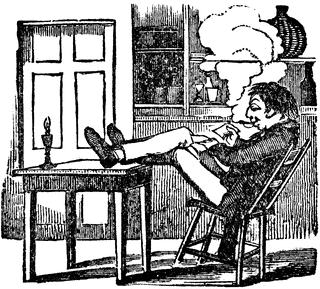
relaxing in a chair

Okay, so you might need more than a chair. This guy isn’t going to get much writing done if he doesn’t pick up a pen!

1) PUT YOUR TUSH IN THE CHAIR.

By this, of course, we learn that if you tell us you want to write, well that’s a nice sentiment. But we know that you mean it if you sit at a desk, pick up a pen (or keyboard) and actually practice writing. Certainly weekly, and preferably daily, you need to write. A human being is only a writer if s/he is a person who writes.  Continue reading

Why I think speculative fiction is just SO Jewish (& you should, too)

One of the things I most like to write (and find it hard to sell) is Jewish speculative fiction. Speculative fiction is a wide-ranging label that includes genres like fantasy, science-fiction, and horror. Basically, in speculative fiction, the author suggests a scenario that proposes the question: “What if_______?”

What if…

…you found out that you weren’t a friendless orphan but a powerful wizard with many supporters? (Harry Potter)

…you discovered the back of the wardrobe led into a magical realm where you became royalty? (Narnia)

…you discovered there was a way to communicate with aliens through your dental work? (Fat Men From Space)

…you accidentally returned to the time of the Holocaust during your Pesach Seder? (The Devil’s Arithmetic)

While Isaac Asimov, Jane Yolen, Harlan Ellison, Daniel Manus Pinkwater, and many other secular Jewish Americans (as well as the Orthodox writer, Michael Burstein and the Israeli writers Lavie Tidhar and Nir Yaniv) have written speculative fiction to great acclaim–even Jewish speculative fiction–specifically Orthodox Jewish speculative fiction is much harder to find. As I have mentioned previously on my blog (and again, and again), there has been movement into this direction. But still, I get a lot of funny looks when I tell people what I most like to write.

But I don’t get it. I think speculative fiction is just SO Jewish, and so should you. Here’s why: Continue reading

Tragedy! My lonely old maid of a story has been rejected once again.

I’m sure I’ve blogged about rejection numerous times at this point, but since I continue to collect rejection letters, why not continue blogging about them?

boy with letter

Mom! I think you just got another rejection letter!

Over the summer, I wrote a story that my husband adored. He likes almost all my stories, but this one he really, really liked. He particularly enjoyed the nasty anti-hero at the center of the story and the unhappy ending.

On the other hand, I didn’t like the way I’d originally executed my idea, so I set it aside for a couple months. Eventually, I brushed it off and polished it up a bit before sharing it with my writing group. They provided extensive feedback, and I acted on it, hoping that the new, much improved story would dazzle the editors. Continue reading

Am I brilliant or not so much? A writer’s self-confidence bounces on a po-go stick.

Yesterday, I was reading the daily post of a great blogger, Bottleworder. His topic? The benefits of being dumb. It’s worth reading.

Today, I’m not going to write about the benefits of being dumb, but something that afflicts many writers: feeling dumb.

“Have you read this yet, Eugenia? It’s brilliant, I tell you! That Rebecca Klempner’s going to win a prize one of these days!”

When I read something I’ve written in the past, I usually have one of two reactions:

1) That was brilliant! I wrote THAT? Was I channeling or something? Wow.

2) I can’t believe I wrote that. Why, oh why didn’t I (insert suggested improvement here) before I submitted? It could have been so much better. People are reading this drech?  And my name’s attached to it? Can I hide now?

I think that writers like me have the self-confidence of a pogo stick. Up-down-up-down. If this were just a matter of my self-esteem, I’d keep this discussion to myself, but it actually affects my decision-making skills relative to my writing.

When do I submit? Is it good enough? Will it be accepted as it is, or will some editor laugh at my sub and then tell his buddy in the next cubicle about how terrible it was.

Is what I wrote actually funny, or did the members of my writing group (and my darling husband) only laugh because of the intonation of my voice while I was reading? Or because they were feeling punchy after too little sleep?

You catch my drift. Continue reading