My thoughts on Tablet’s article “Do Jewish Children’s Books Have a Problem with Gender?”

Emily Sigalow, in Tablet this week, published an article entitled “Do Jewish Children’s Books Have a Problem with Gender?”

While she does make one point I agree with, that awards committee’s tend to favor Jewish picture books with male lead characters and that the females tend to be engaged in traditional roles, she seems to learn from that that Jewish children’s books as a whole have a problem.

I have to disagree with the overall picture Sigalow paints, though.

You can see my comments on the article if you visit Tablet (scroll to the bottom of the page), but I’d like to make a few more thoughts.

Jewish children’s books do have problems. Actually, many secular books have the same problems. Continue reading

Take 2 Books and Call Me in the Morning: British docs prescribe books for patients

Therapeutic reading?

pill tablet prescription

Imagine popping a couple chapters of a book instead of two of these.

Newspapers are reporting that doctors in the United Kingdom will be prescribing self-help and health books as reading material for those suffering from a variety of mild-to-moderate mental ailments, such as mild depression, anxiety and panic attacks. The CEO of the British charity the Reading Agency, Miranda McKearney, explained in an article in The Guardian, “There is a growing evidence base that shows that self-help reading can help people with certain mental health conditions to get better.”

Wales has already started the recommended reading program, with England scheduled to start in a few months. Continue reading

Can teenagers really save the world? Musings on middle grade and YA lit

I’m completely behind both writing and housework this week due to a bout of strep throat (thankfully, on the mend now due to penicillin).  This was the second time I’ve been laid up for several days since Sukkos, so it was pretty much a drag, and I really need to try to wrap up at least one story this week. However, I just feel the need to share this with my readers.

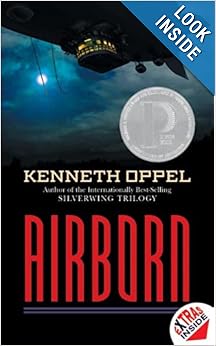
airborn by oppel

Can three teens really save their airship from pirates? Not sure I buy it.

While lying in bed trying very hard not to swallow (it just hurt too much), I read a slew of middle grade and YA novels. Now, I know that tween and teen novels tend to share certain characteristics, and that many of these meet the psychological needs of tweens and teens. But as a once-but-no-longer teen, a particular trait rubbed me the wrong way. Continue reading

Mormon and Orthodox Jewish writers: Does optimism hold back fine writing?

Mark Oppenheimer, in last Friday’s New York Times, posited that the optimistic attitude embraced by Mormons has prevented them from creating literary fiction. Sure, they have succeeded in Sci-fi (Orson Scott Card), fantasy (Stephanie Meyer), and books for teens and children (Shannon Hale, James Dashner, J. Lloyd Morgan).  But how many Mormon writer’s have won Pulitzers, National Book Awards, Bookers, or Nobels?

Oppenheimer interviewed a number of Mormon writers for his article, and includes some interesting insights:

“It is a fair thing to point out,” said Shannon Hale, a Mormon who writes young adult fiction, “that there have been very prominent Jewish writers that have received a lot of accolades, and worldwide the number of Mormons are comparable to the number of Jews, so why hasn’t that happened?”

Ms. Hale’s theory is that literary fiction tends to exalt the tragic, or the gloomy, while Mormon culture prefers the sunny and optimistic.

And also:

“I’ll tell you why they write young adult,” said Ms. Nunes. “Because they don’t have to write the pages and pages of sex. They don’t want to spend a lot of time in the bedroom.”

Another author pointed out that since Mormon theology strongly identifies with the idea of a Messianic redemption, Mormon writers gravitate towards the “savior motif.”

This all got me thinking. Even though Ms. Hale correctly identified Jews as successful authors of literary fiction, Orthodox writers are not foremost among them (despite examples of some who are, like Ruchama King Feuerman and Risa Miller and even, I’d argue, Bracha Rosman and Henye Meyers). And guess what? Continue reading

How to optimize your Goodreads “To-Read” list

A few weeks back, I posted about how we select the books we want to read now, next and never.

On a related theme, I just spent an hour culling unwanted books from my Goodreads “To-Read” list. 

Because what good is a “To-Read” list if you don’t really want to read the books on it?

After my very well-intentioned husband took the aforementioned list to the library and returned with many of the books it contained, I discovered few were readable in the land of Mrs. Rebecca Klempner. Three offended my (admittedly rather sensitive) sensibilities so much that I immediately took them out to our van and left them there to be returned to the library. Ugh.

How do such books get on my “To-Read” list in the first place? Continue reading

I am not a blogger

I am not a blogger.

There, I said it.

I came to this realization yesterday, after the funny (as in “weird,” not in “haha”) response I had to PopChassid’s marvelous list of 7 bloggers he thinks deserve more attention. As I read about all the fabulous bloggers (Several I had heard of, and a couple I had not…my favorite post by one of the unfamiliar ones was Ruchi Koval’s interview with her yetzer hara. Just so funny and true!), I felt more and more (embarrassing to admit) jealous.

Now, I’ve blogged here before about how important it is not to envy other writers. I’m a big believer in being farginen those around me. But I sensed something unusual about the variety of jealousy I was experiencing. Continue reading