My family loves Aish.com videos, and this new one is both totally hilarious and example of what I previously have described as a modern-day moshel.
Click below to watch “Samurai Jew.”
My family loves Aish.com videos, and this new one is both totally hilarious and example of what I previously have described as a modern-day moshel.
Click below to watch “Samurai Jew.”

The Latest from Bracha Goetz!
My friends know that I love to support writers and illustrators local to me in L.A., but this time I’m turning to a writer from my hometown (hint, I’m forever an Orioles fan).
Bracha Goetz is a well-known Jewish writer and the creator of the popular “What Do You See” series of boardbooks from Judaica Press. She’s now teamed up with them for a new series, of which the first book just came out.
My Very Own Mitzvah Hands follows two young children as they employ their hands in a variety of activities. This book is similar to the secular Hands Are Not for Hitting, but differs in two significant ways: 1) the emphasis is exclusively on the positive, 2) the actions are directly connected to using our hands to connect to the Almighty through His mitzvos.
Bracha Goetz’s text rhymes nicely, and uses simple, clear language which is appropriate to the youngest readers. Attractively and colorfully illustrated by Malka Wolf, children will find the pictures engaging, and they’ll particularly appreciate the final spread, which recaps all the actions discussed earlier in the book.
I very much liked the underlying message to children–just because your hands are little, doesn’t mean they can’t bring good into our world. This message is empowering, but it isn’t overpowering in its presentation. My Very Own Mitzvah Hands lends itself also very well to two common parenting experiences:
1) If your child is using their hands for trouble (like creating murals on your wall with permanent marker or smacking the baby), you can use the rhymes in this book to redirect them or to remind them of better things to do with their hands.
2) Sometimes, children complain about being bored. Using this book as a springboard, parents can invite their children to brainstorm things they can do with their hands to alleviate that boredom.
Whether you’re still doing your Chanukah shopping or looking for books at other times of the year, I’d recommend this book. My Very Own Mitzvah Hands refers to several of elements of Jewish practice only engaged in on a daily basis by traditional and religious families, so I would describe the target audience as children 1-5 years from those backgrounds.
 I just saw the cover of this week’s Ami Magazine (November 29, 2012), and it just made me feel good all over (and I’m pretty sick today, so that’s an accomplishment). On it, Rabbi Yom Tov Glaser is on his skateboard and playing guitar. He looks so frum and like he’s having so much fun. He’s an amazing speaker, by the way, and I think he’s in the States right now promoting his Possible You seminar.
Over the last couple weeks, we’ve been hearing about images that break your heart or just make you angry. But this photo warms my heart.
Anybody out there care to share the details of a photo that warms their heart? Please do so in the comments.
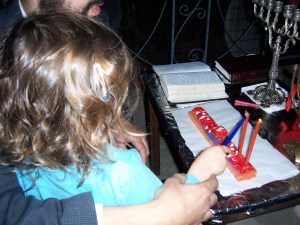
Chanukah is coming! Did you remember to get this cutie a gift?
In the upcoming Chanukah edition of CitySpirit Magazine (available here in L.A. within the next week or so), you’ll find reviews of four books either authored or illustrated by local L.A. talent. Any of them would make perfect gifts for Chanukah for kids. The books I reviewed for CitySpirit (with links to their pages on Amazon) are:
If you’re looking for a Chanukah gift for a teen or an adult reader, why don’t you check out Libi Astaire’s newest The Tempest in the Tea Room. Continue reading
Last week was marked by big news in the book world. Famed-American Jewish author (Jewish meaning author’s ethnicity only, in this case–see previous posts on the subject) Philip Roth has declared that he’s retiring from writing. On the other hand, equally aged and famous American-Jewish author Herman Wouk has just put out another novel. Interestingly, these events didn’t just make headlines in Jewish publishing, but publishing as a whole.
The stereotypical Jew is considered “bookish,” pale due to the amount of time he spends indoors. We are called “the People of the Book.” How is it that Jews became inextricably interwoven with books? Continue reading
 Rebecca Klempner